The Oil Crisis: Queues Despite Stocks Available! Whose Loss Is It? Who Bears the Burden?
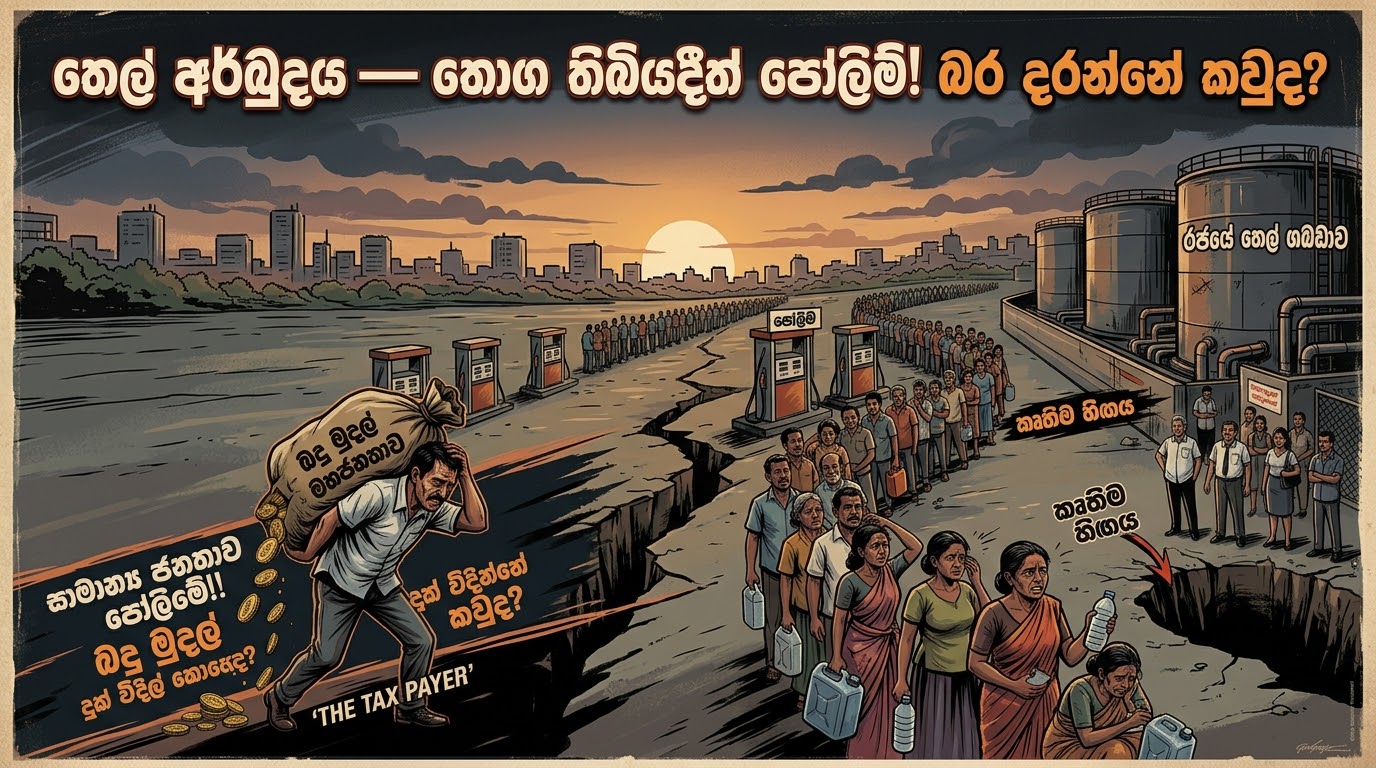
The government claims there is no fuel shortage. Yet, long queues remain near filling stations. They talk about a subsidy of LKR 41 billion, but private suppliers are restricting their supply. They claim the Ceylon Petroleum Corporation (CPC) made a profit, but also state that losses are incurred on certain fuel types. If so, what is the true reality behind this crisis?
The fuel crisis that re-emerged in October 2026 is not merely a question of a fuel shortage. It is a crisis that tests the government’s energy management, its agreements with private suppliers, its pricing policy, and its accountability regarding public funds.
If There Is Fuel, Why Are There Queues?
The Chairman of the CPC stated on October 7 that the country’s fuel stocks were sufficient and that imports exceeding October’s requirement had been arranged. It was also reported that steps had been taken to expedite two additional shipments of fuel.
However, the Minister of Energy and the CPC Chairman stated that fuel shortages and queues were created in certain areas because private companies reduced their supply.
According to figures presented by the CPC Chairman, compared to January, the daily diesel supply of Lanka IOC dropped by 45%, Sinopec by 66%, and RM Parks by 48%.
Consequently, the CPC was forced to increase its own supply to fill the gap in the market.
Here, the question the public has a right to know is: if the country’s fuel stocks are sufficient, what is the government’s mechanism to deliver them continuously into the hands of the people?
Having stocks alone is not enough. Distributing them at the right time, in the right quantities, and at a fair price is also the government's responsibility.
Why Were Private Companies Able to Restrict Supplies?
According to government statements, private suppliers restricted fuel distribution claiming that they were incurring losses under domestic prices due to rising international prices and import costs.
However, the serious question here is whether—when entering into agreements with companies that directly affect the country's energy supply—sufficient conditions were included to protect the public supply during an emergency.
The Minister stated in Parliament that under existing agreements, the government faces limitations in issuing direct orders to supply a specific quantity of fuel to every filling station. However, it was noted that directives could be issued regarding the maintenance of minimum fuel stocks.
If so, the issue is clear:
If a government can bring private companies into the country’s fuel market, why was it unable to secure a guarantee that the public supply would be protected during a crisis?
This is not a crisis that arose just today. It is an issue that warrants an investigation into how the agreements were drafted, regulatory powers, and the government's prior preparedness.
If CPC Made a Profit, What Is This Talk of Losses Now?
Figures reported by the President indicated that the CPC earned a profit of around LKR 36 billion in 2025 and a profit of around LKR 28 billion so far in 2026. It was also mentioned that CPSTL’s profit was around LKR 3.5 billion.
However, according to statements by the CPC Chairman, losses are being incurred on fuel types such as Auto Diesel, Super Diesel, and Kerosene, which have to be covered using revenue from other sectors including Petrol, Jet Fuel, and refining operations.
According to an estimated price differential per liter reported by the media for August 2026, a loss of around LKR 46.88 per liter of Auto Diesel, LKR 30.59 per liter of Super Diesel, and LKR 13.51 per liter of Kerosene was shown. It should also be noted that these are estimates based on price and cost, not final audited accounts.
Therefore, overall corporate profit and the profit or loss of individual fuel types are not the same thing.
However, there are several fair questions the public can ask:
What is the CPC’s actual import cost? How is the price determined for each type of fuel? Why do costs differ for private companies? Who covers the losses? When profits are made, what are the benefits the public receives from those profits?
It is the government’s responsibility not just to present figures, but to disclose the complete calculations behind them to the public.
How Much Fuel Is Needed Per Day?
According to fuel sales data from all suppliers in 2024, an average of around 4,307 metric tons of Auto Diesel, 118 metric tons of Super Diesel, and 369 metric tons of Kerosene were sold per day.
In that year, the total daily average sales of these three fuel types amounted to around 4,794 metric tons.
According to a demand forecast presented for the year 2026, the daily requirement for these three fuel types is around 4,115 metric tons. It should be clarified that this is a forecast, not actual daily sales for 2026.
These figures show that fuel supply is not a simple task of importing and storing oil for a few days. It is an interconnected management process involving daily national consumption, ship arrivals, storage capacity, transportation, and market distribution. Therefore, the government’s responsibility does not end with merely blaming private companies after queues have formed.
Is the LKR 41 Billion Subsidy Relief for the Public or a Future Burden?
Media reported that the government plans to provide a subsidy of nearly LKR 41 billion for a period of three months to minimize the impact of rising fuel prices on the public. According to some reports, providing a subsidy of around LKR 70 per liter to diesel suppliers is part of this plan.
An important point must be clarified here. Providing a subsidy does not necessarily mean a new tax will be imposed immediately. However, since that money must be borne by the government budget, it carries a financial burden.
That burden can be met through tax revenue, cuts to other expenses, reallocation of budgetary funds, or borrowing. Accordingly, the cost of the relief given today may appear tomorrow as a reduction in other public services or as fiscal pressure.
The International Monetary Fund (IMF) has also emphasized the importance of clearly recording subsidies—including fuel—within the budget and managing them systematically while safeguarding fiscal sustainability.
Therefore, the issue is not simply whether providing subsidies is good or bad.
Who truly benefits from this subsidy? Who bears its cost? How will prices and supply be maintained once the subsidy ends?
The benefit received by a low-income family is not equal to the benefit received by someone with high fuel consumption. Hence, there should be a targeted mechanism to deliver the subsidy to those who need it most.
The Government Must Answer to the Public Now!
What is needed today is not just media statements declaring that there are no queues, but a open, data-driven plan that the public can trust.
For this, the government should:
🔹 Publish accurate daily data on fuel stocks, daily consumption, and upcoming shipments.
🔹 Review the contracts between the CPC and private suppliers to check for conditions that safeguard public supply, and take legal action.
🔹 Ensure transparency in the fuel pricing formula, import costs, taxes, profits, and losses.
🔹 Present a report on the allocations, beneficiaries, and actual costs of the LKR 41 billion subsidy.
🔹 Conduct an independent investigation if the public was unfairly affected due to supply restrictions.
🔹 Present a long-term plan to ensure fuel supply does not depend excessively on a single institution or a few companies.
In the End, This Is the Question!...
What the public expects from a government that promised to catch thieves is not merely the exposure of past rulers' mistakes. People expect the government to run state institutions efficiently during its own tenure, use public funds properly, and take responsibility when a crisis occurs.
A government cannot completely control the rise of international oil prices. However, preparing in advance, drafting proper agreements, managing stocks, regulating supply, and maintaining transparency regarding public money are the government’s responsibilities.
If there are fuel stocks, they must reach the public. If subsidies are provided, their cost must be explained to the public. If private companies restrict supply, it must be disclosed how agreements and legal powers are being exercised.
The public does not want a government that merely says there are no fuel queues. They want a government that works to prevent fuel queues from forming, explains the reasons when things go wrong, and remains accountable for public funds.
Vehicles cannot be driven on political slogans. What the public needs is fuel, clear data, and accountability!
— Jayalathe Sunil Gamini ✍️