Where is the truth behind the billion dollar investment story?
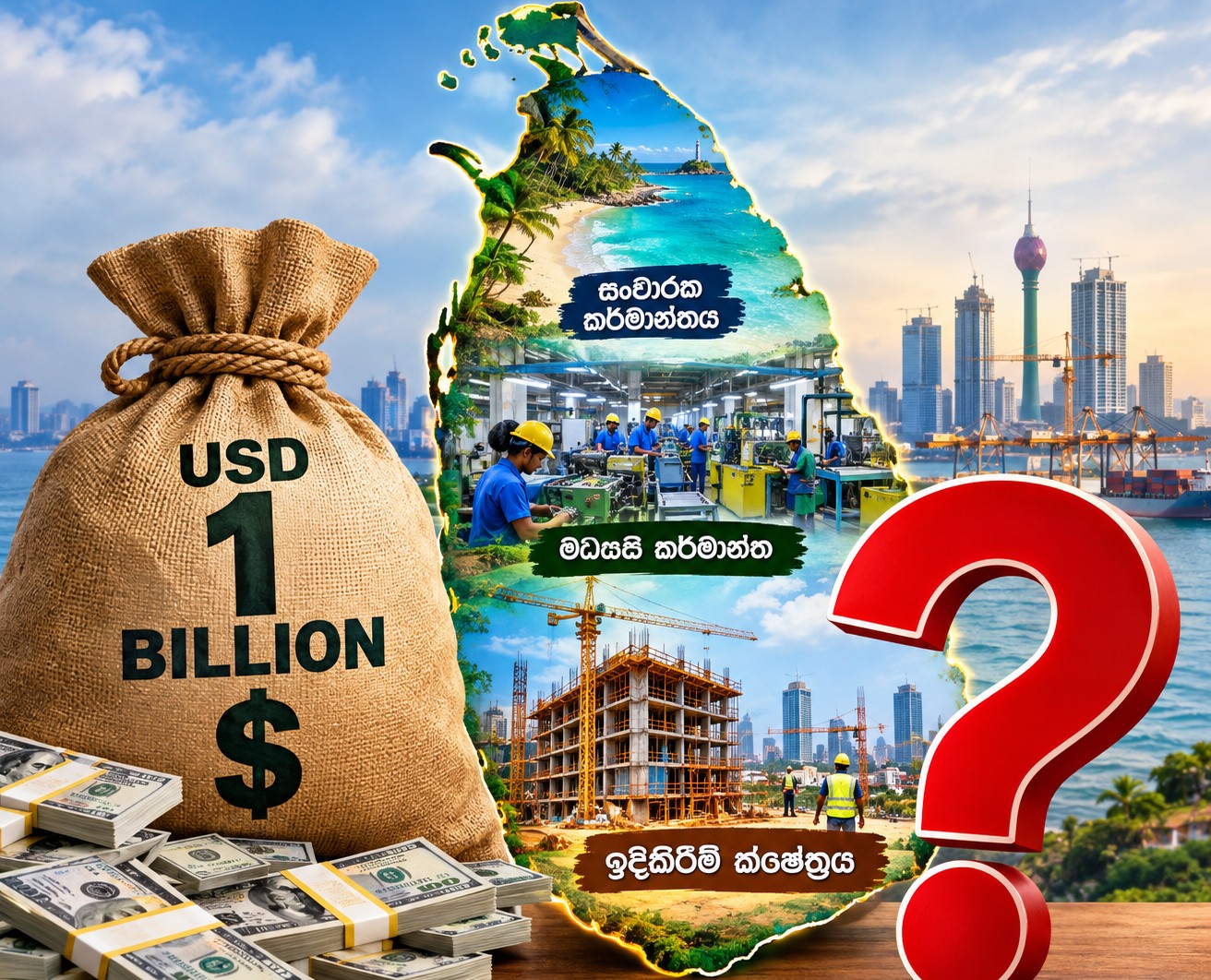
Bringing foreign direct investment (FDI) to Sri Lanka is a crucial factor in rebuilding the economy.
Therefore, the fact that Sri Lanka received US$ 1,057 million in FDI in 2025 is certainly not something that can be ignored. That is a 72% increase compared to 2024. The government has a good reason to point to this as a factor in restoring investor confidence.
But the story does not end here.
The question is not only whether a billion dollars came.
Where did that billion dollars come from?
From new foreign investors?
From new factories and projects?
Or from companies already in Sri Lanka?
The numbers tell the story....
Of the $ 1,057 million reported as FDI in 2025, only $ 167 million came as equity capital. Another $213 million is reinvested earnings.
However, $567 million is intra-company borrowings and another $110 million is reported as foreign commercial borrowings.
Accordingly, it is not correct to look at the 'headline figure' of $1 billion and think that "foreigners brought a new billion dollars into the country".
The large amount of debt-like financing, in particular, shows that a significant part of this FDI flow is not new risk capital, but internal financing of multinational businesses already operating in Sri Lanka.
How many new investors?...
This is the most important question.
Although the number of companies that granted foreign direct investment (FDI) in 2025 was 188, only 24 of them were new projects.
Those new projects received only $134 million, or 13% of the total FDI. The remaining $923 million came through expansion and reinvestment of businesses already in the country.
Therefore, the question that needs to be asked of the government here is very simple. That is, rather than saying “a billion dollars came”, how much new investment did it bring to Sri Lanka?
If that amount is $134 million, it is clear that the real picture behind the triumphant propaganda of the billion dollars is not that big.
Where did the investment go?...
Of the 2025 Foreign Direct Investment (FDI),
46% went to Manufacturing, 26% to Port Development, 11% to Tourism & Leisure, 6% to Telecommunications and
5% to Property Development.
Manufacturing and port development alone account for more than 70% of the total FDI. This is not a bad thing. Indeed, foreign investment in the manufacturing sector and the port economy is important for the country.
But in addition to the amount of investment, its quality must be considered.
How many jobs will it create?
How much export revenue will it generate?
How much technological knowledge will it bring to the country? How much foreign exchange will be saved in the country? How much profit will it ultimately return to the country?
Without answering these questions, it is not enough to simply show the amount of Foreign Direct Investment (FDI) and declare an economic victory.
Investment approval and investment inflows into the country....
In 2025, the BOI has approved 146 projects. Their total value is $ 1.906 billion, of which the expected amount as foreign capital is only $ 896 million.
This is also an important point that the public needs to understand. “Investments of $ 1.906 billion were approved” does not mean “$ 1.906 billion came to Sri Lanka”.
For approved projects to be implemented, obstacles such as land, permits, infrastructure, financing and government approval must be overcome. Approved values do not always completely translate into actual inflows.
So, is the NPP government a failure?...
No. Saying so does not do the statistics justice.
The increase in FDI in 2025 is a positive result. The country’s increased economic stability, lower inflation, macroeconomic stability under the IMF program, and improved investment facilities may have affected investor confidence.
But it is also wrong to jump to the conclusion that “the NPP government created a large inflow of new foreign investment.”
Because we cannot ignore the fact that only 13% of the FDI received in 2025 came from new projects, and a large part was the expansion, reinvestment, and internal financing of investors already in Sri Lanka.
What we really need is not a billion dollars....
What Sri Lanka needs is quality investment. Investment that creates jobs. Investment that increases exports. Investment that brings new technology. Investment that connects with local businesses. Investment that generates foreign exchange. Investment that increases the country’s production capacity.
Instead, if an existing company takes a loan from its parent company and expands its business in Sri Lanka and calls it a new foreign investment revolution, we are misleading the public with statistics.
2026 is the real test...
The BOI has set an FDI target of $1.5 billion for 2026.
So the challenge for the government now is not to advertise the 2025 figure.
How much of that $1.5 billion in 2026 will come from real new projects? How many jobs will it create? How much export revenue will it generate? How much technological know-how will the country gain? How much foreign exchange can be retained in the country?
And finally, has Sri Lanka become an attractive country for investors, or are only old investors ready to run their businesses? The challenge is to overcome these.
This should not be seen as political propaganda against the NPP government, but as some reasonable economic questions that the people should ask the government.
The arrival of a billion dollars is a happy thing. But celebrating it as a victory without asking how a billion dollars arrived is not an economic analysis.
The real victory is not the FDI headline,
but the creation of an investment that increases Sri Lanka's production, employment, exports, technology and the income of the people.
Not only the quantity of the investment, but also its quality should be questioned.
Jayalathge Sunil Gamini ✍️