Who is Accountable for the Prime Minister's Statistics?
• From Chichi's Satellite to the 2027 Budget...
• How can we trust the figures presented to the public in Parliament?
The statements made by a Prime Minister in Parliament are not ordinary political platform speeches. They are information that must be presented with responsibility concerning the nation's official policies, public financial management, and the future of the citizens.
However, looking back at two parliamentary statements made by Prime Minister Dr. Harini Amarasooriya, a serious question arises.
Is it not the Prime Minister's responsibility to verify the accuracy of the statistics presented to Parliament?
First Incident: Rohitha Rajapaksa's 'Chichi's Rocket'!
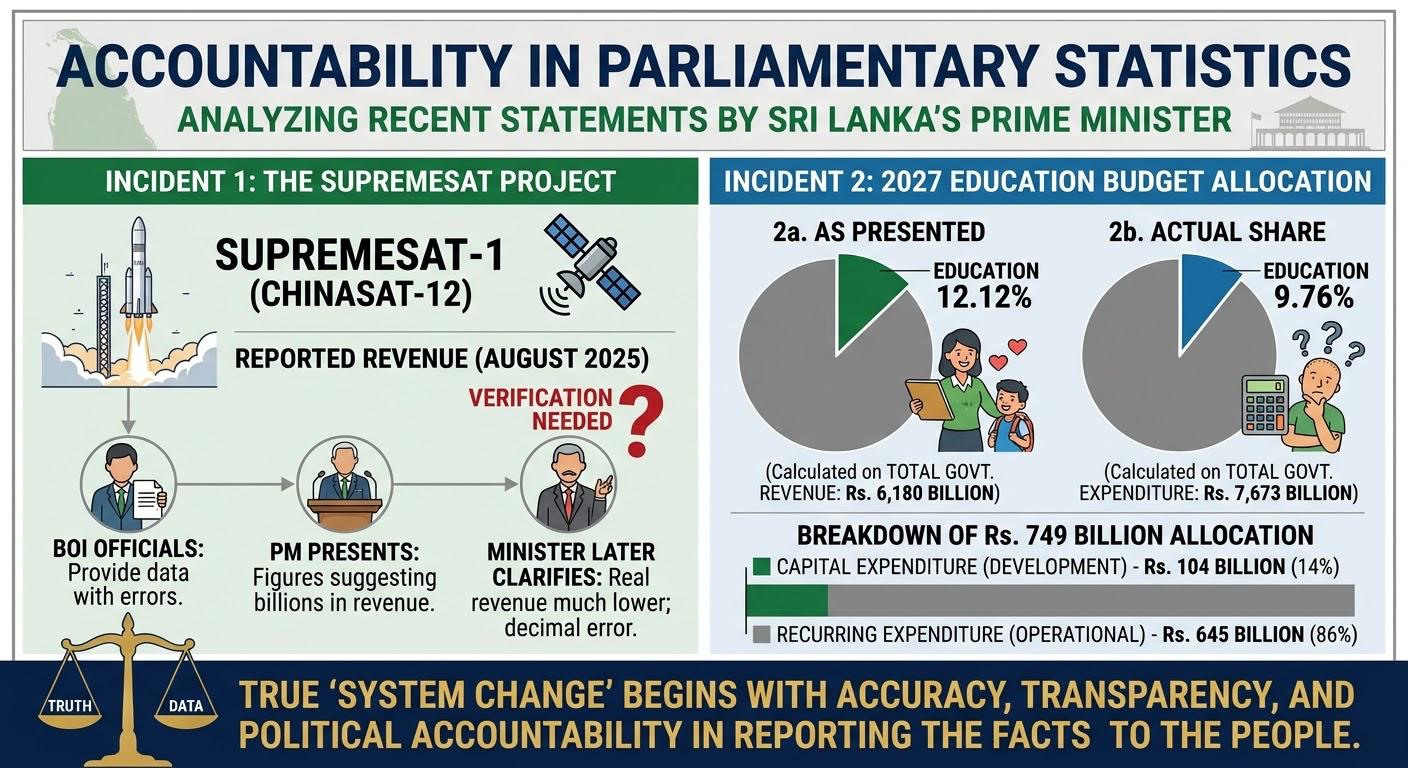
On August 6, 2025, the Prime Minister made a special statement in Parliament regarding the SupremeSAT project concerning Rohitha Rajapaksa, which had been a subject of long-standing political debate.
Based on information provided by the Board of Investment (BOI), she stated in Parliament that the government had not invested money in this project and that the project had generated a massive income.
According to the statistics she presented, the company's revenue from 2015/16 to mid-2023 appeared to be in the hundreds of billions of rupees.
But what happened after that statement?
Trade Minister Vasantha Samarasinghe later stated that the BOI statistics provided to the Prime Minister were incorrect. He stated that a confusion between millions and billions had occurred due to a decimal conversion error, and that the revenue earned by the company was far lower than the figure presented by the Prime Minister.
Consequently, a serious contradiction arose between the Prime Minister's statement and the subsequent clarification made by the Trade Minister.
Regarding this, I wrote an article in Lanka E News on August 12, 2025, pointing out the inaccuracies in the Prime Minister's facts. The Daily Mirror newspaper also reported on this on August 9, 2025, highlighting that questions had been raised regarding the credibility of the government's answers in Parliament.
There is another question here. Subsequent analyses clarified that SupremeSAT-1 was a communication service marketed using the capacity of China's ChinaSat-12 satellite, and that introducing it as a separate spacecraft belonging to Sri Lanka was incorrect.
If so, why were all these facts presented to Parliament without proper verification?
The Prime Minister later clarified that the figures she presented were obtained from BOI officials. However, the responsibility of verifying information received from officials before presenting it to Parliament does not absolve the Prime Minister.
Second Incident: Education Expenditure in the 2027 Budget!
As a year and three months pass since the first incident, questions have once again arisen regarding the credibility of the Prime Minister's statement concerning the 2027 Budget.
She mentioned in Parliament that Rs. 749 billion has been allocated for education, which amounts to 12.12% of total government expenditure.
There is no debate about allocating funds for education; our country should allocate even more funds for education. However, the issue lies in how the percentage of that amount was calculated.
According to the 2027 Budget Estimates:
* Allocation for education: Rs. 749 billion.
* Total government expenditure: Rs. 7,673 billion.
* Total government revenue and grants: Rs. 6,180 billion.
Now let's look at the math:
749 ÷ 7,673 × 100 = 9.76%
That means the amount allocated for education is only 9.76% of the total government expenditure.
However, when calculating 749 ÷ 6,180 ×100, the result is 12.12%.
Thus, the 12.12% percentage was obtained by calculating based on total government revenue instead of total government expenditure.
Government revenue and government expenditure are not the same thing. Overlooking such a fundamental difference raises serious questions about budget statistics.
Another point is that out of the total education allocation of 749 billion, only about 104 billion has been allocated for capital expenditures, with the rest allocated for recurring expenditures.
Therefore, portraying the entire allocation to the public as a brand-new educational development investment is also incorrect.
The issue is not limited to numbers; it is a question of political accountability!
There is a connection between these two incidents. One is that the statistics presented to Parliament based on BOI data regarding the SupremeSAT project were subsequently challenged by a minister of the government itself.
The other is the issue that has arisen regarding the basis of calculation when presenting education expenditure as a percentage of total government expenditure.
Although these are not identical incidents, the common question raised by both is: Who verifies whether the statistics presented to Parliament are accurate?
When doing politics, it is easy to criticize rulers by pointing out statistics while in the opposition. But once in power, one has to take responsibility for the accuracy of the statistics they present.
A government that specifically declared it came to power to bring about a "system change" and alter the old political culture cannot escape this responsibility.
Questions the Prime Minister Must Answer to the Public!
* How did unverified statistics get presented to Parliament in the SupremeSAT incident?
* Were systematic steps taken following that incident to verify statistics obtained from state institutions?
* When stating that education expenditure in the 2027 Budget is 12.12%, was government expenditure or government revenue used for the calculation?
* When will an explanation be provided to Parliament regarding the 9.76% obtained based on total government expenditure?
A Prime Minister is not a newsreader reading files provided by officials. She is a political leader bearing a major responsibility in the country's executive branch.
If officials provided incorrect information, they must be held accountable. If there is a calculation error in one's statement, it must be corrected. Openly admitting and correcting incorrect information given to the public is also a quality of political leadership.
Presenting incorrect information is one problem; failing to correct it is a far more serious problem.
What we need is not politics that wins public praise by claiming 749 billion has been allocated for education, but governance that accurately states how much that amount actually is, what purposes it is spent on, and what percentage of government expenditure it represents.
Parliament is not a political propaganda platform. It is the supreme legislature where the truth must be reported to the public.
'System change' does not mean merely changing the names of rulers; it means changing the accountability, transparency, and attitude towards truth of the rulers.
Madam Prime Minister,
Education does not improve by exaggerating numbers. A country's economy does not strengthen by presenting false data.
What the public wants is not attractive numbers, but accurate numbers.
It is your political responsibility to provide accurate answers to the questions raised back then about Chichi's rocket, and today about the education budget.
Telling the truth is the beginning of a system change. Correcting the statistics is its minimum condition!
Jayalathge Sunil Gamini ✍️