How “Our Public Servants” Became “Opposition Lackeys”
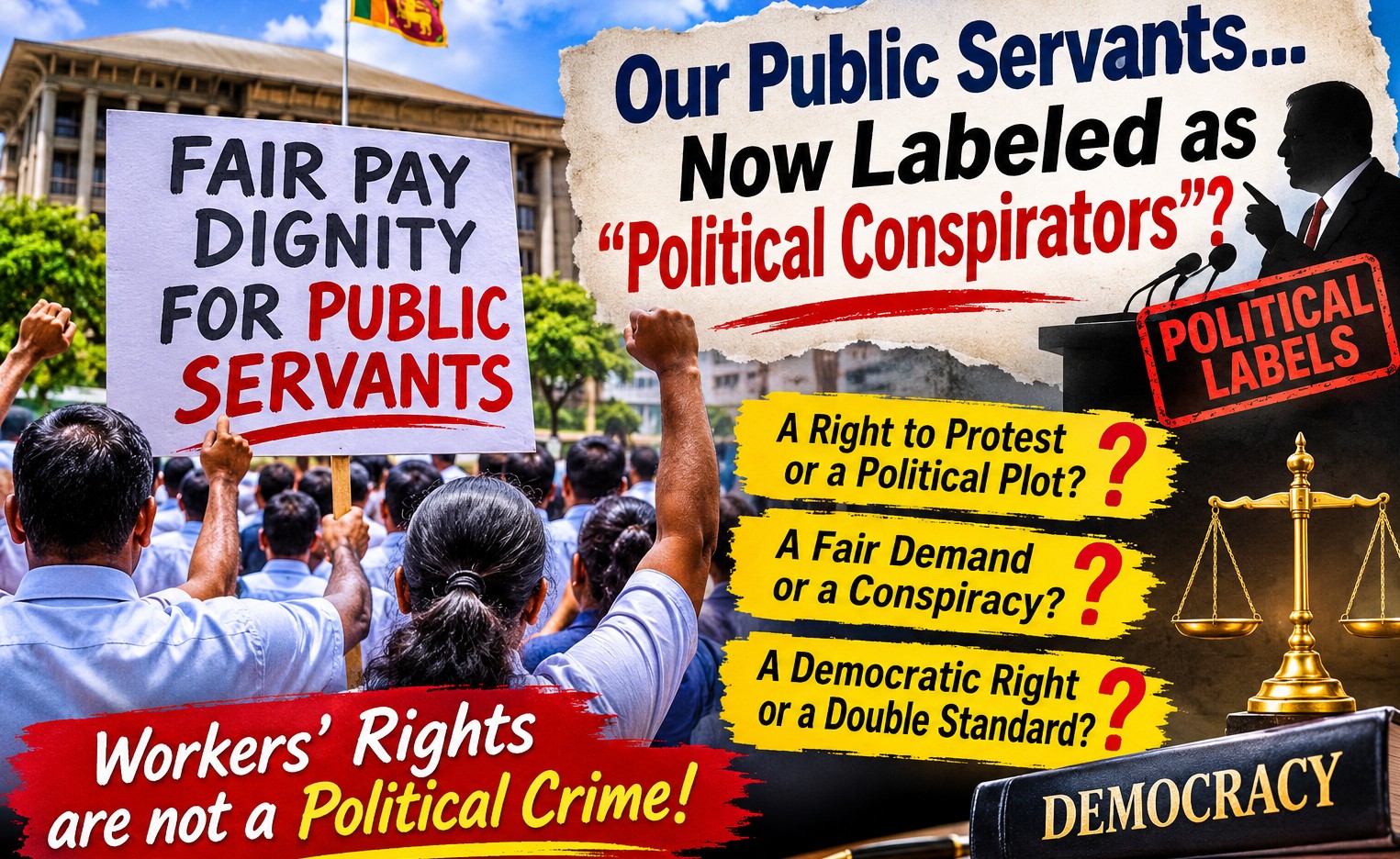
The Political Hypocrisy of a Government That Once Rose to Power Through Trade Union Struggles
When a political movement builds its strength through trade union struggles and eventually comes to power, only to label trade unions protesting against it as politically motivated and attempt to undermine their voices, it raises serious questions about its commitment to democracy.
Those who once went on strike against governments are now in government. Those who once stood on trade union platforms demanding workers’ rights are now ministers. Those who once extended political support to public servants’ struggles are now exercising state power.
Yet today, when public servants take to the streets demanding better salaries, allowances, improved working conditions and wages that reflect the cost of living, how do representatives of the current government describe them?
They are labelled as “political conspirators acting on behalf of the opposition”, “representatives of defeated political groups”, and even “conspirators attempting to bring the remnants of the opposition back to power”.
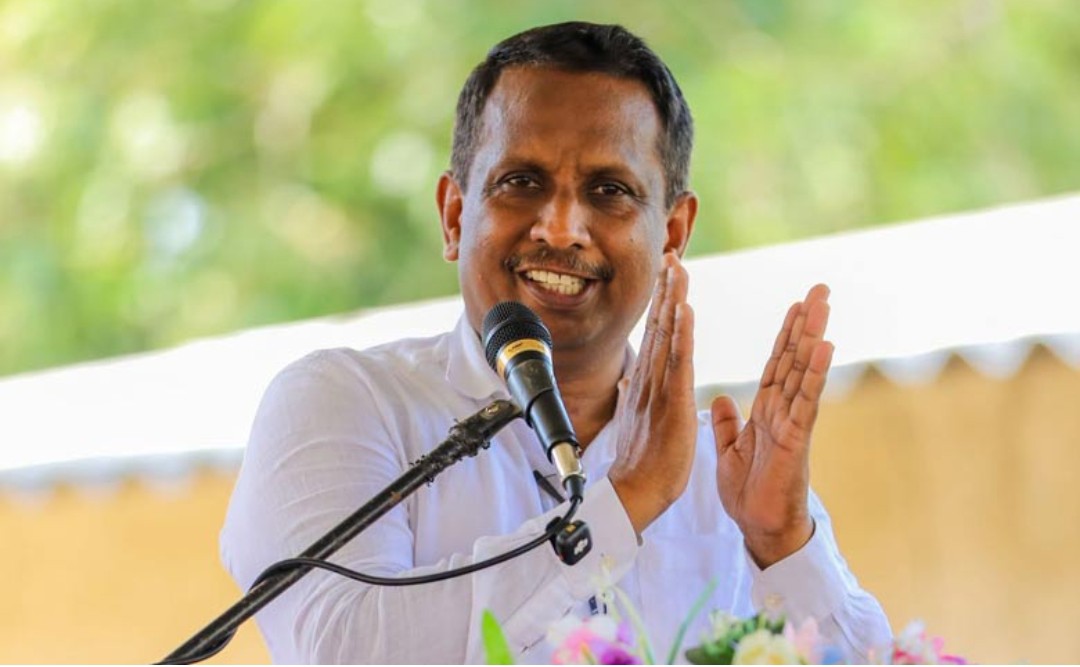
Deputy Minister of Labour Mahinda Jayasinghe has described these protests as acts of “ingratitude” and “immorality”. He has also characterised the protests as a conspiracy involving “a political gang painted red and the remnants of the opposition”.
He has further declared:
“We will never surrender or bow down to those who are trying to fulfil the interests of the defeated opposition.”
These statements make it clear that the criticism is directed not merely at the demands themselves, but also at the legitimacy, morality and political background of the trade union action taken to pursue those demands.
This leaves us with a simple question:
Are trade union struggles legitimate only when a government is in opposition? How does the same struggle suddenly become a political conspiracy once that movement comes to power?
What kind of political morality is it to insult those raising legitimate demands instead of answering them?
Has the Government's Own Response Exposed Its Inconsistency?
Mahinda Jayasinghe has pointed out that the government has increased public sector salaries by between 65% and 80%.
However, two fundamentally different issues must be distinguished here.
One is the salary increase granted by the government. The other is the range of problems that employees continue to face and the demands they are still making.
The granting of a salary increase does not automatically resolve all salary disparities, problems relating to allowances, working conditions or the impact of the rising cost of living.
If so, on what grounds can the right of employees to continue making demands be questioned?
If a government cannot accept a trade union's demands, it can explain why. If there are economic constraints, it can demonstrate them through figures. It can also present a timetable for addressing the demands.
But attempting to discredit trade unions by attaching political labels to them does not resolve the underlying problems.
A government that cannot answer a demand cannot escape its responsibilities by questioning the character or motives of those making it.
Isn't the incompleteness acknowledged by Lal Kantha itself an answer from within the government?
Hasn't Minister Lal Kantha Acknowledged What Remains Unresolved?
The statement made by Minister of Agriculture K.D. Lal Kantha in Parliament is particularly significant in this regard.
According to his explanation, among the demands raised by public servants are the inclusion of allowances in their basic salaries and salary increases that adequately reflect the cost of living.
He has acknowledged that the government has taken steps regarding the first demand, but that the second demand has not yet been fully addressed.
If so, the issue is clear.
When a minister in the government itself acknowledges that public servants have not yet received salary increases sufficient to match the cost of living, how can it be wrong for employees to raise their voices in pursuit of that very demand?
Shouldn't the politicians who once campaigned for these demands now be prepared to listen to the employees making them?
The consultative mechanisms proposed by Minister Lal Kantha, such as a salary commission, may provide a useful avenue for negotiations. However, pointing to such mechanisms does not take away the right of trade unions to hold protests.
Do public servants who voted for the government have no right to criticise it?
Did Public Servants Lose Their Right to Criticise the Government After Voting for It?
Minister of Public Security Ananda Wijepala has reportedly stated that approximately 70–80% of public servants voted for the NPP government.
Even if we accept that statement as accurate, what does it actually mean?
Does voting for a government mean agreeing unconditionally with every decision it makes? Does a citizen lose the right to criticise a government they supported at an election when they believe one of its policies is wrong?
Voting at an election and engaging in trade union action to defend professional rights are not contradictory activities.
A public servant has the right to vote for a government, criticise its policies and participate in industrial action to defend their employment rights.
These rights are not mutually exclusive.
The Uncomfortable Truth Revealed by Election Statistics
It is worth looking back at the recent electoral figures to refresh the memories of government ministers and MPs.
According to official reports of the Department of Census and Statistics, Sri Lanka has a total of 1,156,018 public and semi-government sector employees, excluding the armed forces.
At the 2024 Presidential Election, 712,319 public servants were eligible to vote by post. In numerous districts, between 55% and 68% of these postal voters reportedly supported the candidate who is now the President.
At the 2024 Parliamentary Election, 738,050 public servants were eligible for postal voting. In a majority of districts across the country, an overwhelming 70% to 82% reportedly supported the political movement that went on to secure a two-thirds parliamentary majority.
Those hundreds of thousands of public servants were celebrated on election platforms as “our public servants” and “our trade unions”.
Today, when those same employees raise their voices against what they consider injustices, they are branded as “pawns of the remnants of the opposition”.
Can there be a clearer example of political hypocrisy?
Therefore, what matters far more than political statements about how public servants voted is the government's response to the genuine demands they are making today.
Voting for a government does not turn a citizen into its unconditional follower. Their rights cannot be subordinated to the political preferences of those in power.
Yesterday, trade union struggles were described as a legitimate political right. Why are they now being portrayed as opposition conspiracies?
Has the NPP Forgotten Its Own Political History?
The importance of trade union activism in the political history of the NPP movement cannot be overlooked.
For decades, the JVP political movement built its political influence through trade union organisation, strikes, protests and struggles for workers' rights.
In the past, issues relating to public servants' salaries, allowances, working conditions and the cost of living were presented on political platforms as legitimate demands deserving support.
If a minister in the government itself now acknowledges that some of those demands remain unresolved, what justification is there for branding employees who continue to struggle for them as political representatives of the opposition?
It is possible that an opposition political party may attempt to exploit a protest for its own political advantage. That is a normal occurrence in politics.
However, that possibility does not make the genuine grievances of employees disappear.
Trade unions may have political affiliations. But the mere existence of such affiliations does not make every demand they raise unjustified.
The legitimacy of a trade union's demands must be assessed according to their substance and the actual problems faced by employees, not according to whether those demands benefit the government or the opposition.
A public servant is not a political follower of the government!
Public Servants Are Citizens, Not Political Subordinates of the Government
According to the 2024 Public and Semi-Government Sector Employment Census, Sri Lanka has 1,156,018 employees working in these sectors.
They are a massive workforce responsible for maintaining public administration, healthcare, education, transport and numerous other essential services.
The fact that they receive salaries from the state does not mean they must accept the political views of the government.
They are citizens of the country. Like everyone else, they have to cope with the cost of living, meet their children's educational expenses and deal with housing and transport costs.
Their trade unions have the right to negotiate, hold protests and engage in lawful industrial action.
These rights are not political privileges granted at the discretion of whichever government happens to be in power. They are rights that must be recognised in a democratic society.
At the same time, trade unions also have responsibilities. They must take into account the impact of their actions on the public and ensure that their demands and industrial action remain responsible and proportionate.
In particular, the rights of the public must be protected when industrial action affects healthcare, education and other essential public services.
However, recognising these responsibilities and insulting trade unions are two entirely different things.
Are only those trade unions that refrain from challenging the government considered democratic?
Are Trade Unions Democratic Only When They Do Not Challenge the Government?
There is another important question emerging from the current situation.
Trade unions are not organisations established solely to implement the political projects of whichever government is in power. Their fundamental purpose is to protect the rights and interests of workers.
Therefore, a trade union does not become democratic merely because it supports the government, nor does it become an opposition stooge simply because it criticises the government.
If such political reasoning is accepted, what room will remain for the independence of trade unions?
Recognising only those unions that agree with government policies while portraying critical unions as political enemies raises serious concerns about trade union freedom.
A government has every right to disagree with trade unions. But that right cannot be used to undermine their freedom of expression and their right to organise.
What Is the Government's Real Responsibility?
It is true that the government has to bear substantial public expenditure on salaries and pensions. The country's economic limitations must also be taken into consideration. It may not be possible to fulfil every demand immediately.
However, these realities do not release the government from its responsibilities.
What the government should do is:
Examine the demands submitted by trade unions individually.
Clearly explain which demands can be fulfilled and which cannot, providing supporting evidence.
Present a timetable for resolving salary disparities and addressing the demand for wages that reflect the cost of living.
Engage in meaningful discussions with trade unions.
Respond to the actual problems raised by protesters instead of attaching political labels to them.
Having to face criticism is not a failure of governance. It is a normal part of democratic government.
Some Questions Remain...
Are the political leaders who once fought for public servants' salaries now prepared to listen to those same employees and their demands?
If organising trade unions against governments was a legitimate political right in the past, how can trade union action against the government today be described as a political conspiracy?
Can the problems that continue to affect public servants simply be ignored on the grounds that a salary increase has already been granted?
Can the right of public servants to criticise the government be denied simply because they voted for it?
Political power is not a licence to silence the voices of the people. It is a responsibility to respond to their concerns.
Those who fought struggles yesterday are now in power. Those who are struggling today will continue to serve under another government tomorrow.
The meaning of trade union rights must not change whenever political power changes hands.
It is the government itself that must answer for the political contradiction of supporting trade union struggles before coming to power and insulting those same struggles after assuming office.
There is one truth that politicians who attach political labels to public servants' struggles instead of addressing their demands should never forget.
Trade unions can be insulted. Protesters can be branded with political labels. But none of this will resolve salary problems. It will not reduce the cost of living. Nor will it abolish the rights of workers.
Democracy does not mean listening only to the voices of those who support you. It also means recognising the rights of those who raise their voices against you.
Never forget that yesterday's struggle was your political right. The same right belongs to the workers who are struggling today!
Jayalathge Sunil Gamini ✍️