Let Us Build a Broad-Based People’s Movement, Not Another Political Party!
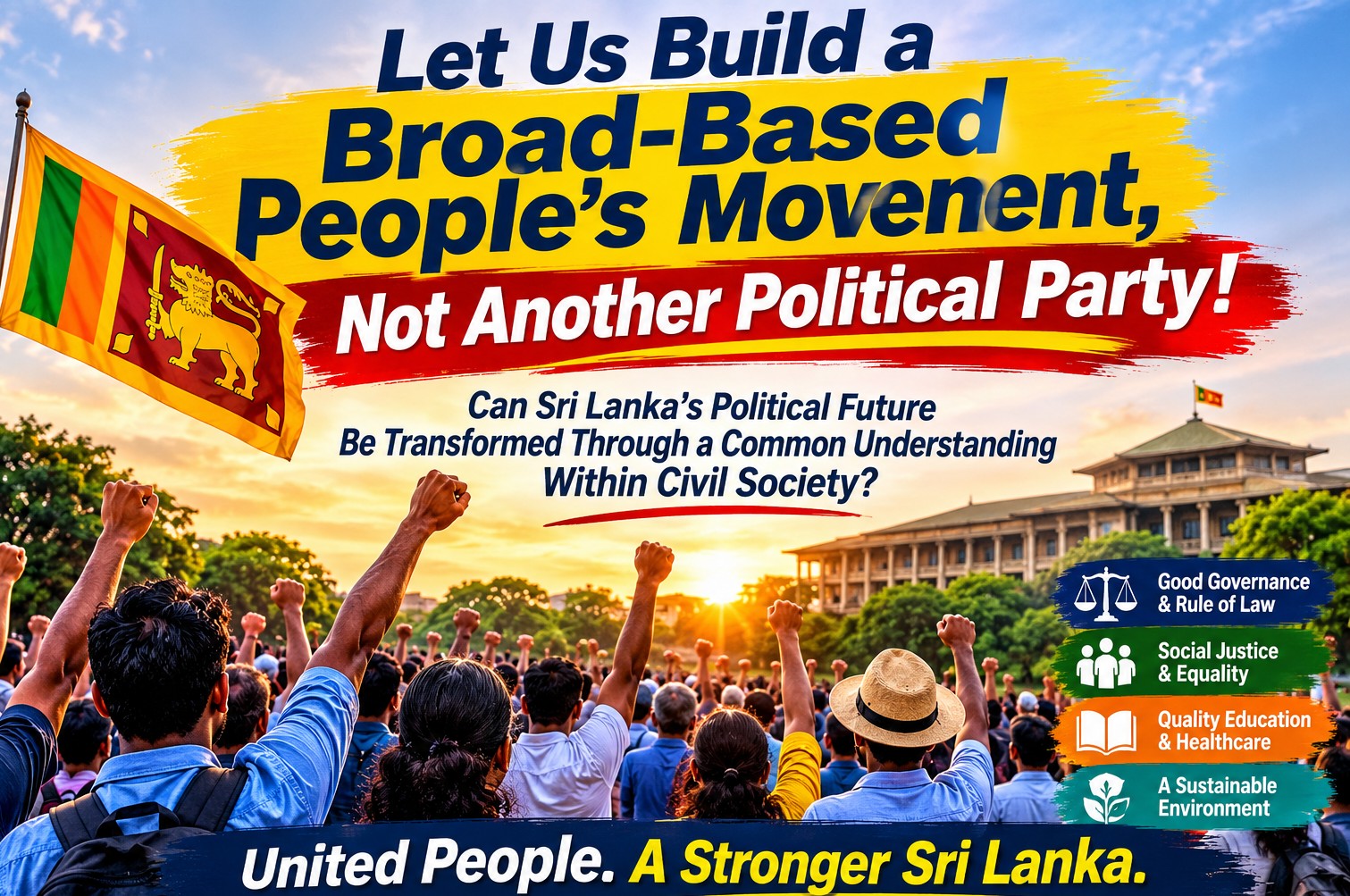
Can Sri Lanka’s Political Future Be Transformed Through a Common Understanding Within Civil Society?
Does Sri Lanka need yet another political party, or does it need something much broader and more meaningful — an independent, democratic people’s movement capable of bringing together different sections of society?
This is a question worth serious consideration at a time when public confidence in traditional political parties and established political institutions is increasingly challenged.
Experiences from countries such as Serbia and Greece demonstrate that when people lose confidence in conventional political leadership, movements emerging from civil society can become powerful forces for political change. However, they also show that mobilising people against an existing system is not the same as building a sustainable political alternative.
Lessons from Serbia and Greece
In Serbia, student-led protests following the tragic collapse of the railway station canopy in Novi Sad in November 2024 developed into a wider movement. Students were joined by teachers, farmers, trade unions and other sections of society, demanding transparency, accountability and justice.
The significance of this movement lies in its ability to bring together different social groups around common demands, rather than allowing their differences to divide them.
Greece offers a different but equally important political experience. Following years of economic crisis and austerity, widespread public dissatisfaction created the conditions for the rise of SYRIZA, which came to power in January 2015.
These experiences demonstrate that public movements can challenge established political structures and even reshape the political landscape. But they also remind us that political transformation requires more than protests and public anger. It requires a common vision, clear policies, democratic organisation and the ability to sustain public confidence.
What Can Sri Lanka Learn from the Aragalaya?
Sri Lanka’s own experience in 2022 provides an important starting point.
The Aragalaya brought together young people, professionals, artists, trade unionists, civil society activists and ordinary citizens from different political and social backgrounds. Despite their differences, they united around a common demand for political accountability and an end to the Rajapaksa administration.
It demonstrated that people can come together beyond traditional party politics when they recognise a shared national challenge.
However, a movement united mainly by opposition to a government does not automatically possess a common programme for governing a country or transforming its institutions.
That is one of the most important lessons Sri Lanka must take from the Aragalaya.
Can Sri Lanka’s Civil Society Unite?
Sri Lanka has a considerable number of organisations and individuals working in areas such as human rights, media freedom, environmental protection, education, healthcare, labour rights, social justice and democratic governance.
These groups have valuable experience, knowledge and public credibility. Yet their collective influence remains limited when they operate separately, without a common platform or coordinated strategy.
What is needed is not the disappearance of individual organisations or the surrender of their independence. Instead, it is a mechanism through which they can work together on issues of common concern while retaining their individual identities and freedom of action.
Such a network could bring together different sections of society around a shared minimum programme.
What Should Be the Common Programme?
A broad-based people’s movement must be built on practical policies and democratic principles, not merely on slogans.
A common programme could include:
Anti-corruption and public accountability – ensuring transparency in public spending and holding political leaders and public officials accountable.
The rule of law and democratic freedoms – protecting judicial independence, freedom of expression, the right to protest and the fundamental rights of every citizen.
Economic and social justice – developing policies that address poverty, inequality, unemployment and the rising cost of living.
Education and healthcare – protecting and strengthening public education and healthcare as essential rights of all citizens.
Independent public institutions – ensuring that state institutions operate without political interference and serve the public interest.
Equality and national unity – rejecting racism, religious extremism and all forms of discrimination while respecting the rights and dignity of every community.
Most importantly, this movement must have democratic internal structures, collective leadership and genuine representation for women, young people, workers and different communities.
It must also remain independent of traditional political parties. Otherwise, it risks becoming another instrument of party politics rather than an independent voice of the people.
From Dialogue to Collective Action
Building such a movement will not happen overnight.
The first step should be an open and inclusive dialogue among civil society organisations, academics, professionals, trade unions, youth groups, artists and concerned citizens.
The next step should be to develop a common minimum programme, establish local and district-level networks, monitor government policies and spending, and create a platform through which citizens can collectively demand accountability.
The movement should also develop practical policy alternatives on the economy, taxation, public debt, employment, education and social welfare.
Participation in electoral politics may be considered at a later stage, but only if it emerges from a transparent and democratic decision by the movement itself.
The objective should not simply be to replace one group of politicians with another. It should be to create a political culture in which governments are answerable to the people and public power is exercised in the public interest.
The Real Challenge Before Sri Lanka
Sri Lanka does not lack political parties. What it urgently needs is a strong, independent and organised citizen movement capable of holding every government accountable, regardless of which party holds power.
A movement of this nature should not be built around one individual, one political party or one ideological tradition. Its strength must come from a shared commitment to democracy, justice, equality and the public interest.
The real question is whether Sri Lanka’s civil society can move beyond fragmented campaigns and individual struggles to build a common platform for meaningful national change.
People give political parties the power to govern through elections. But should they not also have the power to shape decisions about their own future?
Perhaps the time has come for Sri Lanka to think beyond another political party — and begin building a broad-based, independent people’s movement.
Jayalathge Sunil Gamini ✍️