The “Terrorist” Millstone and Politics
A week ago, I wrote a short piece that prompted a number of questions from some of my political friends. It is in response to those questions that I decided to write this article.
Lawyers who stand up for human rights, together with civil society groups committed to protecting human rights in this country, have already provided sufficient explanations about the dangers and potential consequences of the proposed laws: the Bill introduced in the name of “Protecting the State from Terrorism” and the Bill intended to combat “Organised Crime.” Therefore, my intention here is not to examine the provisions of these Bills one by one.
As I understand it, the term “terrorism” is used throughout the world to describe individuals and groups who rise up in pursuit of particular political objectives.
One question raised with me is whether discussions about terrorism, and the introduction of laws to combat it, did not intensify across the world after 11 September 2001, and become even more widespread following the Paris attacks in 2015.
Some also point to the Hamas attack on Israel on 7 October 2023. I am fully aware that discussing these matters in depth would require a lengthy debate.
However, whether we like it or not, we must recognise that, at the end of the day, all these actions are rooted in political questions and conflicts.
It is clear that many political groups resort to acts of terrorism in their efforts to achieve their objectives. Sri Lanka's experience over the past 50 years provides more than enough examples to understand this.
When members of the main party in the present government are questioned about whether it was wrong for them, in the past, to hack and kill their political opponents, their response is that they were merely retaliating against State terrorism, which had been killing them.
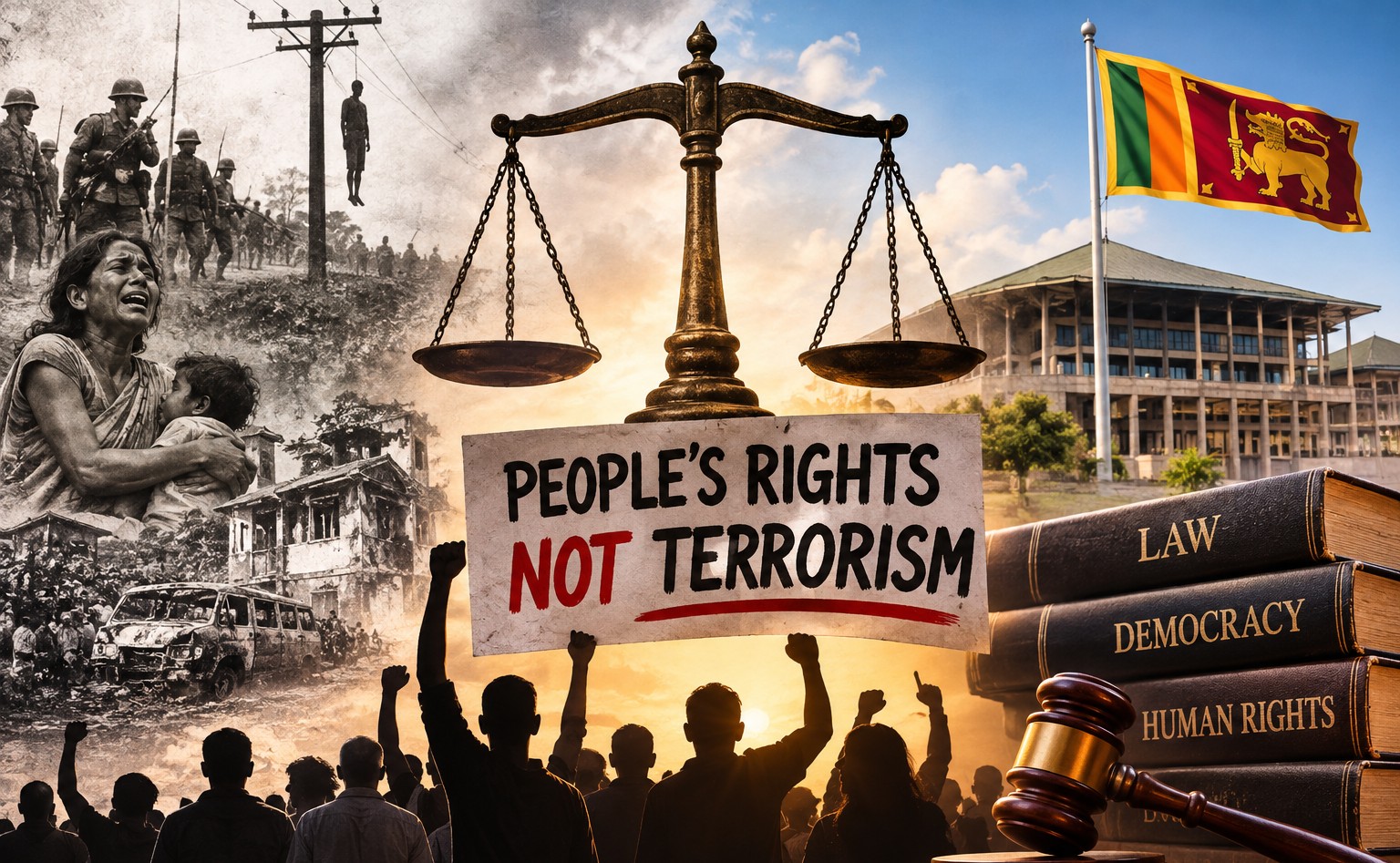
We know that, between 1987 and 1990, people were killed in villages across the South and their bodies hung from electricity poles.
We also know that government forces massacred hundreds of people in certain southern villages, dismembering their bodies and leaving them along roadsides as food for dogs and crows. Who does not remember the bodies of young people burning on tyre pyres beside the roads?
It is also well known that young insurgents would break into the homes of their political opponents at night, abduct them, slit the throats of unarmed people and kill them. They even prohibited the lifting of the bodies of their victims above knee level.
In much the same way, we know how young men and women in the North, who took up the struggle demanding their rights, were branded terrorists and killed. We also know how, in retaliation, some of those young militants went on to kill civilians in Sinhala villages.
Therefore, if you ask someone in Sri Lankan society, “Who is a terrorist?”, the simplest answer you are likely to receive is this: in the South, a JVP supporter; in the North, an LTTE supporter.
However, those with a deeper political understanding do not reduce this question merely to terrorism. They recognise that armed rebellions emerge when governments suppress political rights through their own failures and injustices, leaving people with no meaningful avenue to stand up for their rights.
Likewise, governments in power throughout the world frequently label their opponents, who rise up to demand their political rights, as terrorists. In my assessment, as many as 95% of those branded terrorists are individuals and groups who advocate and fight for political rights.
In my understanding, people who fight for such rights cannot be silenced through repressive legislation and state repression. This is because they are fighting for their rights.
Sri Lanka itself provides the clearest examples.
The first example is the Criminal Justice Commissions Act, introduced in 1972 with retrospective effect to punish those of us who participated in the April 1971 insurrection. Through the Criminal Justice Commission (CJC), punishments were imposed on the insurgents — people like us, whom the authorities labelled terrorists.
But although we were called terrorists, we know that this political movement did not come to an end. Indeed, the very people who emerged from that movement are among those governing the country today.
The second example is the Prevention of Terrorism (Temporary Provisions) Act, enacted in 1979. Under J. R. Jayewardene, a special military unit was sent to the North under Colonel Wijetunga.
The objective was to suppress the so-called terrorists — in reality, politically active young people — within three months and eradicate terrorism once and for all.
At that time, the “New Tamil Tigers” (NTT) was still a very small political organisation. State terrorism was unleashed against young people suspected of having links with it. The authorities also destroyed memorials erected in honour of respected poets, intellectuals and young leaders such as Sivakumaran, who were held in high esteem by the people of the North.
The consequences of the criminal acts committed under this State terror campaign were that thousands of young people joined those political movements.
What had once been very small groups of young activists subsequently grew into powerful forces. They plunged the country into a devastating war, created a deeply divided society in which different ethnic communities viewed one another with suspicion, and ultimately pushed our entire society into the abyss in which it finds itself today.
Yet those uprisings were not brought to an end. Nor did the supposedly temporary Act remain temporary; it continues to exist to this day.
Despite all these measures, we experienced a prolonged civil war, as well as the Easter Sunday attacks. Therefore, I believe Sri Lanka has more than enough experience to demonstrate that problems cannot be resolved simply by having harsh laws or by killing people.
The party currently in power, the JVP, claims to have a process of correcting its mistakes based on the principles of “criticism and self-criticism.” Its members also frequently tell us that we must “learn lessons from history.”
If that is genuinely their position, then why are they attempting to correct the mistakes of the rulers responsible for what they themselves describe as 70 years of national misfortune by following the very same path those rulers took?
In my view, Sri Lanka's problems did not arise because of “terrorism”, as previous governments repeatedly claimed and sought to establish in the public consciousness.
What young men and women in both the North and the South sacrificed their lives for was the right to enjoy democratic freedoms and the right to share in the benefits of national resources that had been exploited and plundered by a predatory elite.
I accept that laws are necessary to govern a country. However, in a country where laws have historically been abused, introducing even harsher repressive legislation while leaving the same state machinery intact will bring no benefit to the people.
I believe that most of the laws already in force in this country are sufficient to combat crime. If they are not sufficient, appropriate additions could be made through dialogue with citizens and the legal community.
But if a government uses its parliamentary power to enact laws according to its own wishes, just as J. R. Jayewardene did, is it not following the same authoritarian path taken by J. R. and his successors?
I have heard that President Anura Kumara Dissanayake once spoke very emotionally at a school in Thambuttegama about how some of his schoolmates, his own relative and others were killed by the police and military.
After winning elections by recalling those painful memories and invoking the heroic sacrifices of those who came before them, it is deeply troubling if they now forget the legal framework under which those brothers and sisters were forced to sacrifice their lives.
If so, one has to question: what purpose does it serve for them to speak about that history?
According to the present government, organised crime in Sri Lanka evolved into a form of a “criminal state” because politicians, government officials and underworld networks worked together to obstruct the implementation of the law. In other words, the problem was not the absence of laws in the country.
If that is the case, what needs to happen now is to break that cycle, restructure institutions such as the police, prevent political power from being used to abuse the law, and restore the rule of law throughout the country.
It is not about granting an already criminalised police force even greater powers, or extending the powers previously held by the police to military institutions whose own records are also deeply problematic.
Where there is no organised civil society, there is no one to speak on behalf of the people. If citizens are to protect their democratic rights, they must organise themselves.
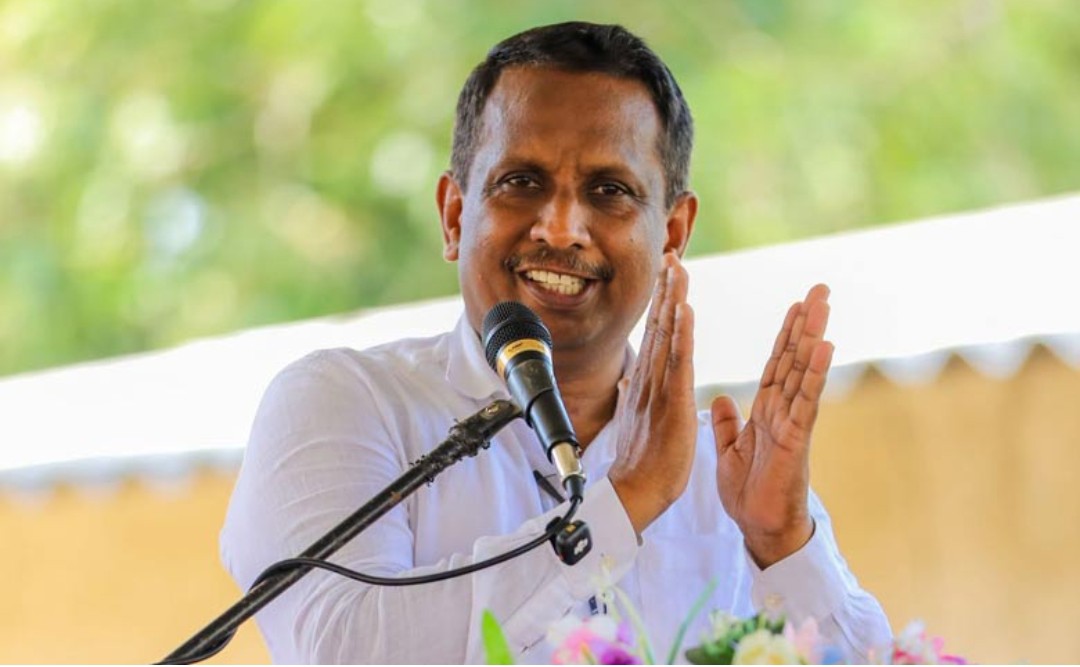
Ranjith Henayaka Arachchi ✍️