

Delay in cases is a long-standing problem in the judicial system of Sri Lanka. The NPP/JVP has acknowledged this in its policy manifesto titled "A Rich Country, a Beautiful Life" presented to the people in 2024.
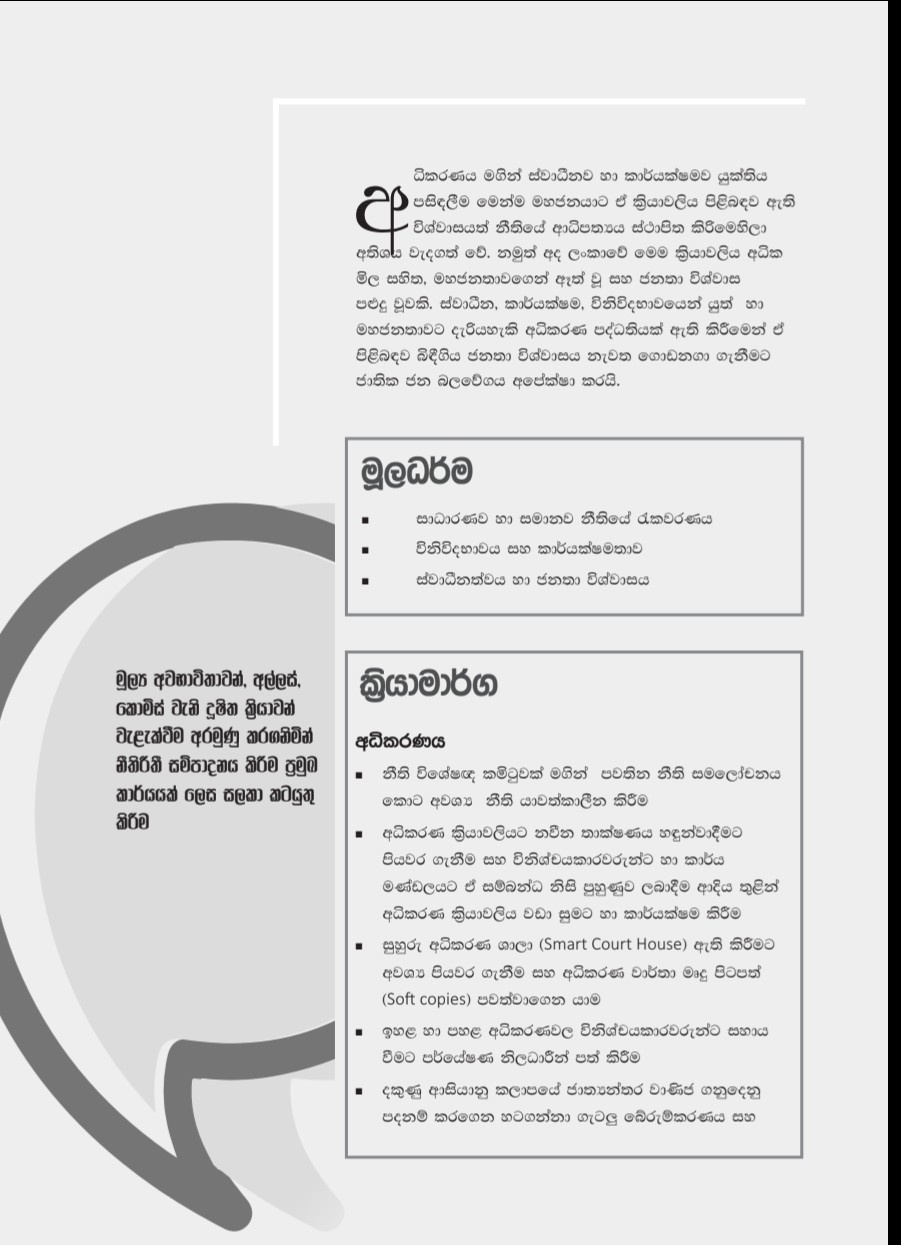
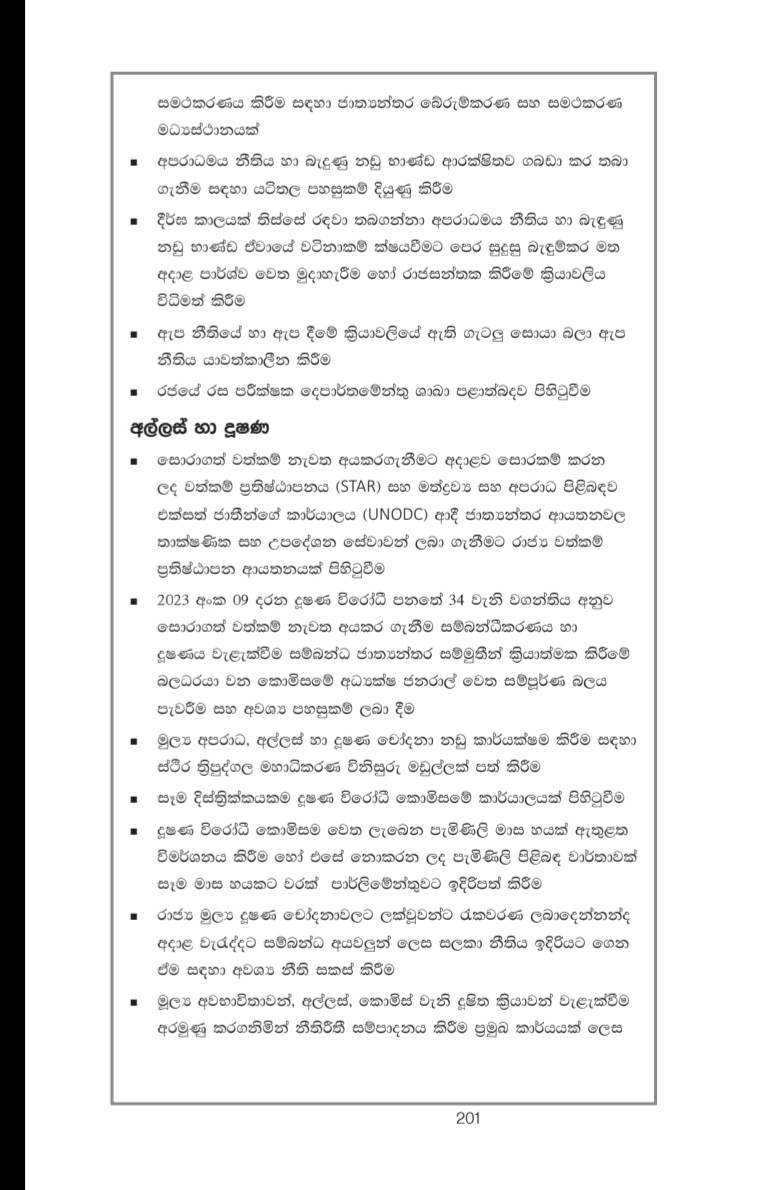
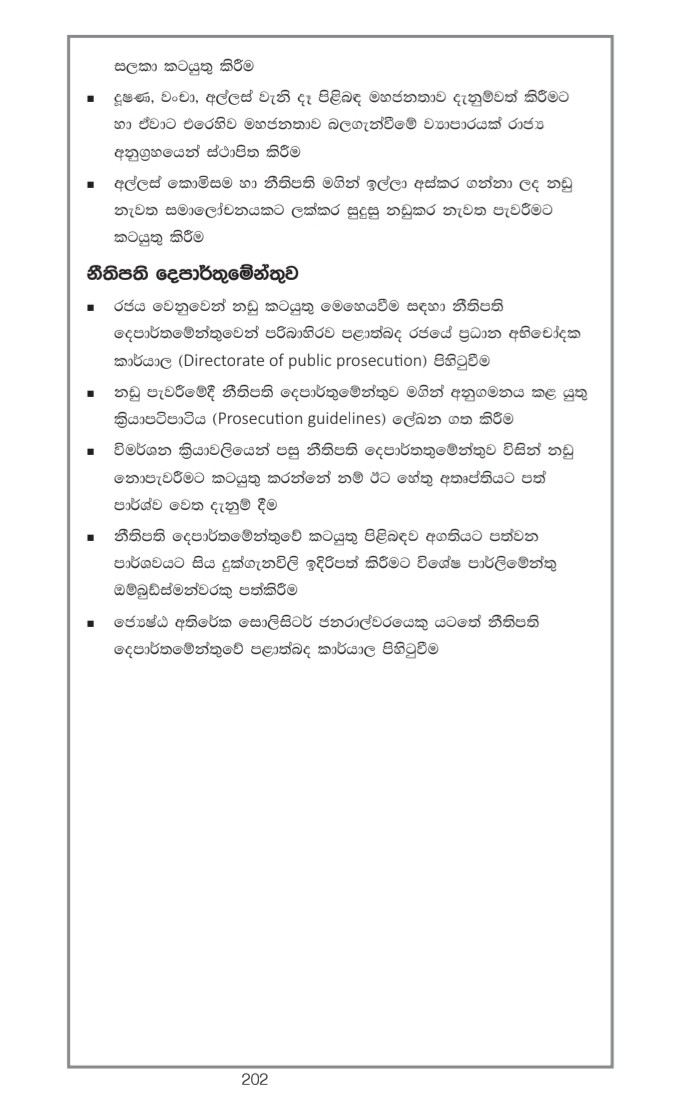
Under the heading "Rule of Law, an Inclusive Judicial System", pages 199 to 202 of the policy manifesto (Sinhala) clearly state the principles and measures that will be used for this. (Photocopies of those pages are attached to this article.)
Is delay in cases a problem that arose only in 2026?
When the National People's Power prepared the policy manifesto in 2024, it is clear from their own law reform document that they considered the weaknesses of the judicial system of Sri Lanka. It also focused on shortcomings in law enforcement, political interference and the decline in public confidence in the judicial system.
What solutions did they offer before coming to power for an issue they were aware of? This policy statement states that efforts should be made to increase the efficiency of the judicial system in Sri Lanka, prevent delays in cases and ensure speedy delivery of justice. So the issue of delays in cases is not something new to them in 2026. They were well aware of this issue even before the NPP came to power.
Solutions to the backlog of cases...
When reading the 2024 Policy Statement, it is clear that the NPP has proposed a number of future measures or policies to address the backlog of cases.
Some of the main proposals are as follows:
• Review and update of laws.
Its purpose is to remove obsolete laws.
• Introduction of modern technology to the courts. Its purpose is to make the process more efficient.
• Smart Courthouses.
Its purpose is to modernize judicial activities.
• Digitization of court records. The purpose is to speed up documents and processes.
• Appointment of research officers. The purpose is to provide legal research support to judges.
• Safe storage of evidence. The purpose is to reduce the backlog of cases.
• Updating the bail law/process.
The purpose is to reduce unnecessary delays.
• Expediting cases of sexual crimes against women and children. This means
expediting special cases.
• Establishing provincial branches of the Government Analyst's Department. Its purpose is to expedite the provision of scientific evidence.
• Establishing a special High Court bench for financial crimes/corruption cases. Its purpose is to expedite corruption cases.
The most important thing that can be seen from this is that the solution they identified in 2024 was to reorganize the judicial process and create special mechanisms to expedite cases.
In a reorganization to prevent delays in the judicial process, there is no proposal or policy that the retirement age of judges should be increased, as mentioned anywhere in the National People's Power's policy statement.
The simple argument that was not there then...
The simple argument that the National People's Power government is presenting today is, "Sri Lanka has a huge backlog of cases. We need enough experienced judges to complete the cases. Therefore, the retirement age of judges should be extended by two years."
Justice Minister Harshana Nanayakkara says that there are currently about 1.1 million cases pending, and extending the retirement age of judges is part of a broader judicial reform.
On July 27, 2026, cabinet approval was received to increase the retirement age of judges in all courts by two years. A constitutional amendment is required for the Supreme Court and the Court of Appeal, and the relevant acts are to be amended for other courts.
But there are two very serious issues that cannot be resolved here. That is
Why didn't they strongly emphasize extending the retirement age as a necessary solution in their manifesto when they asked the people for votes in 2024?
On the other hand, how did extending the retirement age suddenly become a major solution today?
Prove the necessity of the decision....
It is absolutely impossible to argue that the retirement age of judges cannot be changed under any circumstances.
It may be reasonable as a policy to retain experienced judges to increase the efficiency of the judicial system. But it is very important to prove the method of deciding it and its necessity.
Therefore, there are several questions that any citizen will have to ask the government.
1. How many additional cases can be concluded per year by extending the retirement age?
2. Is there specific data for that?
3. How many vacancies are there currently for judges?
4. How much can the backlog of cases be reduced by filling those vacancies?
5. Has extending the tenure of existing judges proven to be more efficient than appointing new judges?
6. Why was this retirement age amendment not included as a key solution in the NPP 2024 policy statement?
Instead of giving political answers to these, we need answers with data and documents.
When talking about the delay in cases, the question should not only be asked about the retirement age of judges, but also about the existing vacancies of judges.
In June 2026, the Minister of Justice stated in Parliament that action is being taken regarding the appointments of Supreme Court and Court of Appeal judges, and that these appointments fall under the power of the President.
Therefore, the public has another simple question. That is, have the existing vacancies been fully filled and the capacity of the judiciary maximized? Or has extending the retirement age been chosen as a quick solution? A clear numerical answer is needed.
It is not impossible.. but...
Before coming to power, the NPP said that its goal was to build an independent, transparent, accountable judicial system and an efficient trial process. Today, the government has decided to change the retirement age of judges due to the need to increase the efficiency of the judicial system.
It is not impossible. But the question is why the people were not told about it earlier.
A political party presents its manifesto before an election to tell the people what it is going to do for the country after coming to power.
So, shouldn't such an important constitutional change being presented today have been put before the people as a policy then?
Today, the government is saying, "Judges are needed to conclude cases quickly." Very good. So let's ask this.
Was there a delay in cases in 2024 too? There were still cases piling up then, weren't there? There were still questions about the capacity of judges then, weren't there? So, if extending the retirement age is a necessary solution, where is it in your policy manifesto?
Why was it hidden from the people then?
This is not a question to beg a government. This is a question to clarify the gap between the policy promise made to the people and the policy decision taken today.
If judicial reforms are needed, do it. If cases need to be expedited, do it. Fill vacancies. Increase infrastructure in the courts. Bring in digital systems. Eliminate delays in government laboratories, government analysts, police investigations and the Attorney General's process.
If special trial chambers are needed, set them up too.
What is the institutional necessity of the decision?...
But if you choose to extend the retirement age of judges among all these, explain the institutional necessity of that decision to the country with data and evidence.
Because the judiciary is not another state institution that a government can change as it wants. Maintaining the independence of the judiciary does not mean being in favor of a government or opposing a government. It is about maintaining the people's trust that the law will be implemented in the same way, regardless of the government or the person in power.
Back then, you asked the people to vote on the promise of "let's rebuild the rule of law." The people are asking you the same thing today. "Show the rule of law that you said back then in action today." If a solution that was not in the policy statement back then has become a necessary solution today, explain to the people why that change was made. That is responsibility.
That is transparency. That is good governance.
Raigam Kankanamge Anjana ✍️

A very heated discussion is currently taking place within society regarding Galagoda Aththe Gnanasara Thero, who has been sentenced to prison. There are two factions: one that approves of the senten…
Information revealed to us indicates that the Director General of the Coast Conservation and Coastal Resource Management Department, Senior Professor Terney Pradeep Kumara, is currently acting to lega…
A major political theme of the current government has been, “Catching thieves.” “Stopping theft.” “Protecting public money.” It is natural for these slogans to attract public attention. It is necessar…

From public frequency to political power centers... The name ‘Sirasa’ cannot be ignored in a discussion of media power in Sri Lanka. But Sirasa should not be talked about only in terms of its popular…