Information revealed to us indicates that the Director General of the Coast Conservation and Coastal Resource Management Department, Senior Professor Terney Pradeep Kumara, is currently acting to legalize illegal constructions by arbitrarily altering the rules and regulations enacted for coast conservation.
The Director General has been utilizing the permit-issuing process to legalize these illegal constructions within the coastal zone. This illegal act is receiving full support from B.H.J. Premathilaka, the Director of the Coastal Resource Management Division.
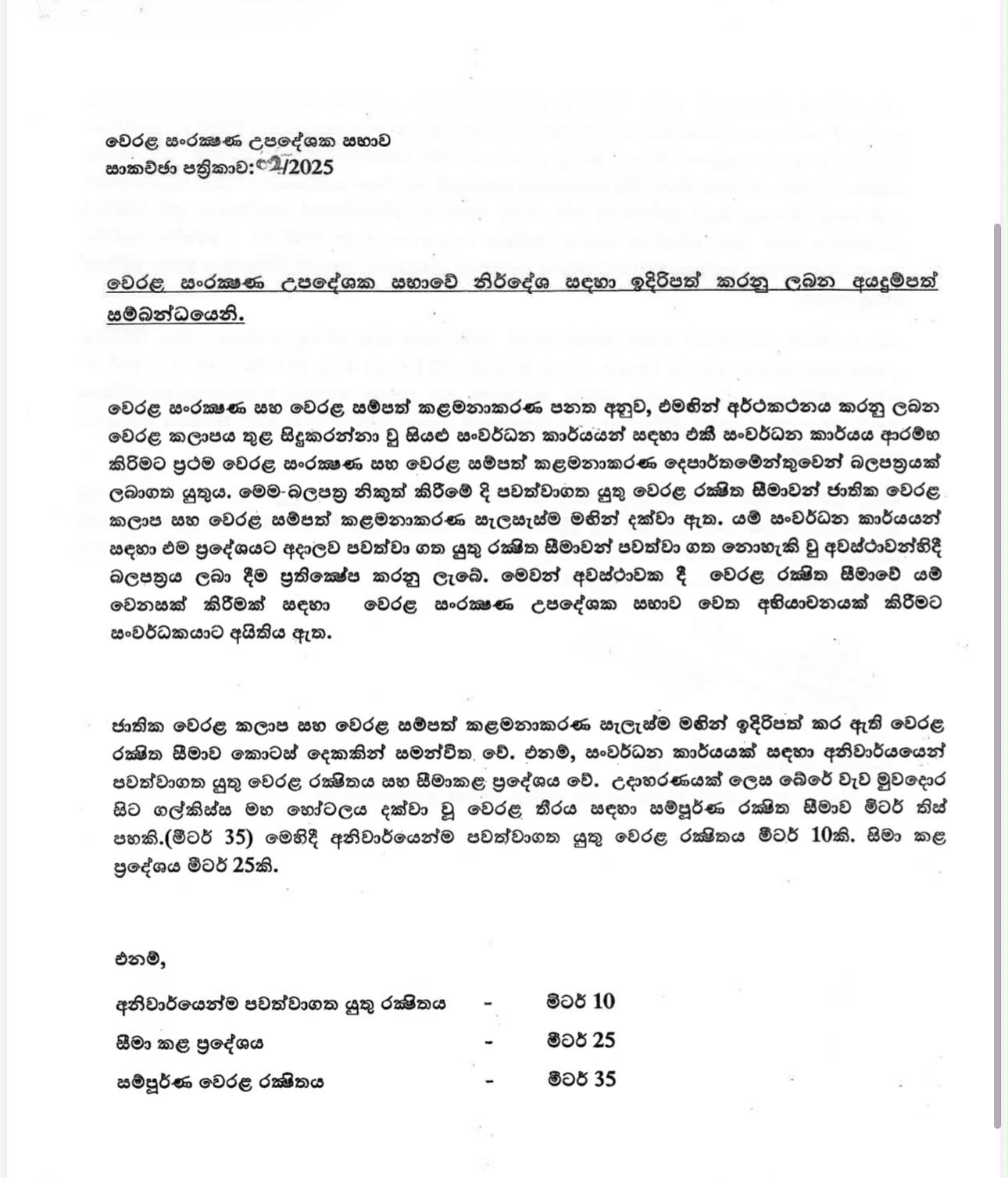
What is this Reserve Zone...?
According to the Coastal Resource Management Plan presented by the Coast Conservation Department for 2024–2029, the specific reserve zone that must be maintained within the coastal region during permit issuance has been clearly published.
Under this Coastal Resource Management Plan, the coastal reserve zone consists of two parts: the mandatory Beach Reserve that must be maintained for any development activity, and the Restricted Area.
For example, the total reserve limit for the stretch of coast from the Beira Lake outlet to the Mount Lavinia Hotel is 35 meters. Here, the mandatory Beach Reserve is 10 meters, while the Restricted Area is 25 meters.
No construction can be carried out within the mandatory Beach Reserve, while only development work essential for vital state activities is permitted within the Restricted Area.
Why is there an Advisory Council...?
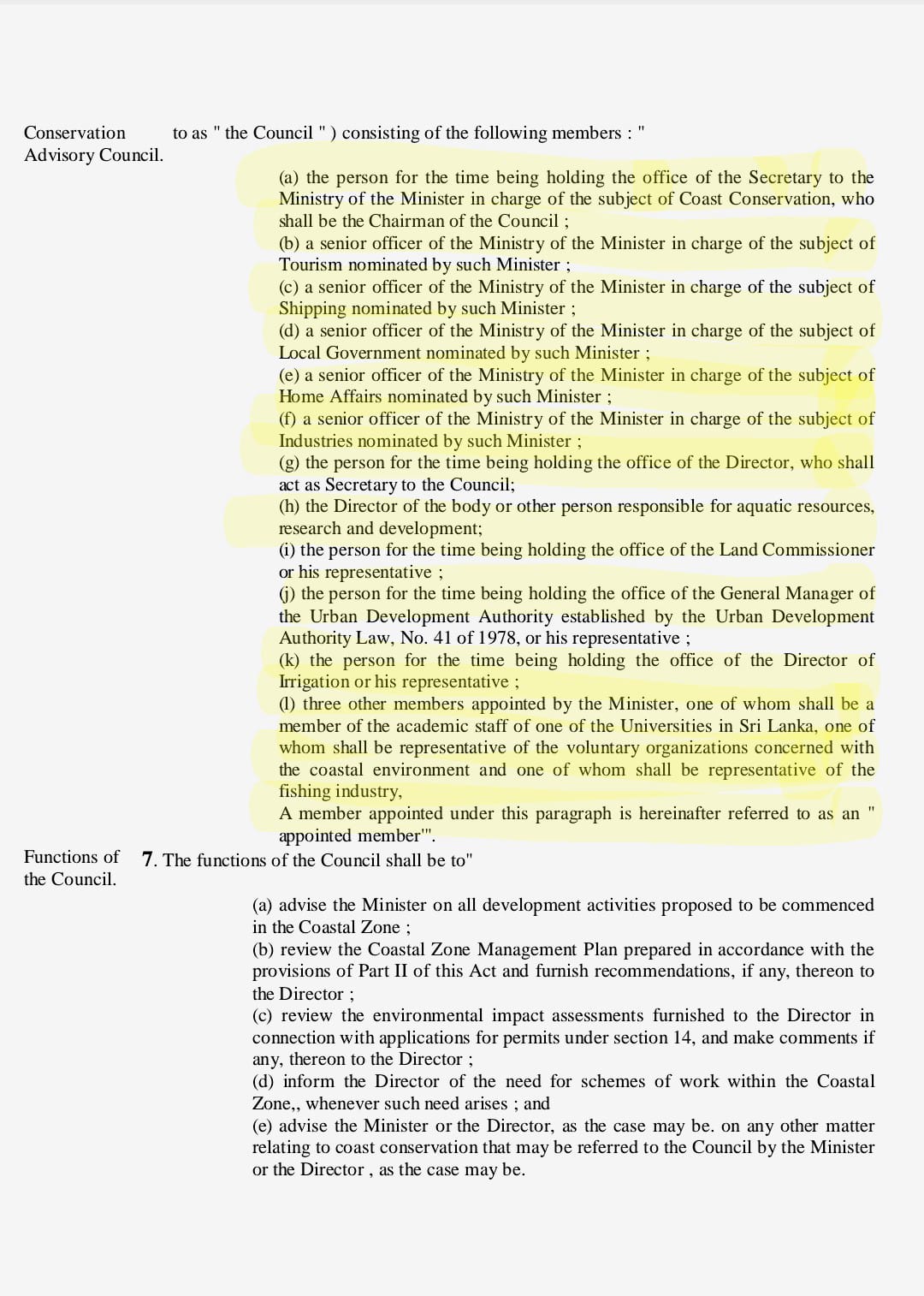
Furthermore, granting approval for such construction can strictly be done only by the Coast Conservation and Coastal Resources Management Advisory Council, established under Section 6 of the Coast Conservation Act.
According to the Coast Conservation and Coastal Resources Management Act No. 57 of 1981, the head or Chairman of this Advisory Council is the Secretary to the Ministry of the Minister in charge of the subject of Coast Conservation. The other members of this Advisory Council consist of senior official representatives from numerous large ministries and institutions, including Tourism, Fisheries, Wildlife, Ports, Irrigation, and Urban Development. (Details specified in the Act are attached below.)
The inclusion of such a large group of representatives in the Advisory Council was stipulated in the Act because granting permission for development work within the reserve zone is a highly sensitive and risky matter.
Therefore, it is clear that such approvals must be handled with extreme care and through a unanimous decision of the relevant institutions.
Unlawfully Usurping Authority...
Despite this framework, the Director General of the Coast Conservation and Coastal Resource Management
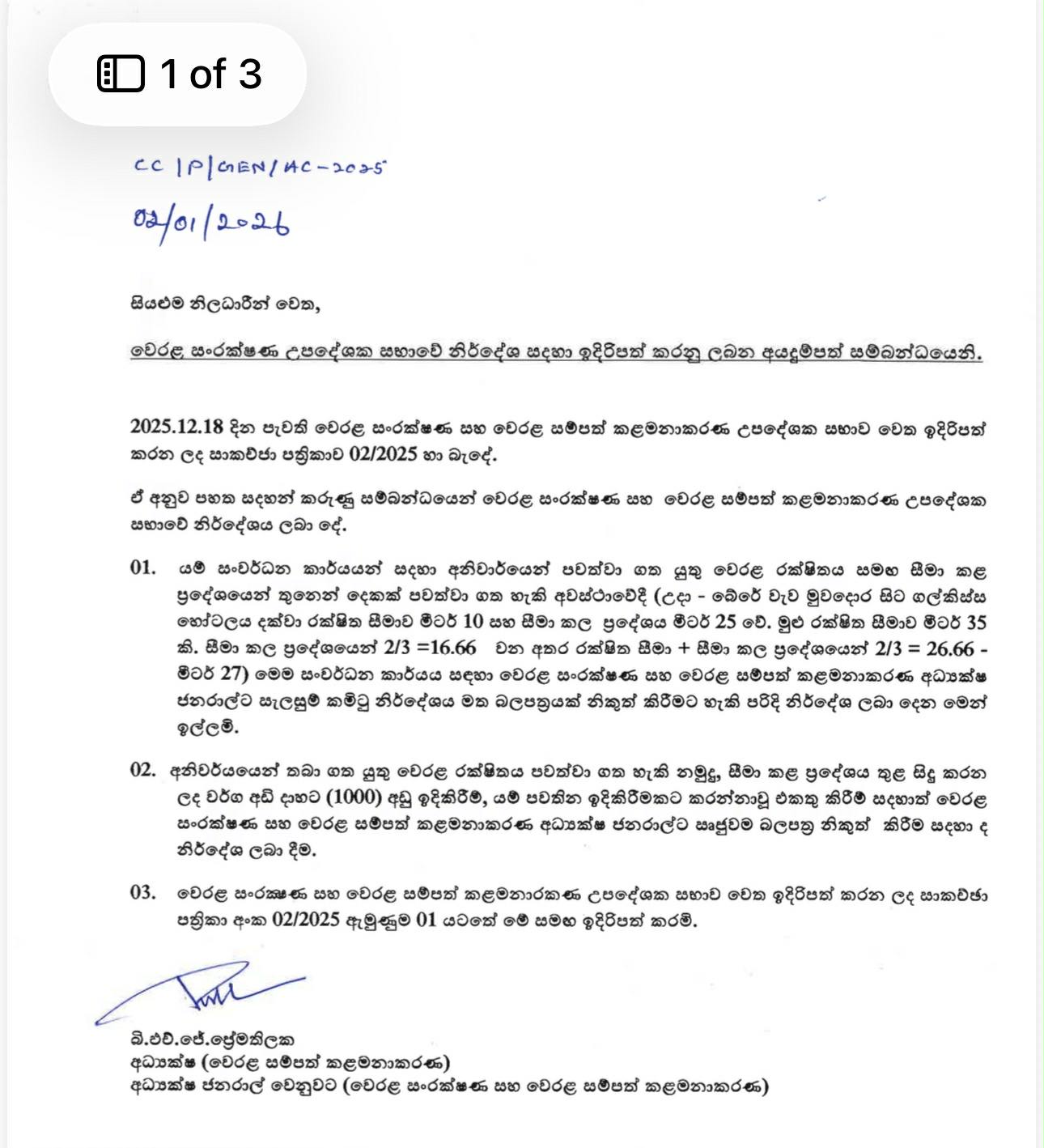
Department and the Director of Coastal Resource Management, B.H.J. Premathilaka, have jointly transferred powers—hitherto reserved exclusively for the Advisory Council—to a Planning Committee comprising just four members of the department, as well as to regional office heads.
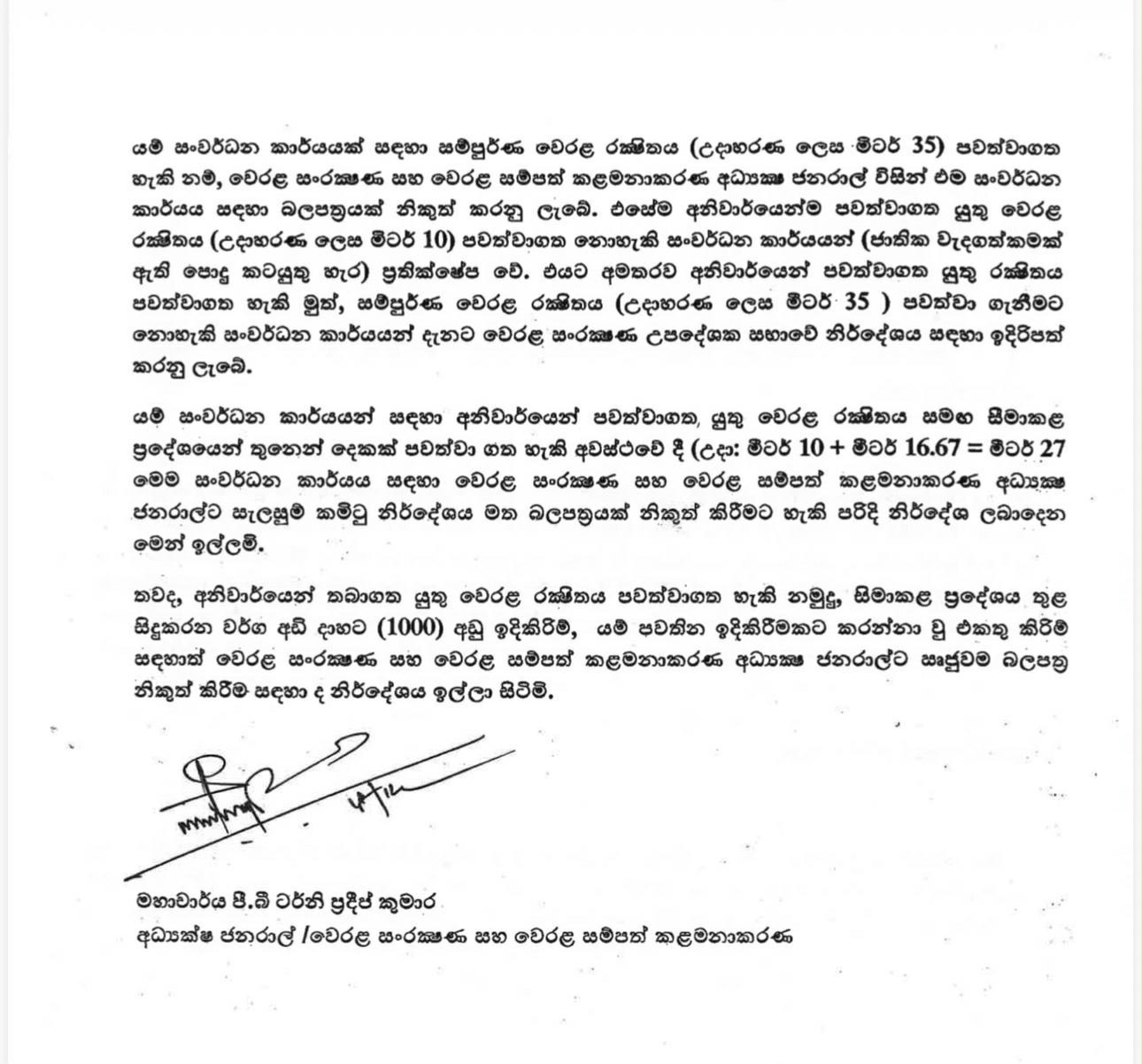
This was revealed through a letter issued by the Director of Coastal Resource Management, B.H.J. Premathilaka, dated 02.01.2026. (The letter is shown below.) Issued on paper lacking official departmental letterhead, the letter bears a signature above the name B.H.J. Premathilaka, but lacks his official stamp.
Additionally, although a document of such importance should be issued by the head of the institution, it was issued by the Director of Coastal Resource Management. While the letter mentions an attached Advisory Council discussion paper from 18.12.2025 authorizing this transfer, nowhere in that discussion paper does it state that authorization was granted by the Advisory Council. Furthermore, there is no signed document showing that the members of the Council or the Ministry Secretary granted approval for this delegation of power. Instead, what is attached is merely an application submitted by Terney Pradeep Kumara to seek recommendations from the Advisory Council. (That document is also shown below.)
A Challenge in Court...?
On the other hand, the authority of an Advisory Council established by an Act of Parliament cannot be transferred to another committee without a legal procedure. Doing so is an illegal act, and decisions taken through such unlawful procedures can be challenged in court.
A departmental director cannot issue a letter instructing actions that override an approved management plan or the statutory powers of a parliamentarily established Advisory Council.
Nevertheless, with the Advisory Council's authority unlawfully usurped through the intervention of the Director General and Director B.H.J. Premathilaka, a significant number of permits have already been issued.
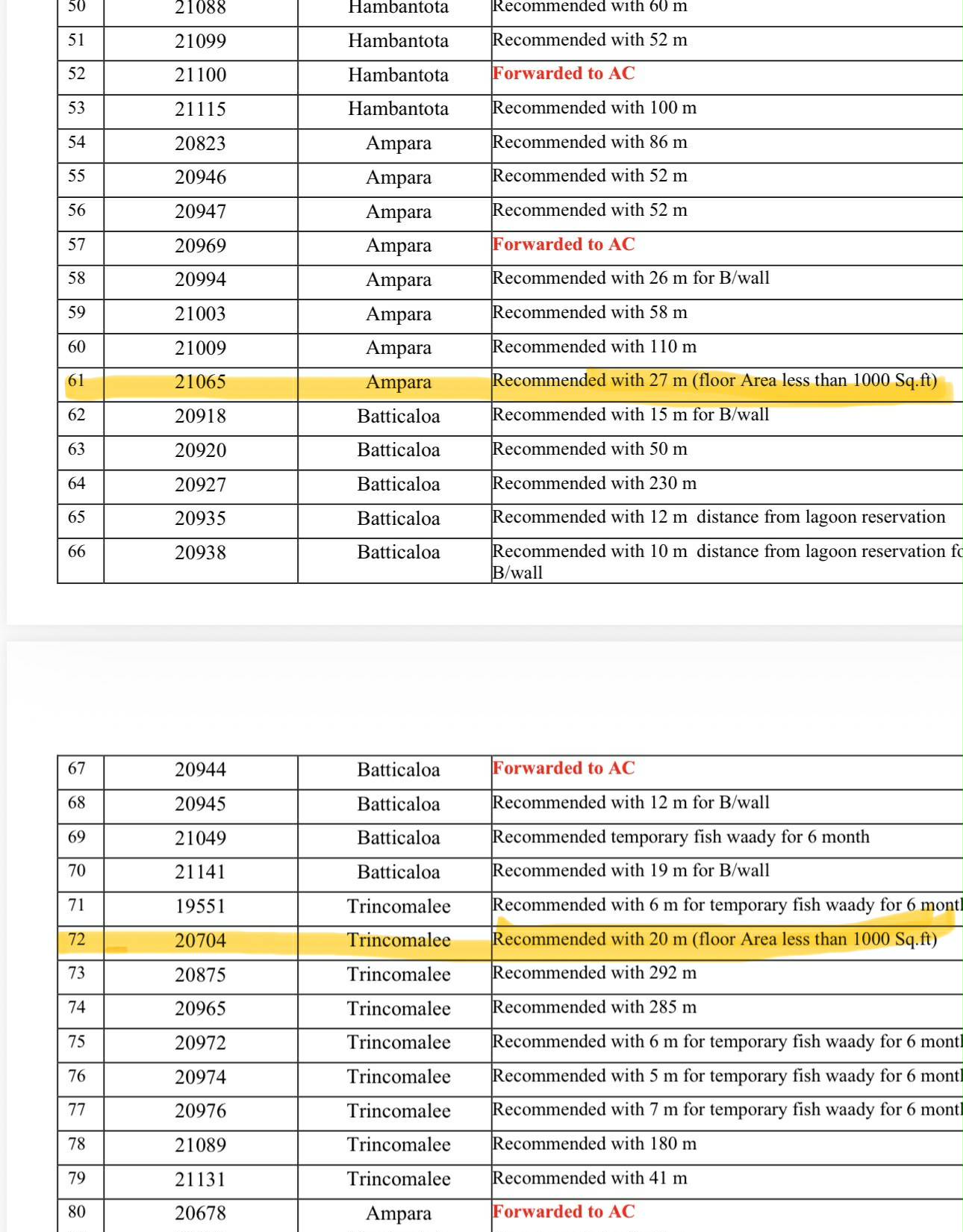
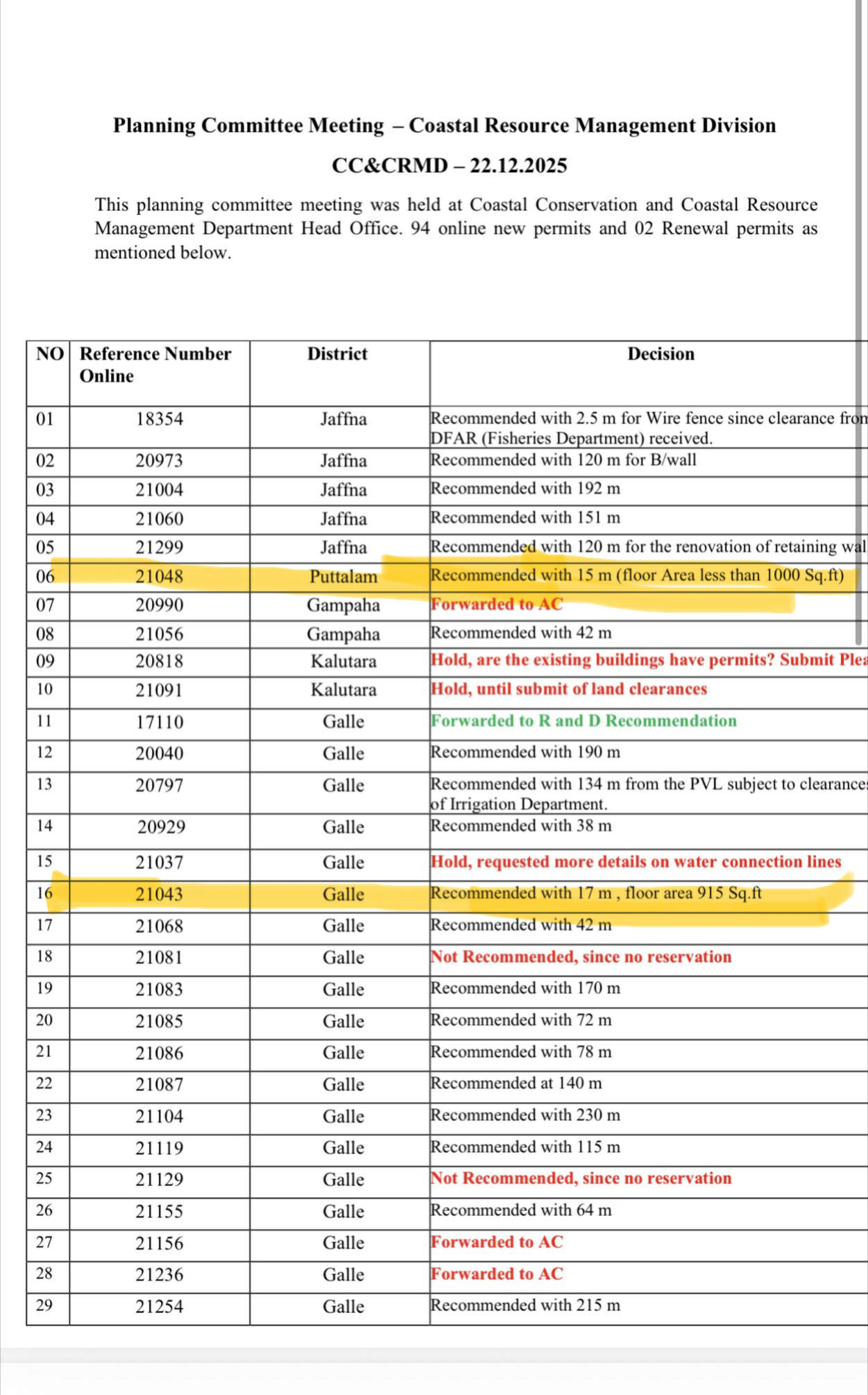
Here are details of several permits granted by abusing the powers of the Advisory Council:
Ref. No. 21048: The Planning Committee recommended issuing the permit at a distance of 15 meters.
Ref. No. 21043: The Planning Committee recommended issuing the permit at a distance of 17 meters.
Ref. No. 21065: The Planning Committee recommended issuing the permit at a distance of 27 meters.
Ref. No. 20704: The Planning Committee recommended issuing the permit at a distance of 20 meters.
Ref. No. 20878: The Planning Committee recommended issuing the permit at a distance of 19 meters.
Ref. No. 20092: The Planning Committee recommended issuing the permit at a distance of 10 meters. (Related documents are shown below.)
Exceeding Power and Paving the Way for Corruption...
All of these recommendations constitute an abuse of the Advisory Council's powers, and implementing such decisions is illegal. Under the Coast Conservation Act, the power to remove or alter the reserve limit lies solely with the Coast Conservation and Coastal Resources Management Advisory Council. Delegating that power to an internal departmental committee—such as the Planning Committee—or to regional heads is illegal.
Acting beyond the authority of an Act passed by Parliament is an ultra vires act (exceeding power). Court actions can—and should—be filed against decisions made in excess of authority. In such an event, those who acted on and recommended these decisions will be liable as offenders, not just those who typed the letters.
The Advisory Council serves as an inter-institutional coordinating body. An internal departmental committee cannot fulfill the purpose expected of that Council. Decisions of this nature pave the way for corruption, aggravate environmental damage, and erode public trust.
Internal departmental leaks reveal that this operation is being carried out with the full backing of Director General Terney Pradeep Kumara and at the behest of a few cronies, including Coastal Resource Management Director B.H.J. Premathilaka, purely to facilitate bribery, fraud, and corruption.
It is clear from this that the Director General appointed by the Compass (Malima) government is blatantly violating the Coast Conservation Act, setting aside coast conservation, and actively engaging in issuing permits that destroy the coastline.
– Sunil Gamini Jayalath

A very heated discussion is currently taking place within society regarding Galagoda Aththe Gnanasara Thero, who has been sentenced to prison. There are two factions: one that approves of the senten…

A major political theme of the current government has been, “Catching thieves.” “Stopping theft.” “Protecting public money.” It is natural for these slogans to attract public attention. It is necessar…

From public frequency to political power centers... The name ‘Sirasa’ cannot be ignored in a discussion of media power in Sri Lanka. But Sirasa should not be talked about only in terms of its popular…

The discussion about bringing a new law to replace the Prevention of Terrorism (Temporary Provisions) Act No. 48 of 1979 (PTA), which has been heavily criticized for decades in Sri Lanka, has resurfac…