The NPP’s “Changed Path”: A Sharp Political Examination
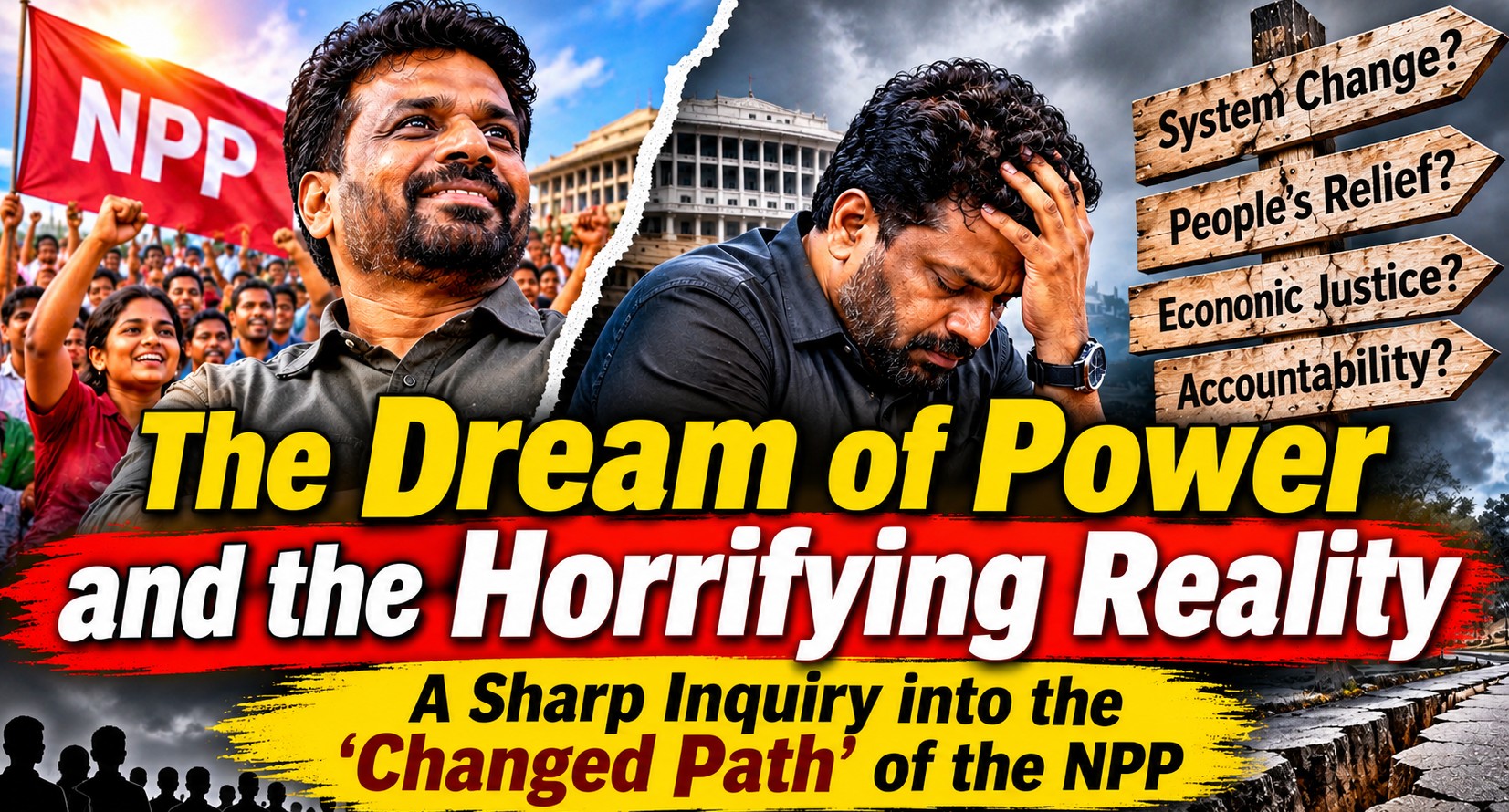
Sri Lanka’s recent political history offers few examples of a political movement that has demonstrated such rapid ideological contradictions and policy reversals after coming to power.
Today, the National People’s Power (NPP) and the Janatha Vimukthi Peramuna (JVP) find themselves confronted with a serious political dilemma in the face of state power.
There is an enormous contradiction between the ideological slogans they proudly championed while in opposition and the harsh economic realities they have had to confront after assuming office.
This cannot simply be dismissed as a minor “change in policy.” It is a situation that demands serious scrutiny, particularly in terms of political integrity and public trust.
The Revolutionary Rhetoric and Anti-IMF Campaigns That Once Echoed Across Political Stages
During the period from 2022 to 2024, while the country was struggling with a devastating economic crisis, the central theme of the political campaign conducted by the NPP across Sri Lanka was its fierce accusation that previous governments had betrayed the country by surrendering to the International Monetary Fund (IMF).
The Accusation of “Betraying the Country”
They repeatedly declared that the IMF programme amounted to selling away Sri Lanka’s economic sovereignty and would only push ordinary people further into economic hardship.
Promises on Taxes and Economic Relief
They pledged to immediately reduce what they described as unfair taxes imposed on the people, including VAT and PAYE, and to reverse increases in electricity and fuel prices.
The Illusion of the Election Manifesto
Through their election manifesto, “A Rich Country – A Beautiful Life,” they presented an alternative economic path based on domestic production, supposedly free from the influence of the International Monetary Fund.
People were drawn to the party because they genuinely believed in this uncompromising policy position and its confident assertion that “only we can rebuild the country.”
Surrendering to Economic Reality: The IMF Programme and External Committees
But what has happened today?
Almost immediately after coming to power, those revolutionary slogans appear to have evaporated.
Remaining Under the Shadow of the IMF
Far from withdrawing from the IMF programme, which is scheduled to conclude in March 2027, the present government continues to implement its conditions, fiscal targets and stringent tax policies.
The IMF, once portrayed as a “deadly trap designed to sell off the country,” has now effectively become part of what they describe as “our own programme.”
Policy Contradictions and External Experts
The party that once claimed to possess sufficient economic councils and an enormous reservoir of knowledge and expertise has now appointed committees that include external experts and officials who previously worked with the IMF to advise on important economic decisions.
Were the policies and economic plans they presented to the people at that time unrealistic from the outset? Were they merely political deceptions designed to secure power by misleading the public?
That is the sharp political question that must now be asked.
Political Integrity and the Deception of the People
A clear reality emerges when we examine the policies currently being implemented by the government: there is an enormous gap between the promises made while in opposition and the actual policies being pursued today in the exercise of state power.
The Double Standard
While in opposition, they fiercely condemned unpopular decisions taken by previous governments. Yet, after coming to power, they are now implementing those very same policies, in some cases with even greater intensity.
The very people who once declared, “If we come to power, we will reduce these taxes,” are now attempting to justify their failure to do so by telling the public that “tax reductions are impossible because of international obligations.”
Hiding Behind Expert Committees
The appointment of external committees to make decisions about whether to continue with the IMF programme is a strategy that appears designed to conceal the bankruptcy of the economic vision they once claimed to possess.
When a government fails to fulfil the promises it made to the people, shifting responsibility onto expert committees can become a political strategy for evading accountability.
In politics, any party can sell a dream to win power. But when that dream comes face to face with the brutal pressure of reality, the gap between yesterday’s slogans and today’s actions becomes increasingly visible to the people.
What the National People’s Power is implementing today is not the economic programme outlined in its election manifesto. Instead, it is essentially pursuing the same capitalist economic framework and IMF agenda that it once vehemently portrayed as fundamentally wrong.
The fact that the government has now been compelled to bow to the very system it once accused of “betraying the country” demonstrates an important truth: shouting slogans on political platforms is easy, but transforming the economic reality of a country requires a rigorous, scientific and practical approach that goes far beyond empty rhetoric.
Making false promises to the people, winning power and then abandoning those very promises is nothing new in Sri Lanka’s old political culture.
What the National People’s Power is doing today is nothing more than writing the latest chapter of that same old political tradition under a new name.
Jayalathge Sunil Gamini ✍️