The dreams of the great heroes and the Reality of Today
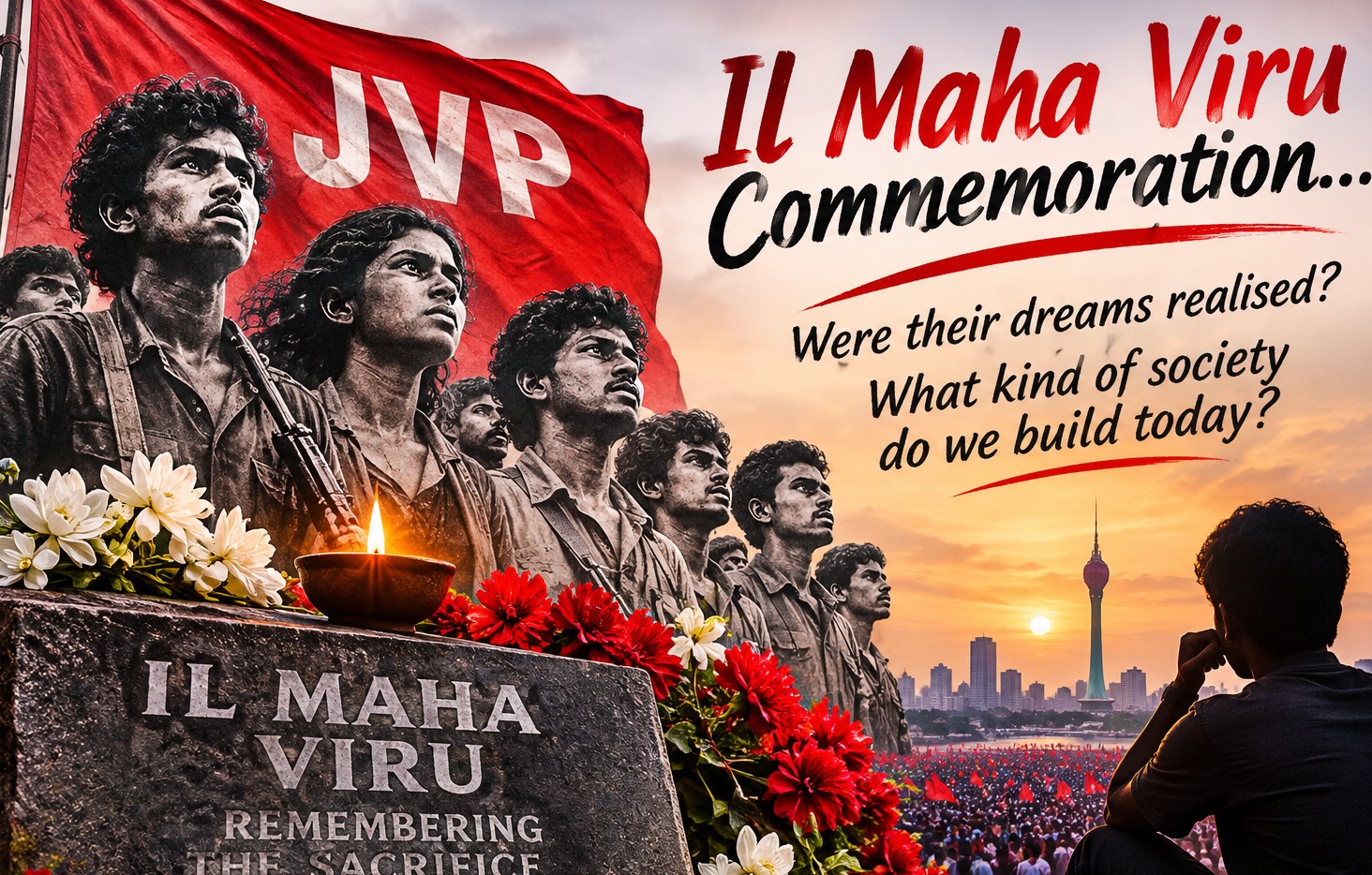
What kind of society did they sacrifice their lives for? And what kind of socio-economic system does the present leadership govern in the name of today?
The annual November commemoration of the November Heroes has come around once again.
Every year, as November approaches, the memories of thousands of young men and women who sacrificed their lives during the history of the Janatha Vimukthi Peramuna (JVP) are brought back to the forefront. They are remembered as the November Heroes. Their sacrifices, struggles, political convictions and aspirations are repeatedly recalled.
However, this year's November Heroes' commemoration carries a particularly significant political meaning.
The reason is that the present political heirs of the party that once led a revolutionary political struggle are now entrusted with the country's executive power and other major responsibilities of state governance.
A political movement that once fought to capture state power now holds that very power.
Therefore, this year's November Heroes' commemoration cannot be confined to merely remembering the past.
It is an occasion to examine the record between the political promises of the past and the political conduct of the present.
Is the society they once aspired to build taking shape today?
Are we witnessing a transformation of the economic system they once opposed?
Or is the very same system they criticised being maintained today under a different political vocabulary?
These are not insults directed at the past. They are legitimate questions that must be asked about those who exercise political power today.
What did the November Heroes aspire to achieve?
The JVP's 1987–1989 struggle cannot be adequately understood merely as an attempt to overthrow a government.
Its political background involved a range of issues, including economic inequality, unemployment, youth frustration, opposition to foreign intervention, national independence and the question of state power.
In particular, the 1987 Indo–Sri Lanka Accord and the arrival of the Indian Peace Keeping Force became central themes of political opposition for the JVP at the time. The introduction of the Provincial Council system under the Accord, together with the debate over national sovereignty, intensified political tensions in the South.
The principal political ideals emphasised by the JVP at that time can be summarised as follows:
A socialist economy and social justice.
Opposition to capitalist exploitation and economic inequality.
Protection of national resources and state institutions.
Opposition to foreign domination and imperialist intervention.
Protection of free education and free healthcare.
Defending the rights of the working class and oppressed communities.
Opposition to corruption, privilege and dynastic politics.
One important point must not be forgotten here.
Not every action carried out during the 1987–1989 period can be justified as a democratic struggle. The killings, threats and acts of coercion committed by the JVP's armed movement, as well as the killings and disappearances resulting from state repression, remain dark chapters in our history. All of them deserve critical examination.
Nevertheless, no one has the right to deny people the freedom to question the political aspirations of the young men and women who sacrificed their lives in that struggle.
Honouring the sacrifices of those who died does not simply mean attending commemorative events held in their names. It also means examining whether the political objectives they stood for have been fulfilled.
Has the economic system they once opposed now been accepted?
At this point, we must pay particular attention to the political transformation of the present-day JVP and the National People's Power (NPP) government.
In the JVP's economic politics of the past, the party strongly advocated the public sector, national resources and public ownership.
It fought against privatisation. It mobilised people against the sale of state-owned enterprises. In particular, in 2004, the JVP strongly opposed proposals to privatise the Ceylon Electricity Board.
But the situation today is different.
The National People's Power policy manifesto presented at the 2024 presidential election clearly refers to policies such as encouraging foreign investment, promoting Public-Private Partnerships (PPPs), creating an investor-friendly environment, and evaluating state-owned enterprises according to their efficiency and economic significance.
This cannot simply be dismissed as a minor policy adjustment.
A political movement that once described privatisation as the sale of the country's national assets now recognises private investment and partnerships as instruments of economic development.
A party that once spoke of a socialist alternative to the market economy now places its confidence in market competition, foreign investment and the contribution of the private sector.
The question is not whether changing policies is wrong.
Economic policies can change over time.
The global economy changes. A country's economic circumstances change. There may be a need to reconsider policies that were once considered appropriate.
But if that is the case, the public deserves a clear explanation.
What exactly was considered wrong in the past? What is now considered right? Why have the economic policies once criticised become necessary to implement today?
Political responsibility cannot be avoided by repeatedly invoking revolutionary slogans of the past without answering these questions.
A changed political position before the International Monetary Fund...
Another area where the political transformation of the present government becomes particularly evident is its policy towards the International Monetary Fund (IMF) programme.
Throughout the JVP's political history, there were strong criticisms of the conditions imposed by international financial institutions, dependence on foreign debt and the economic burden placed on ordinary people.
During the 2024 election campaign, the NPP also promised to review the revenue and expenditure management proposals of the IMF programme, conduct an alternative debt sustainability analysis and carry out an audit of public debt.
But what happened after the government came to power?
The IMF programme, which began in 2023 under the administration of Ranil Wickremesinghe, is now being continued by the present government as well.
Revenue targets, public expenditure management, state-sector reforms, economic competitiveness and market reforms remain among its principal components.
The 2026 BTI Sri Lanka Report also points out that the National People's Power, which had been critical of IMF conditions before the election, has committed itself to implementing the programme after forming the government.
(The BTI 2026 Sri Lanka Report is the country analysis of Sri Lanka contained in the Bertelsmann Transformation Index 2026, an international research report prepared by Germany's Bertelsmann Stiftung.)
There is something important that must be clarified here.
Since the IMF programme began in 2023, it would be unfair to place the entire responsibility for that programme on the present government. However, the decision to continue implementing it after coming to power is a political decision made by the present administration.
Therefore, the questions are these:
What was the alternative economic path promised to the people?
Is that alternative what is being implemented today?
Or is the previous government's economic framework simply being continued with certain modifications?
During an economic crisis, governments may be compelled to make unpopular decisions.
But if the burden of those decisions continues to fall disproportionately on ordinary people, the political promises of social justice made in the past must be reconsidered.
What happened to the politics that once stood for the working class and oppressed people?
In the JVP's politics of the past, the working class, farmers, fishermen, unemployed youth and oppressed communities occupied a special place.
The party spoke about the gap between the privileges enjoyed by the capitalist class and the difficult lives endured by ordinary people.
Today, the government has the power necessary to transform the lives of those very people.
But there are several questions we must ask.
How much has the economic security of ordinary families struggling with the cost of living actually improved?
Is there an adequate programme to reduce the gap between wages and the cost of living?
How effectively has the government intervened to protect the labour rights of private-sector employees?
Have fair and reasonable prices been guaranteed for the agricultural products of farmers?
Is sufficient investment being made to strengthen free education and public healthcare?
The fundamental question of socialist politics is not merely how much a country's economy grows. It is about who receives the benefits of that growth.
A country's Gross Domestic Product may increase. Investment may rise. Foreign exchange reserves may become stronger.
But if the lives of ordinary people continue to become more difficult amidst all these developments, can that be described as a socialist political achievement?
The success of economic growth must not be measured solely through statistics, but also by the extent to which its benefits reach ordinary people.
The state power they once criticised and the state power they exercise today...
In the JVP's politics of the past, there were strong criticisms of state repression, corruption, the abuse of power and violations of democratic rights.
History contains serious experiences that give substance to those criticisms.
Today, the political heirs of that movement hold state power.
So, what should the public expect from them?
A system of governance in which the police, public officials and security forces can function free from political interference.
An independent judiciary.
Freedom of the media.
The right to protest.
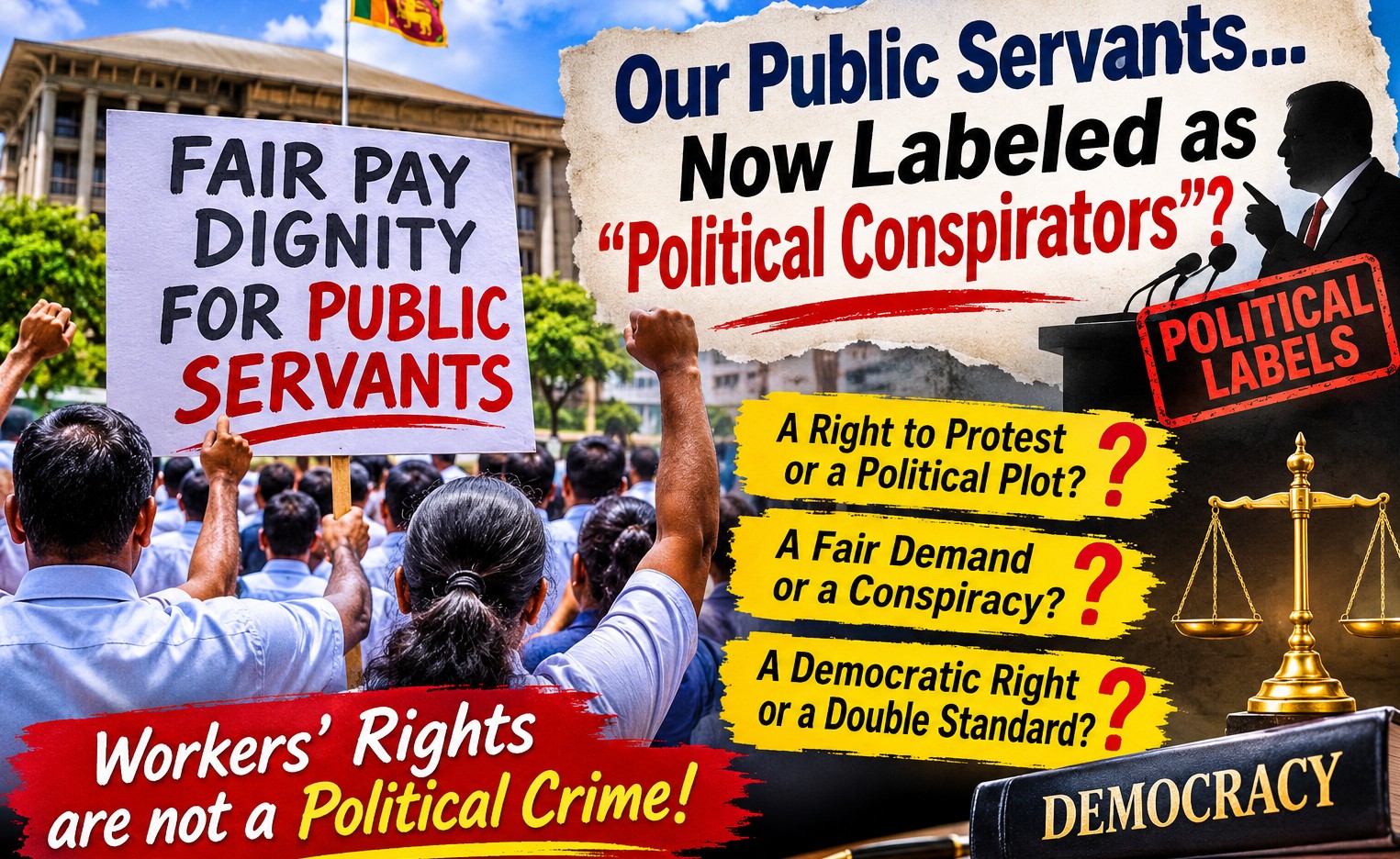
A political culture that respects workers' struggles and trade unions.
A government that recognises that state power is not an instrument for silencing people who hold opposing views, but a responsibility to protect the rights of all citizens.
However, we must remain vigilant about how the government responds when people, trade unions and civil society organisations question or oppose its policies.
If the criticisms made in the past are forgotten once state power is acquired, that is not a political transformation. It is a transformation in one's attitude towards power itself.
Has a party that once spoke of socialism now become a manager of a capitalist economy?
This is one of the fundamental philosophical questions facing the present-day JVP and the National People's Power.
When we examine the economic policies of the present NPP government, what we can identify is a mixed economic system based on the market economy, private investment, foreign capital and public-private partnerships.
It is not a socialist economy.
Here, I would also like to raise another important point.
The state-centred economic policies of the United Front government between 1970 and 1977 cannot simply be presented as JVP policies. Similarly, all the economic policies of the governments that ruled between 1994 and 2005 cannot be attributed to the JVP.
However, from the time the JVP moved closer to political power through its alliance with Mahinda Rajapaksa in 2004, we can identify various stages in the political transformation of the party.
Accordingly, the JVP that exists today is not the same political movement that existed in the past.
It has evolved into a political movement that has grown within electoral politics, built a broader coalition and presented itself as capable of managing the state within a capitalist market economy.
Such a transformation is possible.
But it is the political responsibility of the party to explain that transformation honestly to the people.
If it now accepts the market economy instead of socialism, it should say so openly.
If it now believes that its past criticisms of privatisation were mistaken, it should explain that as well.
Attempting to maintain both the revolutionary image of the past and the market-oriented economic policies of the present at the same time, without explaining the difference, raises serious questions about political honesty.
The name of the November Heroes must not be reduced to political propaganda!
Today, the government enjoys a substantial popular mandate.
That mandate was not given merely to a political party. It was given because people hoped that decades of corruption, fraud, abuse of power and inequality would finally come to an end.
There was also an expectation that a new political culture would be created in place of the old political culture.
Therefore, criticising the present government does not mean rejecting the JVP's struggles of the past.
Remembering the November Heroes does not mean justifying every action of the present government.
No political party has the right to use the names of those who died in the past as a shield against criticism of its present-day political decisions.
It is easy to organise commemorative events in the name of the November Heroes.
It is easy to display their photographs.
It is easy to deliver emotional speeches about their sacrifices.
But what matters far more is examining how far the party that claims to represent their legacy has actually fulfilled the political objectives for which they stood.
The final question: Have the dreams of the November Heroes been fulfilled?
I would like to ask several questions of the political leaders who exercise power today.
You once stood for a socialist economy. What economic philosophy are you implementing today?
You once fought against privatisation. Why are you now promoting private investment and public-private partnerships?
You once stood for the protection of national resources. On what policy principles are you making decisions concerning those resources today?
You once criticised the economic conditions imposed by the IMF. Why are you now managing the economy within the framework of that very programme?
You once claimed to represent the oppressed. How successful have you been in reducing the economic burden on those very people today?
You once fought against state repression. How committed are you today to protecting democratic rights?
They cannot escape answering these questions.
Because today, they are not a political movement sitting in opposition. They are the political movement that holds the governing power of the country.
Justifying the struggles of the past does not automatically justify the governance of the present. The bridge between the two must be policy consistency and political honesty.
In conclusion, I have only this much to say.
The lives of the November Heroes are not honoured merely by placing flowers before their photographs.
Their sacrifices acquire meaning through whether the society being built today by the political movement that claims to represent them has genuinely established justice, equality, freedom and human dignity.
Did they aspire merely to capture political power?
Or did they aspire to create a different society in which power would be exercised in the interests of the people?
Did they fight merely to replace one group of rulers with another?
Or did they fight to transform the system of governance, the economic system and the relationships within society itself?
That is the question before us today.
If the names of the November Heroes are still alive in our political memory, then the right to question whether the society they aspired to build has become a reality must also remain alive.
Because,
The true victory of a revolution is not determined by its leaders becoming rulers, but by whether the social transformation that the revolution aspired to achieve becomes a reality in the lives of ordinary people!
This article is not written merely to commemorate the November Heroes, but to encourage us to rethink the society they aspired to create.
Jayalathge Sunil Gamini ✍️