The Bloodstains of the Robe and Its Present-Day Humiliation!
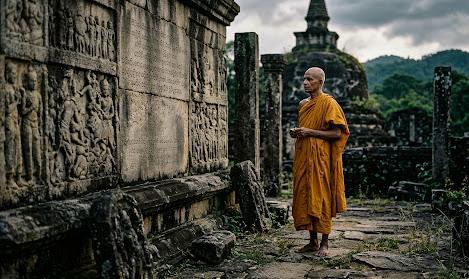
“What Buddhism needs is not political protectors, but a society that safeguards the Dhamma and the Vinaya.”
Some memories of history may fade with time. But forgetting them does not diminish the gravity of the crimes committed in the past.
Looking back at Sri Lanka’s political history, we encounter numerous painful memories of Buddhist monks who lost their lives amid political power struggles, armed uprisings and state repression.
The robe worn by a Buddhist monk today is not merely a piece of clothing. It is a symbol of religious, cultural and moral values that have been nurtured within Buddhist society for centuries. Yet, for many who wore that robe, the political power struggles of this country brought a tragic fate.
The 1987–1989 Period of Terror: Buddhist Monks Who Lost Their Lives Because of Political Ideologies
The second armed insurrection launched by the Janatha Vimukthi Peramuna (JVP) between 1987 and 1989, and the state repression unleashed against it, remains one of the darkest chapters in Sri Lanka’s history.
Thousands of people were killed during this period. Many disappeared, while others were subjected to torture. Buddhist monks were also among the victims.
According to an investigative article published on 9 October 2026 by journalist Dharman Wickramaratne, 41 Buddhist monks were killed by the armed wing of the Janatha Vimukthi Peramuna during the period from 1986 to 1990.
The same investigation states that 681 Buddhist monks were killed by state security forces and paramilitary groups. These figures are statistics presented through the journalist’s investigation.
These figures reveal one deeply disturbing reality: Buddhist monks were forced to pay with their lives simply because they opposed a particular political ideology, maintained connections with another political faction, or refused to provide support to a political movement under coercion.
Names from the Past That Must Never Be Forgotten
Ven. Pohoddaramulle Premaloka Thero
Ven. Pohoddaramulle Premaloka Thero, who served as the Chief Sanghanayake of the Kalutara Thotamuna area, was assassinated on 18 December 1988.
A photograph showing his body lying in state at the Kalutara Town Hall on 21 December 1988 remains a historical testimony to that tragedy.
Ven. Kotikawatte Saddhatissa Thero
A well-known Dhamma preacher, he was murdered inside his own temple on 3 August 1989.
Ven. Beligalle Mahinda Thero
The chief incumbent of the Middheniya Purana Viharaya, he was assassinated on 28 May 1989. According to the investigation, his refusal to attend and bless a protest against the Provincial Councils Act was among the reasons behind his killing.
Ven. Welthota Pannadassi Thero
He was residing at the Kitulagamuwa Temple in Matara when he was assassinated on 30 August 1989.
Ven. Kumbugodde Gnanāloka Thero
Associated with a temple in Mihintale, he was murdered on 11 July 1987.
Ven. Walambagama Pannasara Thero
The chief incumbent of the Dharmashrama Temple in Habaraduwa, he was killed in 1988. According to the investigation, one of the reasons was his refusal to comply with a demand to stop teaching the Dhamma to the children of military personnel.
Ven. Reddagoda Saranankara Thero
He was also among the Buddhist monks who were killed. He had been actively involved in peasant struggles in the Kurunegala area.
These are only a few names. The investigative report contains the names and dates of death of many other Buddhist monks.
Regardless of their political beliefs, these monks had the right to live. They had the right to hold their own opinions. They also had the right to reject the opinions of others.
No political movement or state authority that denied them these fundamental rights has any moral legitimacy to speak about humanity.
A Society That Once Respected the Robe: Where Are We Today?
In the past, Buddhist monks were killed amid political ideologies, power struggles and armed violence.
Today, we are witnessing a tragedy of a different nature.
There are occasional reports of laypeople threatening, publicly insulting and assaulting Buddhist monks. There are also instances of violent confrontations among monks themselves, arising from personal and institutional power struggles.
On 2 November 2025, an incident was reported near the Sri Rathnawali Bhikkhuni Monastery in Kerawalapitiya, Wattala, where two individuals allegedly verbally abused and threatened a Buddhist nun. Media reports stated that the police arrested two suspects in connection with the incident.
In July 2026, a dispute between two Buddhist monks over the position of chief incumbent at the Senasungala Rajamaha Viharaya in Rideemaliyadda reportedly escalated into a violent confrontation. According to media reports, one monk was arrested on allegations of assaulting another monk and was remanded by court order.
Such incidents demonstrate that disputes over temple leadership, property and other administrative rights can sometimes lead to violence even within religious institutions.
This is a serious stain on the Buddhist Sasana itself.
The Incidents Near Ruwanwelisaya and the Growing Tensions in Contemporary Society
The protests and confrontations that have been taking place near the Ruwanwelisaya in Anuradhapura during November 2026 also deserve attention.
A group of Buddhist monks and laypeople staged a Satyagraha protest against the Anuradhapura Sacred Area Development Plan. Tensions reportedly arose between the police and protesters when an attempt was made to put up a temporary structure.
Despite a court order directing those involved to leave the location, the protest continued. Summons were issued requiring five Buddhist monks to appear before the court on 20 November.
On 9 November, a heated verbal confrontation also reportedly took place between an individual and a group of Buddhist monks at the same location.
The point that must be emphasised here is that assaulting or threatening monks who are engaged in a protest can never be justified. At the same time, respecting court orders and the rule of law is the responsibility of all parties.
By now, disputes characterised by hostility have emerged between laypeople and monks within the Anuradhapura Sacred Area. Buddhist monks themselves have also been involved in physical confrontations, with violence resulting in bloodshed.
Buddhist monks have the right to protest in defence of what they believe in. The response to that right should be dialogue and lawful action, not violence.
The problem lies not in the robe itself, but in the way we treat those who wear it.
The Robe Does Not Place Anyone Above Criticism
We must not forget another important fact. Buddhist monks are not a group exempt from criticism. Anyone wearing the robe must remain accountable to the law, social responsibilities and religious discipline.
If a Buddhist monk commits an offence, there must be a fair investigation. Appropriate disciplinary action must follow. If a criminal offence has been committed, the law must be enforced.
However, an allegation of wrongdoing does not give anyone a licence to assault, threaten or take the law into their own hands.
Likewise, power struggles, property disputes, political affiliations and personal animosities among Buddhist monks are not ways of protecting the dignity of the robe.
The dignity of the robe is not protected by preventing people from criticising monks. It is protected by safeguarding the lives and dignity of those who wear it while recognising society’s right to examine their conduct through ethical and moral scrutiny.
The Sons of the Buddha Must Not Become Political Pawns
In the past, political movements used Buddhist monks to advance their own objectives. In some instances, they attempted to force monks to provide political support. In other cases, monks who held opposing views were murdered.
Even today, we can see certain political forces attempting to exploit the religious and social influence of Buddhist monks for their own political advantage.
There is nothing wrong with a monk holding political opinions. Nor is there anything wrong with raising one's voice against social injustice.
However, becoming an instrument of the power ambitions of a political party or leader does not serve the interests of the Buddhist Sasana.
The independence of Buddhist monks must be protected. Laypeople, political parties and the Sangha community itself must all accept responsibility for safeguarding that independence.
The Question We Must Ultimately Ask
What lesson does the memory of Buddhist monks who lost their lives because of political ideologies during the 1987–1989 period of terror teach us?
It teaches us that taking human lives in the name of politics can never be justified.
When a layperson assaults a monk, when one monk attacks another, or when the religious robe is turned into an instrument of political power struggles, we must remember that history.
The greatest tribute we can pay today to the Buddhist monks who were murdered in the past is not to repeatedly invoke their deaths for political advantage. It is to build a society in which such inhumanity can never happen again.
Assaulting a Buddhist monk is not an act of respect towards the Buddhist Sasana. Equally, concealing the wrongdoing of a monk is not an act of protecting Buddhism.
The robe must be respected. The lives of those who wear it must be protected. But the dignity of the robe is safeguarded not through power, fear or the suppression of criticism, but through the Dhamma, discipline, humanity and justice.
The sons of the Buddha need protection. What the Buddhist Sasana needs is not political protectors, but a society that safeguards the Dhamma and the Vinaya.
Jayalathge Sunil Gamini ✍️