Rs. 104.6 Million for Sirasa While State Media Runs at a Loss!
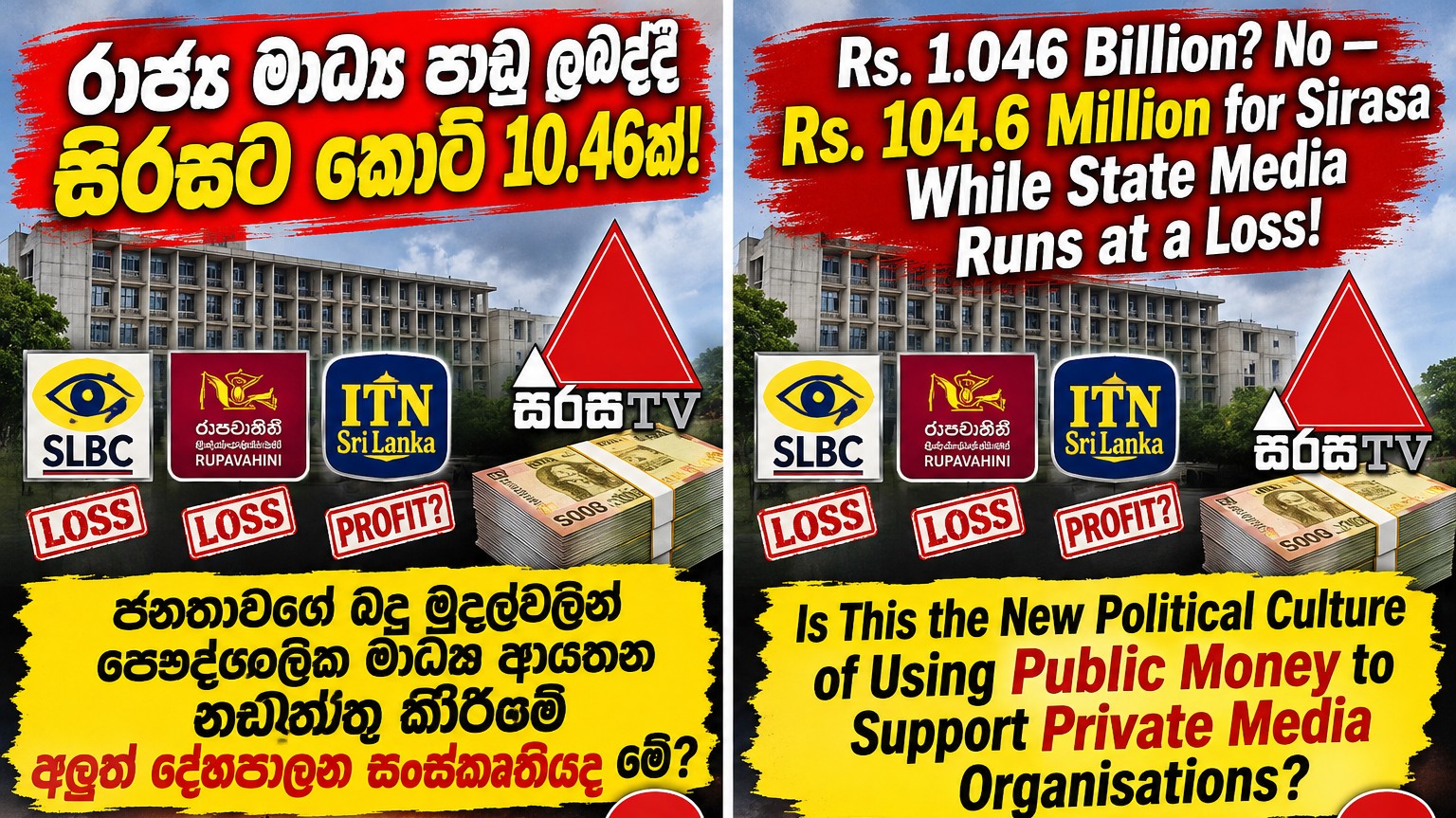
Is This the New Political Culture of Using Public Money to Support Private Media Organisations?
Who was it that once took to political platforms, loudly condemning the misuse of public funds under previous governments?
Who criticised the distribution of state resources on the basis of political affiliations?
Who came to power accusing previous administrations of wasting public money while state institutions were running at a loss?
It was the very same National People's Power (NPP) that is in government today.
But what are we witnessing now?
At a time when state-owned media institutions are struggling with financial crises, the government has granted Cabinet approval to allocate Rs. 104.6 million in public funds to a private media company.
Can this simply be dismissed as an ordinary government expenditure?
What Is the Situation of State-Owned Media?
First, let us examine the financial position of Sri Lanka's three state-owned media institutions.
According to their 2024 financial results:
The Sri Lanka Broadcasting Corporation (SLBC) recorded a loss of Rs. 137.254 million.
The Sri Lanka Rupavahini Corporation (National Television) recorded a loss of Rs. 255.482 million.
The Independent Television Network (ITN) reported a net profit of Rs. 24.788 million.
However, when ITN's other comprehensive losses are taken into account, its total comprehensive result also reflects a loss.
Accordingly, the combined net financial results of these three institutions amounted to a loss of Rs. 367.948 million in 2024.
The National Television Corporation's accumulated retained losses alone had risen to Rs. 1.763 billion.
These are not political talking points. They are figures that can be examined and verified through financial statements and audit reports.
1,607 Employees. Who Is Responsible for Their Future?
According to the 2024 Census of Public and Semi-Government Sector Employment:
The Sri Lanka Broadcasting Corporation employs 395 people.
The National Television Corporation employs 648 people.
The Independent Television Network employs 564 people.
That brings the total workforce of these three institutions to 1,607 employees.
The government has a significant responsibility to safeguard their employment, salaries, technological facilities, the future of these institutions and the continuation of their public service obligations.
Yet, what is the government's clear plan to improve their efficiency, introduce new technology and build their competitiveness in the international media industry?
Rs. 104.6 Million for Sirasa!
Now, let us examine the decision to allocate this money.
On 28 September 2026, Cabinet approval was granted to provide sponsorship funding of Rs. 104,603,876 to MTV Channel (Private) Limited.
That is approximately Rs. 104.6 million.
The funding is intended for the 63rd General Assembly of the Asia-Pacific Broadcasting Union (ABU) and its related programmes.
The approval provides for the funds to be channelled through the Sri Lanka Tourism Promotion Bureau.
There is another particularly important aspect to this decision.
According to reports concerning the proposal submitted to the Bureau's Board of Directors, it was proposed that funds originally allocated for promoting Sri Lanka through international television channels be reallocated to provide domestic media sponsorship.
If so, the questions become even more serious.
What measurable benefits will the country receive by redirecting funds originally intended for international promotion to a private media company?
Were other organisations given an opportunity to submit competitive proposals for this funding?
Were state-owned media institutions given an opportunity to participate in this initiative?
Were the expenditure estimates independently evaluated?
The public deserves answers to these questions.
The Issue Is Not Sirasa. The Issue Is the Government's Policy!
Let us make one thing clear.
Providing government sponsorship to a private media organisation is not inherently wrong. If hosting an international conference brings economic and promotional benefits to the country, such public investment may be justified.
However, the burden of proving that this decision is justified rests with the government.
Transparency becomes even more important when such a substantial allocation is made to a private media company while state-owned media institutions are struggling with financial difficulties.
There is another important concern.
When public funds are allocated to a private media organisation towards which sections of the public perceive the government to be favourably disposed, can the government expect such a decision to dispel doubts about media independence?
Can the government demonstrate that political affiliations or relationships between media organisations and those in power played absolutely no role in determining the allocation of public funds?
These are not baseless accusations. They are legitimate questions about the use of public money.
Five Questions the Government Must Answer!
What specific criteria were used to select the recipient of this Rs. 104.6 million sponsorship?
Was a competitive proposal or bidding process conducted before allocating these funds?
Were state-owned media institutions given an opportunity to participate in this initiative?
What specific mechanism has been established to measure the economic benefits the country is expected to receive from this expenditure?
What is the government's plan to revive the financially struggling state-owned media institutions?
The government must provide documented answers to all five questions.
Finally...
The National People's Power came to power promising to transform the old political culture.
But changing political culture does not simply mean replacing the individuals who held power under previous governments with a new set of people.
The way public money is spent must change.
Accountability towards state institutions must change.
There must be a level of transparency that dispels even the suspicion that political affiliations influence government decisions.
At a time when state-owned media institutions are facing financial crises, the government's decision to allocate public funds to a private media company, without adequately explaining the rationale and public benefits, raises a serious political question.
Public money is not the private wealth of the government. It is the money earned through the sweat, labour and taxes of ordinary people.
The government has a responsibility that goes far beyond political discretion when deciding who receives this money, why it is allocated and what the country receives in return.
If a government that came to power criticising the mistakes of its predecessors repeats those very mistakes in a different form, that is not systemic change. It is merely a change of those holding power.
What the people need is not simply a change in the name of the government, but a change in the standards of governance.
Whose money is this? And in whose interests is it being spent?
Demanding answers to these questions is our right.
Keerthi Lokubandara ✍️