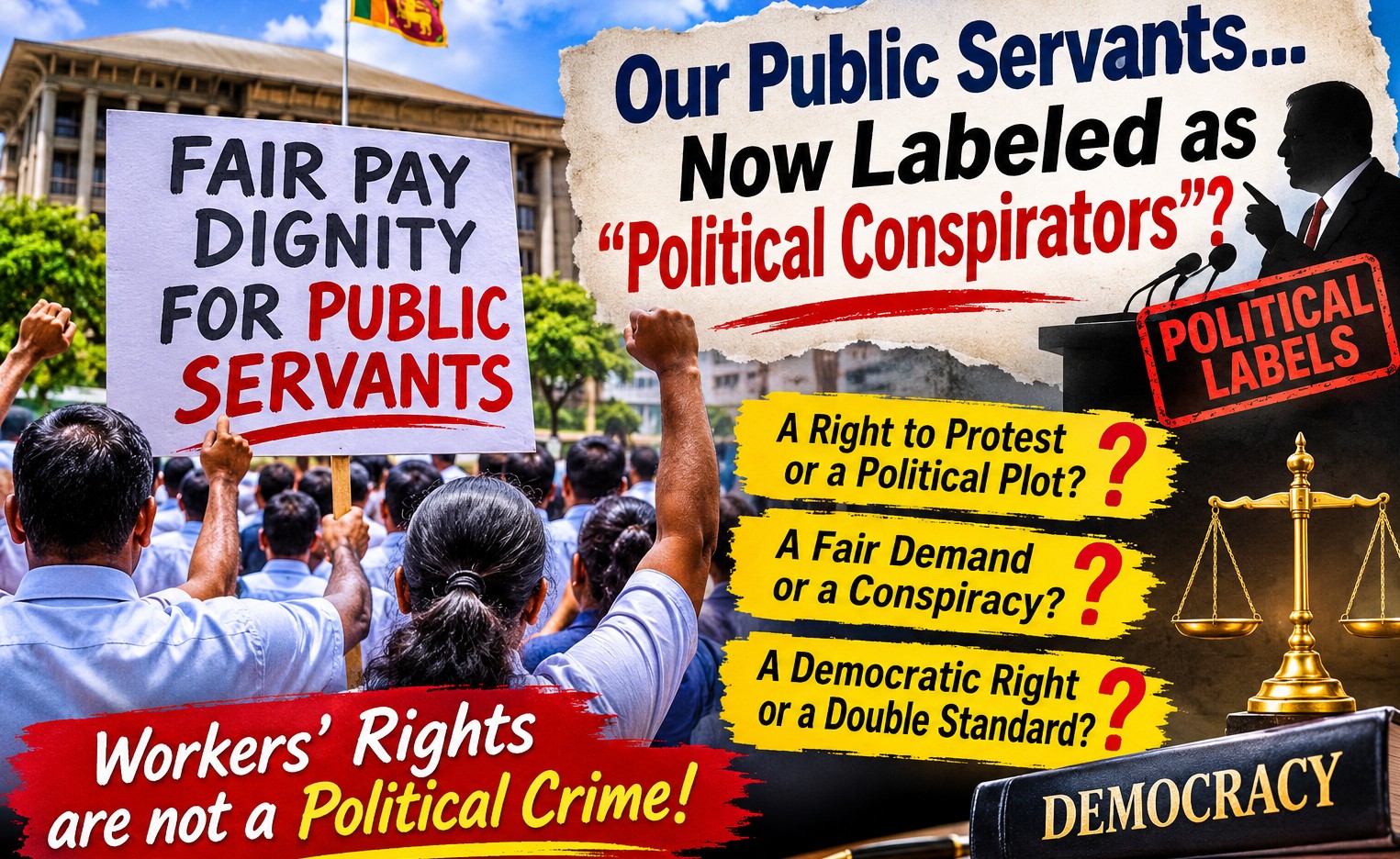
Public Sector Employees Take to the Streets After Budget Fails to Deliver Expected Relief!
Just days after the presentation of the 2027 Budget, the third budget of the National People’s Power (NPP) government, several public-sector trade unions have already launched industrial action.
What makes this situation particularly significant is that, despite the Budget proposing salary and allowance increases for public servants, several groups of employees have resorted to protests and strikes, claiming that the proposed relief is inadequate to meet their expectations.
This is not merely a dispute over allowances or salary increases. It raises broader political questions about the government’s budgetary policies, promises made to public-sector employees, disparities in benefits among different professional groups within the public service, and the government’s financial priorities.
Why Did Trade Union Action Begin Just Days After the Budget Was Presented?
On November 12, 2026, President Anura Kumara Dissanayake presented the 2027 Budget to Parliament.
However, from November 13 onwards, several public-sector trade unions began protests and industrial action over demands they say have not been addressed.
The situation reported by
November 16 was as follows:
Government engineers launched a token strike and protest over issues relating to field-duty and transport allowances.
More than 450 irrigation technical assistants joined industrial action.
Disaster relief officers took steps to withdraw their services.
Government veterinary officers announced a sick-leave campaign for November 17.
Several other public-sector trade unions prepared to hold joint discussions and decide on further action.
These developments cannot be dismissed as an isolated protest by a single trade union. They represent demands emerging from several different sectors of the public service. The government can no longer afford to ignore this situation.
The Gap Between the Government’s Salary Relief Measures and Employees’ Expectations
Chapter 35 of the 2027 Budget deals with public-sector salaries and pensions.
The government states that the revision of public servants’ basic salaries, initiated through the 2025 Budget, is being implemented in three phases, with Rs.110 billion allocated in 2027 for the final phase.
The Budget also proposes increases in special allowances for certain professions.
However, the Budget document itself acknowledges that it is not possible to revise all allowances at once. The government says that outstanding demands will be considered gradually in future budgets, depending on the country’s fiscal capacity.
The question that arises here is not simply whether all public-sector demands can be met immediately. The more fundamental issue is this: What criteria are used to determine which professional groups receive which allowances?
Have the nature of the work, workload, cost of living, expenses personally incurred by employees in carrying out their duties, and the legitimacy of their demands been adequately considered when making these decisions?
The government owes the public clear answers to these questions.
What Happened to the Rs.75,000 Allowance Demanded by Engineers?
One of the main demands of the Government Engineers’ Association is the reinstatement of a field-duty and transport allowance that was suspended in 2024. The monthly allowance they are seeking is Rs.75,000.
The association claims that this allowance had been paid to officers in the engineering service since 2012 and that discussions had previously taken place with the authorities regarding its reinstatement. However, it alleges that the 2027 Budget has failed to provide a solution to this demand.
Consequently, engineers have taken industrial action, including withdrawing from field inspections, overtime duties and certain coordination activities.
The government must explain the grounds on which the engineers’ demand was rejected. It must also clarify whether any prior agreement had been reached to reinstate this allowance and, if so, why that commitment was not reflected in the Budget.
Can the Demands of Irrigation Employees Be Ignored?
The demands made by irrigation technical assistants also deserve special attention.
Among their demands are an increase in the existing field allowance from Rs.300 to Rs.3,000 and the introduction of a monthly field transport allowance of Rs.15,000.
They point to the expenses they have to bear in carrying out duties such as maintaining irrigation systems, conducting field inspections and performing other operational responsibilities.
However, more than 450 officers have joined industrial action, stating that the 2027 Budget has failed to provide an adequate solution to their demands.
The fundamental question is whether it is fair to make employees personally bear the expenses incurred in carrying out official field duties. It is the government's responsibility to provide public servants with the facilities and resources necessary to perform their work.
The Industrial Action by Disaster Relief Officers Is Even More Serious
Among these industrial disputes, the protest by disaster relief officers is particularly concerning because of its potential direct impact on the public.
Disaster relief officers have reportedly launched an island-wide strike from November 16.
Their demands include reasonable allowances for repeated inspections of houses damaged by disasters, increased transport allowances, a reduction in excessive workloads, and solutions to administrative problems within the Disaster Relief Services Centre.
The association claims that an officer receives only around Rs.100 for inspecting a house, while the monthly transport allowance is just Rs.3,000.
Deputy Minister of Defence Aruna Jayasekara had also stated that discussions had taken place with the Ministry of Defence regarding these demands, but no final agreement had been reached.
Providing relief to people affected by disasters is one of the government's fundamental responsibilities. If the problems relating to the working conditions and allowances of the officers responsible for delivering that assistance remain unresolved, it is ultimately ordinary disaster-affected citizens who will suffer.
This is a matter of considerable seriousness.
Can the Problems Faced by Government Veterinary Officers Also Be Ignored?
The Government Veterinary Officers’ Association has also announced an island-wide sick-leave campaign for November 17.
The association points out that although the approved cadre consists of 931 officers, only around 600 are currently serving.
As a result, a smaller number of officers are being required to handle a disproportionately large workload. The association says that although it requested an additional-duty allowance to address this situation, the Budget has failed to provide an adequate solution.
The officers have also warned that if their demands continue to be ignored, they may take further action, including withdrawing from development programmes scheduled for 2027.
This is not merely a salary dispute involving public servants. It is also connected to animal health, agriculture, dairy production and food security.
Are There Disparities in Allowances Within the Same Public Service?
Attention must also be paid to the allowances proposed under the 2027 Budget.
The government has proposed increasing the allowances of medical officers from Rs.70,000 to Rs.95,000 and raising the special-duty allowance for nursing officers from Rs.6,000 to Rs.12,000.
Additional allowances have also been proposed for university academics and certain officers in the judicial sector. Most of these revisions are scheduled to be implemented in phases from July 2027.
There is no reason to reject the need for increased allowances for these professions. Doctors, nurses, teachers, engineers, technical officers and field officers are all essential to the functioning of the country's public service.
However, if one group receives relief while the long-standing demands of another group are overlooked, there must be clear policy-based criteria to justify such decisions.
The issue is not that nobody should receive relief. The real question is whether fairness and equal treatment under a consistent policy framework are being ensured when benefits are distributed.
The Government’s Financial Constraints Are Real. But Can They Be Used to Escape Responsibility?
The government can put forward a reasonable argument. Public-sector salaries and allowances require substantial expenditure, and the country must also take into account its debt burden, interest payments and the fiscal discipline required under the IMF programme. Therefore, the government may argue that it cannot meet every demand at once.
It is also important not to overlook the allocation of Rs.110 billion in the 2027 Budget for the final phase of the public-sector salary revision.
However, that argument does not bring all of the government's responsibilities to an end.
It is the government's responsibility to explain the relationship between the promises made to public servants during the election campaign, the decisions taken after assuming office, and the budget proposals now being presented.
If the government cannot meet the demands of public-sector employees, it should publicly disclose the reasons, financial estimates and a clear timetable for addressing them.
Simply postponing unresolved demands until the next budget is not a solution.
Questions the Government Must Answer
In this situation, several important questions must be put to the government:
Before preparing the 2027 Budget, were the demands of all major public-sector trade unions formally and adequately considered?
As the engineers claim, had there been a prior agreement to reinstate the Rs.75,000 field allowance?
What criteria are used to increase allowances for one professional group while rejecting the demands of another?
Is there a definite timetable for revising the remaining allowances of public-sector employees?
What measures has the government taken to address the impact on the public caused by the unresolved demands of disaster relief officers?
When will solutions be provided to veterinary officers and other employee groups who are handling increased workloads with inadequate staffing?
Providing answers to these questions is a political responsibility of the government.
The Final Question: What Does Changing the System Really Mean?
The National People’s Power came to power promising to eliminate corruption and inefficiency and establish a new political culture based on fairness. Reforming the public service was also a major part of that promise.
However, reforming the public service does not mean refusing to listen to employees’ demands or postponing issues concerning their trade union rights until future budgets.
At the same time, it does not mean that the government must grant every demand made by every group.
The government's responsibility is to maintain a fair salary and allowance system while safeguarding fiscal discipline, provide the facilities necessary for public servants to perform their duties, and maintain open dialogue with trade unions.
The question today is not simply how much money the government has allocated to public servants. It is whether that money has been distributed fairly, whether the promises made have been fulfilled, and whether there is a credible programme to resolve the outstanding issues.
Can a government that speaks of changing the system bring about genuine change without addressing the legitimate grievances of the public servants who keep that very system functioning?
This is not merely a political question directed at the government. It is a question about the future of the country's public service and the quality of public services received by ordinary citizens.
Jayalathge Sunil Gamini ✍️