JVP Cornered Over the East Container Terminal!
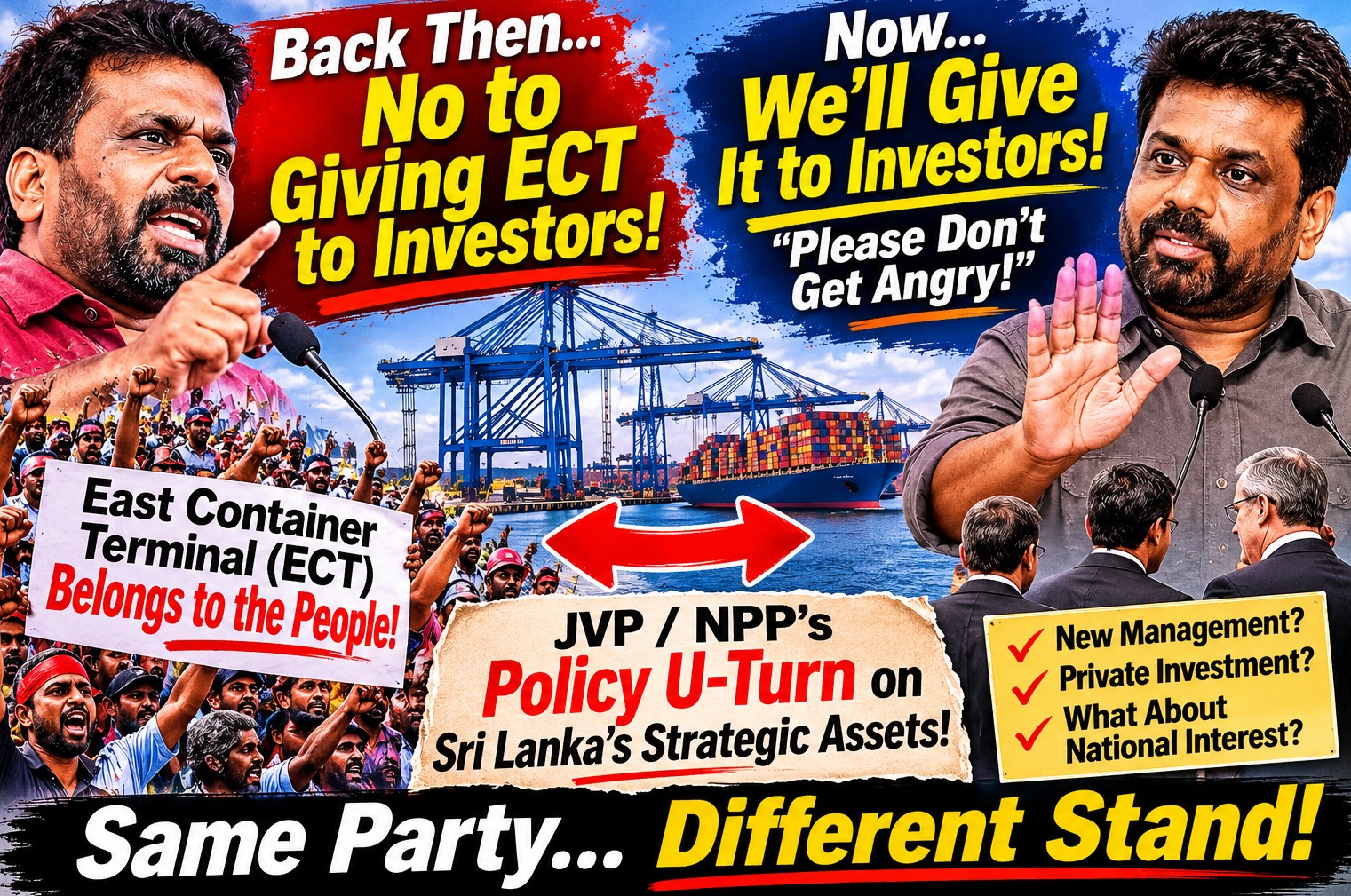
The struggle to protect national assets when out of power… The politics of changing policies after coming to power!
In politics, policies can change. It is not unusual for a country to revise its policies in response to changing economic conditions, technological requirements and the international economic environment.
However, political parties have a responsibility to explain to the public the differences between the positions they advocated before coming to power and the policies they implement once they are in government.
Today, the Janatha Vimukthi Peramuna (JVP) and the National People's Power (NPP) are facing precisely this serious political challenge.
Do You Remember the JVP's Struggle to Protect the East Container Terminal?
In 2016, when the Yahapalana government was preparing to hand over the East Container Terminal (ECT) of the Colombo Port to a private investor, the JVP launched a strong campaign against the proposal.
Anura Kumara Dissanayake, who was then the leader of the JVP, strongly criticised the proposal to hand over the East Container Terminal to a private investor.
What were the arguments the JVP presented to the public at that time?
• The port is a strategically important national asset.
• Transferring state assets to private investors is detrimental to the national economy.
• The East Container Terminal could be developed under the management of the Sri Lanka Ports Authority.
• The public and trade unions must fight to protect national assets.
These were the arguments the JVP put forward at the time.
Even in 2021, when the controversy surrounding India's Adani Group and the East Container Terminal erupted, the JVP did not abandon its opposition.
Anura Kumara Dissanayake strongly criticised the attempt to hand over the East Container Terminal to a foreign company. He also extended political support to protests by port workers and trade union campaigns.
At that time, the JVP presented itself as a political movement committed to protecting national assets.
What Is President Anura Saying Today?
Addressing the Labour Conference held in Colombo on 7 November 2026, President Anura Kumara Dissanayake made the following statement regarding the management of the port, including the East Container Terminal:
"If the port continues in this manner, we can keep saying that we have a port. But we cannot achieve a transformation. If we want to achieve a transformation, we must rethink the services provided by this port. Nobody should get angry. We will arrive at the right decision. We cannot continue with the old management mechanism of the port. These operations need to undergo new management and transformation."
The political significance of this statement is considerable.
Earlier, at an economic and investment summit, the President had also spoken about a plan to retain state ownership of the East Container Terminal while offering private investors shares in a separate company established to manage it.
In other words, the current government's position is to retain state ownership while introducing private investment and new management mechanisms.
This represents a policy shift that must be examined against the political campaign the JVP itself conducted among the public in the past.
How Did What Was Wrong Then Become Right Today?
The question we are asking is very simple.
The JVP once described the involvement of private investors in the East Container Terminal as a betrayal of national assets. On what grounds does it now justify private investment and changes to the management structure of the same terminal?
Were all the arguments it presented at that time wrong?
Did it mislead port workers, trade unions and the general public through its political campaign?
Who will accept political responsibility for the delays caused to the port's development process as a result of mobilising public opposition against investors?
In 2019, Sri Lanka, India and Japan reached a tripartite agreement to develop the East Container Terminal. In 2021, Sri Lanka withdrew from that agreement.
Domestic opposition and the influence of port trade unions were important factors in that decision.
However, we cannot say with certainty what the condition of the port would be today had that development plan been implemented. An alternative economic analysis and a proper cost-benefit assessment would be necessary to establish that.
Nevertheless, an open public discussion about the consequences of the political campaign conducted at that time is essential today.
Why Has the Government Reached the Point of Saying, "Nobody Should Get Angry"?
The most noteworthy part of the President's statement is:
"Nobody should get angry. We will arrive at the right decision."
Isn't the President effectively telling the trade unions that fought to protect the East Container Terminal that the government is now preparing to make a different decision?
The JVP, which once stood for the protection of port workers' rights and national assets, has now reached a position where it is asking those same workers to accept its new policy.
Therefore, port workers and trade unions have every right to demand answers to several important questions.
• To what extent will the powers of the Sri Lanka Ports Authority be restricted under this new management structure?
• What percentage of shares will be offered to private investors?
• Who will have the ultimate authority over management decisions?
• What will happen to the job security of port employees?
• What economic benefits will the state receive?
• Will the agreements relating to these arrangements be made available to the public and Parliament?
Asking these questions does not mean opposing national development. It is an essential part of democratic accountability.
There Is a Right to Change Policies, But No Right to Deceive the People!
Let us make one thing clear once again: we are not arguing that private investment should be opposed.
If the efficiency of the public sector needs to be improved, modern management methods should be introduced. Port services must be developed to meet the demands of international competitiveness.
However, if the government is now adopting a policy that it previously criticised, it must provide answers to the arguments it made in the past.
If the JVP has changed its longstanding political position, it must officially explain that change to the public.
If its previous criticisms were wrong, it must acknowledge that.
If the public was presented with an incomplete or misleading picture at the time, the party must also accept responsibility for that.
If the government now believes that new management is necessary, it must also answer the arguments against private-sector involvement and alternative management arrangements that the JVP itself advanced in the past.
Finally, We Have Just One Question!
Anura Kumara Dissanayake, who once went before the public opposing the involvement of private investors in the East Container Terminal, is now justifying private investment and changes to its management structure as President.
The JVP, which once fought to protect national assets, has now changed its own longstanding political position.
Therefore, the people of this country, particularly the port workers and trade unions who participated in those earlier struggles, deserve an answer from the President.
Were you wrong to oppose it then?
Or are you doing today exactly what you once condemned as wrong?
If what you told the people then was wrong, admit it.
If what you are doing today is right, prove it.
Politicians cannot win power by misleading the public through their words and promises before an election.
The people do not want one policy when a party is in opposition and an entirely different policy when it comes to power.
What the people deserve is a government that stands by the same principles, the same political integrity and the same accountability, whether it is in power or in opposition!
Jayalathge Sunil Gamini ✍️