Is the PTA abrogation? Is it a control over media freedom and trade union struggles?
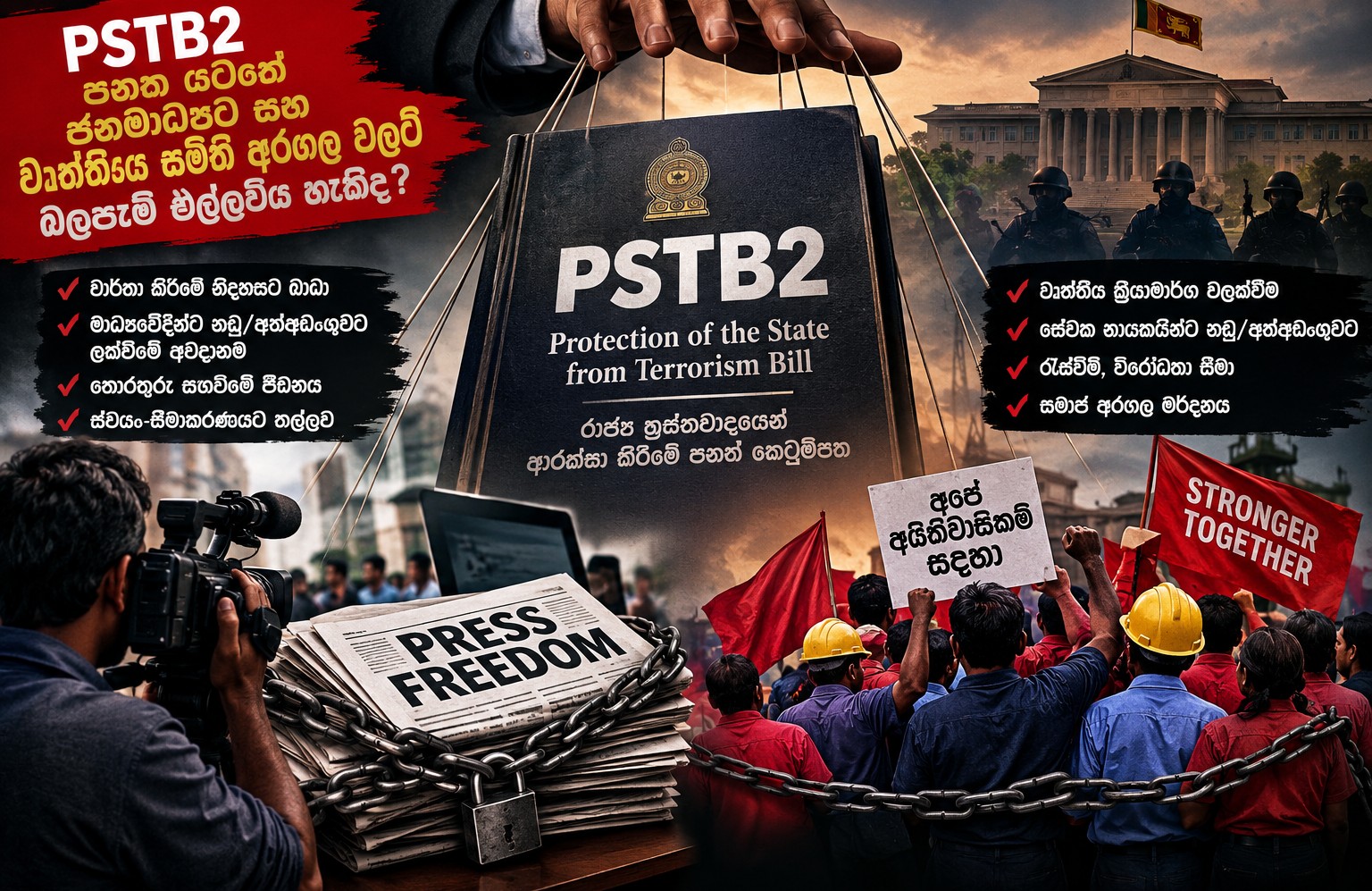
The discussion about bringing a new law to replace the Prevention of Terrorism (Temporary Provisions) Act No. 48 of 1979 (PTA), which has been heavily criticized for decades in Sri Lanka, has resurfaced.
The stated objective of the amended Protection of the State from Terrorism Bill (PSTB2), issued on September 22, 2026, is to introduce a new counter-terrorism legal framework to replace the PTA.
The government side says that this is a correction of the shortcomings of the old law and the introduction of new protection mechanisms.
But the question is, is it enough to just remove the name PTA?
The more important question is,
What are the special powers that the state will receive?
Under what circumstances can they be used?
Is there prior judicial oversight?
What is the risk to a journalist, a trade union leader or a protester under the law?
These are.
What is terrorism?...
The most important aspect of a counter-terrorism law is the definition of the word “terrorism”.
The new draft has attempted to bring several parts of the definition of terrorism closer to international standards. But critics point out that the definition of terrorism also includes broader categories such as acts that pose a risk to state property, the environment, cultural property, electronic systems and public health.
In particular, Ambika Satkunanathan points out that for such property damage to be considered terrorism, there must be clear limits such as a high level of danger to life or a large economic loss.
Ambika Satkunanathan is a prominent human rights lawyer, researcher and human rights activist in Sri Lanka. She has worked specifically on counter-terrorism laws, arrest and detention, prison reform, torture, militarization, transitional justice and gender.
She points out that the absence of the above limitations allows for a broader definition. This is a very important legal point.
Because if the line between a “terrorist act” and a “serious crime” becomes blurred, there is more scope for the application of special powers under counter-terrorism law to an ordinary crime.
The problem with freedom of the press..
One of the important points of the new draft is the protection that journalism, research, satire, political criticism, advocacy and dissent do not constitute terrorism in themselves. This is an important protection.
But at the same time, attention should be paid to Articles 9 and 10.
Article 9 criminalises statements, words, signs or visual representations related to terrorism “encouragement”, while Article 10 creates offences related to acts including the distribution and electronic transmission of “terrorist publications”.
The question that then arises is simple: is a journalist reporting terrorism?
Or is he inciting it?
If the line between the two is not clearly drawn, there could be legal risks to media activity.
The new draft law includes protections for good-faith journalism and public-interest reporting, so not every media report will become a terrorism offence. That should be made clear.
But is that protection in practice a protection that applies before arrest, or a protection that can be presented in court after arrest?
This is a fundamental question that needs to be asked in the drafting of legislation.
What happens to the journalist’s source?......
Today’s journalism is not just a newspaper and a camera.
The journalist’s laptop, mobile phone, memory card, cloud account, encrypted communication and messaging with the source are all professional tools.
The new Bill’s provisions on search, seizure and obtaining information from telecommunications/data service providers raise questions about digital journalism and source confidentiality.
Analysts also point out that the power to unlock encryption that was in the 2025 bill has been removed from the revised bill. That is a change.
But the powers of investigation related to digital devices and communications still remain.
So the question is, “Is the law strong enough to protect a journalist’s source of information?”
Is it a crime to withhold information?..
Another sensitive point is Section 15.
Under the new Bill, failing to provide information required by law while knowingly committing a terrorism offence could be a criminal offence. A significant prison sentence has also been proposed for such an offence.
Think about the nature of the journalism profession here.
What if a journalist receives information from a confidential source?
What if a lawyer receives information from his client?
What if a doctor receives information from a patient?
Clear safeguards are needed to deal with situations where such professional secrecy and state security law may conflict. Critics have drawn particular attention to this risk.
And what about trade union struggles?..
This is another important part.
The new Bill does not say that going on a strike = terrorism.
Instead, there is a safeguard that protests, strikes and trade-union activity do not constitute terrorism on their own.
But the issue does not end there.
Powers to restrict assembly...
Under Section 51 of the new Bill, orders can be obtained to restrict certain meetings, assemblies, processions or other activities.
Furthermore, the latest legal analysis states that there is a way for the police to act without a prior order from a magistrate and then seek court approval in a situation considered to be “urgent national security”.
This raises a very serious question regarding trade union struggles.
For example,
What if port workers go on strike demanding a pay rise?
What if electricians protest over working conditions?
What if teachers hold a meeting over wages or working conditions?
Even if the trade union struggle itself is not terrorism, can other powers be used to restrict meetings, demonstrations or related activities?
That is a question that needs to be asked after reading the Bill.
Police powers for the military...
A major criticism of the new Bill is that it grants the arrest and search powers of the police to the armed forces and the coast guard.
According to a recent legal analysis, military/coast guard officers have reasonable There are provisions that grant powers such as arrest, search, stop, custody of materials and questioning of persons on suspicion.
The question here is not whether the military should be assisted in preventing terrorism.
The question is, “To what extent should the military be given general law enforcement powers?”
This limit should be very clear, especially in cases involving journalists, trade union activists and ordinary protesters.
Does changing the PTA mean removing all the powers of the PTA?...
No. The new Bill still has special powers such as detention orders, restraining orders, search powers, arrest powers, prohibition of organizations and restrictions on assembly.
Along with this, several judicial safeguards have been increased.
Therefore, it is neither correct to say
“Nothing has been changed in the PTA”
nor to say “the PTA has been completely changed”.
The right questions to ask That is:
What was removed from the old powers?
What was amended?
What is still retained?
What new powers were added?
Is their exercise subject to judicial review?
Powers to restrict assembly...
Under Section 51 of the new Bill, orders can be obtained to restrict certain meetings, assemblies, processions or other activities.
Furthermore, the latest legal analysis states that there is a way for the police to act without a prior order from a magistrate and then seek court approval in a situation considered to be “urgent national security”.
This raises a very serious question regarding trade union struggles.
For example,
What if port workers go on strike demanding a pay rise?
What if electricians protest over working conditions?
What if teachers hold a meeting over wages or working conditions?
Even if the trade union struggle itself is not terrorism, can other powers be used to restrict meetings, demonstrations or related activities?
That is a question that needs to be asked after reading the Bill.
Police powers for the military...
A major criticism of the new Bill is that it grants the arrest and search powers of the police to the armed forces and the coast guard.
According to a recent legal analysis, military/coast guard officers have reasonable There are provisions that grant powers such as arrest, search, stop, custody of materials and questioning of persons on suspicion.
The question here is not whether the military should be assisted in preventing terrorism.
The question is, “To what extent should the military be given general law enforcement powers?”
This limit should be very clear, especially in cases involving journalists, trade union activists and ordinary protesters.
Does changing the PTA mean removing all the powers of the PTA?...
No. The new Bill still has special powers such as detention orders, restraining orders, search powers, arrest powers, prohibition of organizations and restrictions on assembly.
Along with this, several judicial safeguards have been increased.
Therefore, it is neither correct to say
“Nothing has been changed in the PTA”
nor to say “the PTA has been completely changed”.
The right questions to ask That is:
What was removed from the old powers?
What was amended?
What is still retained?
What new powers were added?
Is their exercise subject to judicial review?
In the end, there is only one question...
A law is needed to protect the state.
But is the law that protects the state the same law that protects the citizen who criticizes the state?
Is the distinction between a terrorist and a journalist clear?
Is the distinction between a violent group and a trade union clear?
Is the distinction between terrorist propaganda and investigative journalism clear?
Is the distinction between violent rebellion and peaceful protest clear?
If these boundaries are clear, there is less risk of a counter-terrorism law becoming an anti-democratic law.
But if those boundaries are unclear, the interpretation of the law enforcement officer gains great power.
Then a law that can be used against an opposition journalist today can be used against a government critic tomorrow.
A power that can be used against a trade union today can be used against another trade union tomorrow.
Therefore, the question is not only “Will this government use these powers well?”
The more important question is,
“Even if any future government misuses these powers, are there sufficient legal barriers in this bill to protect the citizen?”
It is not enough to replace the PTA with a new name.
The law must change.
Even more important is the change in the safeguards that limit state power.
It is not determined by the name, but by the clause, the powers and the judicial protections against them.
It is certain that it is the duty and the serious responsibility of every citizen to pay sharp social attention to the amended Protection of the State from Terrorism Bill (PSTB2) issued on September 22, 2026, which has not yet become a law.
Jayalathge Sunil Gamini ✍️