Increasing the retirement age and the independence of the judiciary!
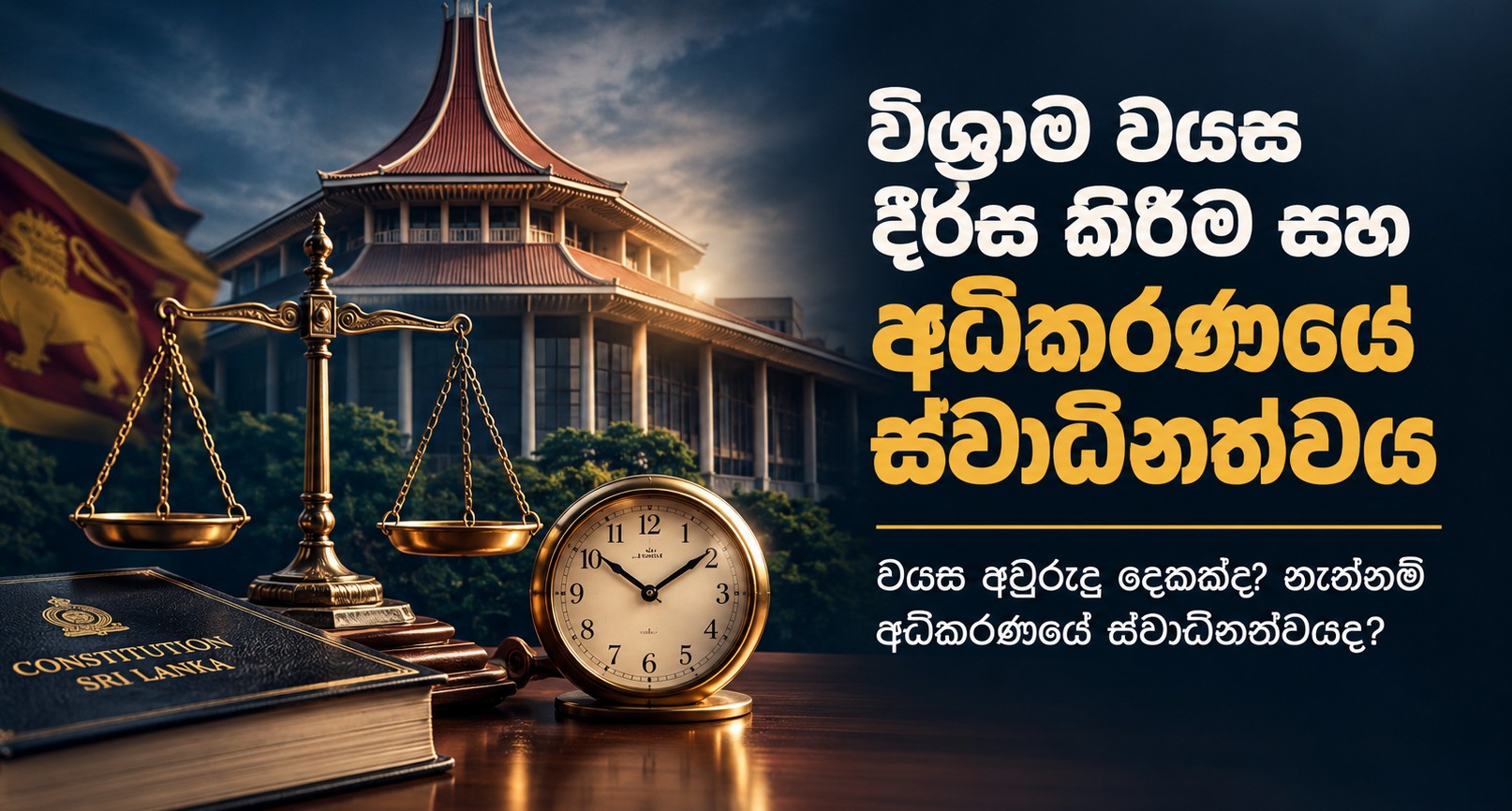
Looking at the debate that has arisen in the country today about the 22nd Amendment, some people have reduced it to a very simple question.
“What happens when the retirement age of judges is increased from 65 to 67?”
“Increasing the age is also done in other countries of the world.”
“In the United States, Supreme Court judges can hold office for life.”
“The retirement age has also been increased in England.”
All these are debatable issues.
But these are not answers to the real constitutional question of this constitutional amendment.
The fundamental question is this.
Can the retirement age of a judge who is in office today be increased later through a constitutional amendment, and given an additional term of office?
If it is possible, it is not just a matter of “increasing the retirement age.”
It becomes a change in the security of tenure and tenure of judges already in office.
First, an important point to clarify.....
Changing the retirement age of judges through a constitutional amendment is not illegal in itself.
The current government is proposing to increase the retirement age of Supreme Court judges from 65 to 67 years and that of Court of Appeal judges from 63 to 65 years.
Since such an age limit is in the constitution itself, it is normal that a constitutional amendment is required to change it.
Therefore, it is not correct to say that “increasing the retirement age of judges alone makes it illegal.”
But the real problem begins with the question of who will be affected by this new retirement age?
Who will be affected by this new retirement age?.....
Does this new retirement age only affect future judges? Or with the judges who are already in office?
This is where the whole constitutional crisis lies. If a judge is legally required to retire at the age of 65, and after his appointment, the law is changed and
“Now you can stay in office for another two years,” it is not a law that affects only the future. It is a law that affects the tenure of a person who is already in office.
It is a serious mistake to dismiss this issue by saying “just two years were added” without understanding this difference.
What has the Supreme Court itself said about this before?.....
This is not just the opinion of a political party or a bar association.
In its decision in the case of In Re Inland Revenue (Amendment) Bill — S.C. S.D. Nos. 64–71/2022 of 2022, the Supreme Court has stated a very important principle.
It was stated that an amendment to the Constitution that changes the retirement age or tenure of judges in a manner that directly or indirectly affects the judges currently in office affects the independence of the judiciary and requires a referendum as it violates Article 3.
The same principle has been cited in another Supreme Court judgment. The principle of the judgment of 2022 In Re Inland Revenue (Amendment) Bill, S.C. (S.D.) Nos. 64/2022–71/2022 is the judgment cited later;
Justice A.H.M. Upaly Abeyrathne v. A. Jagath D. Dias & Others — SC/FR/282/2018.
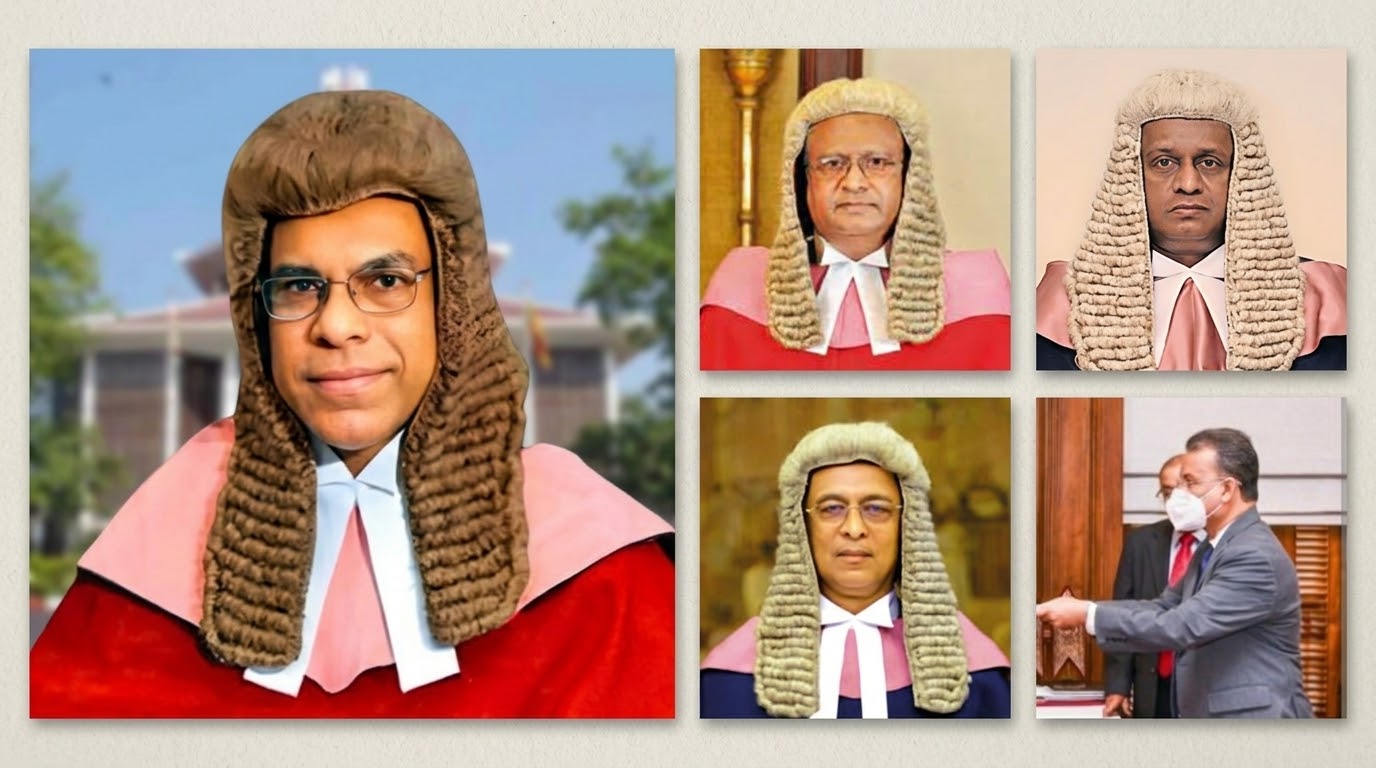
The judgment in this case was delivered on 14 January 2026. The bench consisted of S. Thurairaja PC J., A.L. By Shiran Gooneratne J. and Mahinda Samayawardhena J. (dissenting). (Supreme Court)
Here, at paragraph 104, the principle of the 2022 Inland Revenue case is directly quoted.
“Any Constitutional amendment to the retirement age or the period of office impacting on incumbent judges, whether directly or indirectly, will impinge on the independence of the judiciary and [be] violative of Article 3 which requires a Referendum.”
This is stated at page 40, paragraph 104 of the judgment in SC/FR/282/2018.
(Supreme Court +1)
Another important point....
Paragraph 103 of the 2026 judgment also mentions another old case, In Re Industrial Disputes (Special Provisions) Bill — S.C. (S.D.) No. 30/2022. The 2026 judgment states that “Sovereignty” in Article 3 includes the right to an independent judiciary.
Therefore, today we are not asking a new question. Does a principle previously stated by the Supreme Court apply to the 22nd Amendment?
Why is Article 3 important?...
Article 3 of the Constitution of Sri Lanka recognizes the fundamental principle of people’s sovereignty.
One important aspect of that people’s sovereignty is the judiciary.
Therefore, a constitutional amendment that has a serious impact on the independence of the judiciary can be linked to Article 3.
Then the need for a referendum under Article 83 may arise.
Therefore, the question here is not, “Is the age 67 or 65?”
The question is, “Can the security of tenure that protects the independence of the judiciary, which exercises the judicial power of the people, be changed after a political majority?”
For those who ask, “How can judicial independence be compromised?”
Let’s understand this very simply.
In order for a judge to be able to give independent decisions, he or she must have security of tenure.
If a judge feels insecure about his or her position, it can create an environment that affects judicial independence.
Therefore, judicial independence is not just a question of, “Are judges good people?”
It is a question of, “Can a judge give a decision without political influence and with security of tenure?”
There is another very sensitive issue....
If a law extends the tenure of the judges currently in office, who will have to decide the constitutionality of that amendment? The Supreme Court.
Then another question arises. If the decision can benefit the tenure of the existing judges themselves, does it not raise a question of institutional impartiality?
The principle of law, nemo judex in causa sua, compels us to think about such situations.
This is not an accusation that any judge is personally biased.
It is a question of public confidence in the system.
It is not enough for the judiciary to be independent. The public also needs to see that the judiciary is independent.
The government's argument should also be heard...
If it is a reasonable criticism, even the argument that one does not like should be mentioned.
The government and the Attorney General have indicated that this amendment is part of a reform aimed at increasing the efficiency of the judiciary, retaining experienced judges and reducing the backlog of cases.
The Attorney General has argued in the Supreme Court that the proposed amendment does not change the entrenched provisions requiring a referendum under Article 83, and that the petitioners have not legally shown how Articles 3 and 4 are violated.
This is a reasonable legal argument that the government can present. But it is not the final answer. Because the fundamental question before the 2022 Supreme Court doctrine still remains.
Is the argument that “other countries have also increased the retirement age” sufficient?..
The retirement age of judges in another country to 70, 75 or higher does not change the Constitution of Sri Lanka.
Constitutional provisions such as Article 3, Article 4, Article 83 and Article 107 of the Constitution of Sri Lanka should be interpreted in their own context.
The system of England is for England.
The system of America is for America.
The answer to the question of Sri Lanka should be sought through the Constitution of Sri Lanka.
So, is “increasing the retirement age” completely wrong?...
Changing the retirement age of judges is not impossible at all.
It can be done by following the legal process, obtaining the required majority in the constitution and, if necessary, a referendum.
However, giving the judges who are currently in office additional terms that were not available when they took office is a separate issue. This is the heart of the entire debate.
A future judge and an existing judge are not the same..
Let’s look at this with another simple example.
Today’s law says:
“A judge must retire at the age of 65.”
A person becomes a judge knowing that law. Then the law is changed and says, “Now the retirement age is 67.”
It is one thing to apply it to the next judges who are appointed. But it is another thing to say, “You who are already in office, two more years.”
The new law does not only govern future appointments. It also affects the current tenure.
That is why the concepts of “incumbent judges” and “directly or indirectly” in the 2022 Supreme Court doctrine are so important.
There is a bigger issue than the age of 67…
Today, the retirement age of a judge has been raised to 67. Tomorrow, another government may come to power and say
“Let’s extend the tenure of judges by two more years.”
The next government may come to power and say “three more years.”
What will happen if political power starts changing the tenure of judges?
Then the basic defense of judicial independence may be weakened.
Judicial independence is not just a privilege of a few judges today. It is a protection for every citizen of the country.
Not for a judge today, but for you tomorrow...
When talking about judicial independence, some people ask, “What will happen to us if we extend the term of judges by two years?”
The answer to that question is very simple.
You may have a case with the government.
You may have a case related to your land.
You may have a case related to your business.
You may have a problem with a state institution.
You may have been wronged and have to go to court.
Then you need a judiciary that is independent of political power.
Therefore, protecting judicial independence is not just about protecting judges. It is about protecting the people.
Here are some questions that the government needs to ask...
First,
Does this new retirement age apply to judges currently in office?
Second,
If it does, is it clearly stated in the constitution?
Third,
Isn’t extending the tenure of sitting judges contrary to the 2022 Supreme Court Principles?
Fourth,
Wouldn’t it affect the sovereignty of the people under Article 3?
Fifth,
If there is such an impact, why is there no need for a referendum under Article 83?
Sixth,
What is the answer to the question of the institutional impartiality of the judiciary regarding an amendment that would benefit the current judges themselves?
Instead of answering these questions, it is not enough to simply say, “Our goal is the efficiency of the judiciary.”
What is the price to pay to solve the backlog of cases?...
The backlog of cases in the country is a big problem.
If there is a shortage of judges, it must be solved.
Judicial efficiency must be increased.
New judges must be appointed.
Technology must be used.
Case management must be improved.
Judicial infrastructure must be increased.
Legal procedures must be simplified.
All these must be done.
However, simply presenting the argument that “cases are delayed, so let’s extend the tenure of the existing judges”
does not end the fundamental issue of judicial independence.
Should the filing of 67 petitions also be ignored?
67 petitions were taken up for hearing before the Supreme Court regarding the proposed 22nd Amendment.
The request for a full bench was rejected and the hearing was held before a five-judge bench.
The bench concluded the hearing on September 2 and informed the Speaker that the decision would be forwarded to him in secret.
One thing is clear.
This is not a simple matter that can be dismissed as a simple administrative amendment.
Whatever the final decision, there is something we need to remember...
When the Supreme Court has not yet announced its final constitutional decision on this issue to the country, it is not right to say, “This is definitely illegal.”
It is also not right to simplify the issue by saying, “It is just an increase of two years; there is no problem.”
The correct position is that the change in the retirement age itself is not illegal. But if that change affects the tenure of judges currently in office, it is a serious constitutional issue in terms of judicial independence, Article 3 and the need for a referendum.
The question we should be asking in this debate is not, “What if the retirement age of judges is increased by two years?”
The question we should be asking in this debate is,
“Can the tenure of a judge who is already in office be extended by a political majority beyond the law that existed at the time of his appointment?”
If it can be done, where is the limit?
If it cannot be done, how can we clearly ensure that the 22nd Amendment does not apply to current judges?
This is where the real constitutional debate lies.
What needs to be understood is…
The judiciary is not the property of the government.
The judiciary is not the property of the opposition either.
Judges should not be the property of any political party.
The judiciary belongs to the people.
Therefore, protecting the independence of the judiciary is not about protecting the personal interest of any judge. It is about protecting the fairness that you will receive when you appear before the court tomorrow.
If a judge who is favorable to the government in power today can have his term extended, can another government that comes to power tomorrow use the same system for judges who are favorable to it?
That is the question we should fear.
Judicial independence will not be destroyed in one day.
It happens when small justifications like, “What will happen with this?”
“It’s only two years.”
“Other countries have them too.”
“The government has a good intention.” accumulate one after another.
Therefore, what we need to protect today is not an age limit for judges.
What we need to protect is the public’s trust that the judiciary will make decisions independently of political power.
The question is not whether it is 65? 67?
The question is whether a judge's security of tenure can be changed later by political power.
ඝThe answer to that question will affect not only the judges of today,
but also the rights of every citizen before the courts of Sri Lanka tomorrow.
Jayalathge Sunil Gamini ✍️