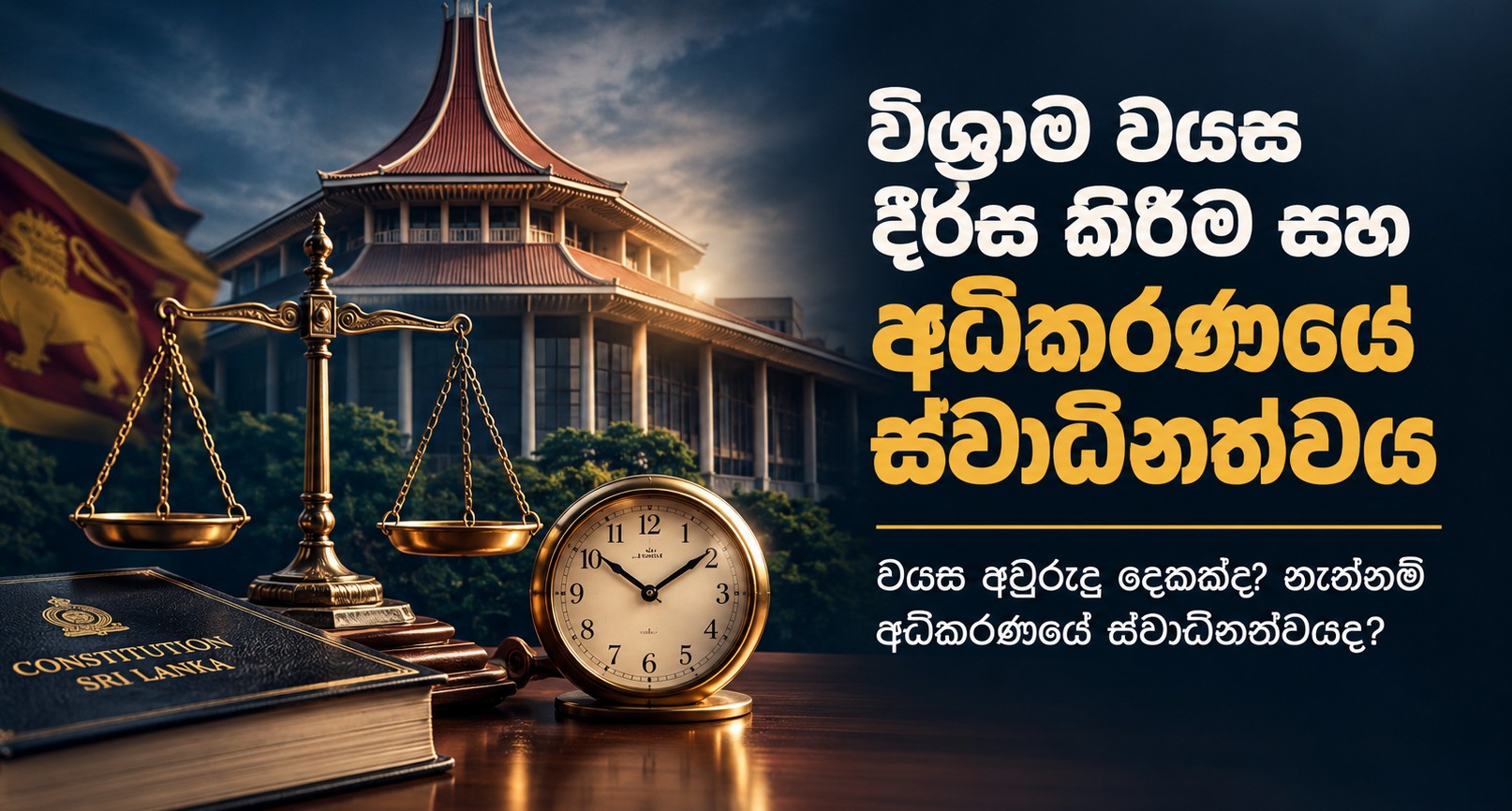
How can we say that judicial independence is not affected?
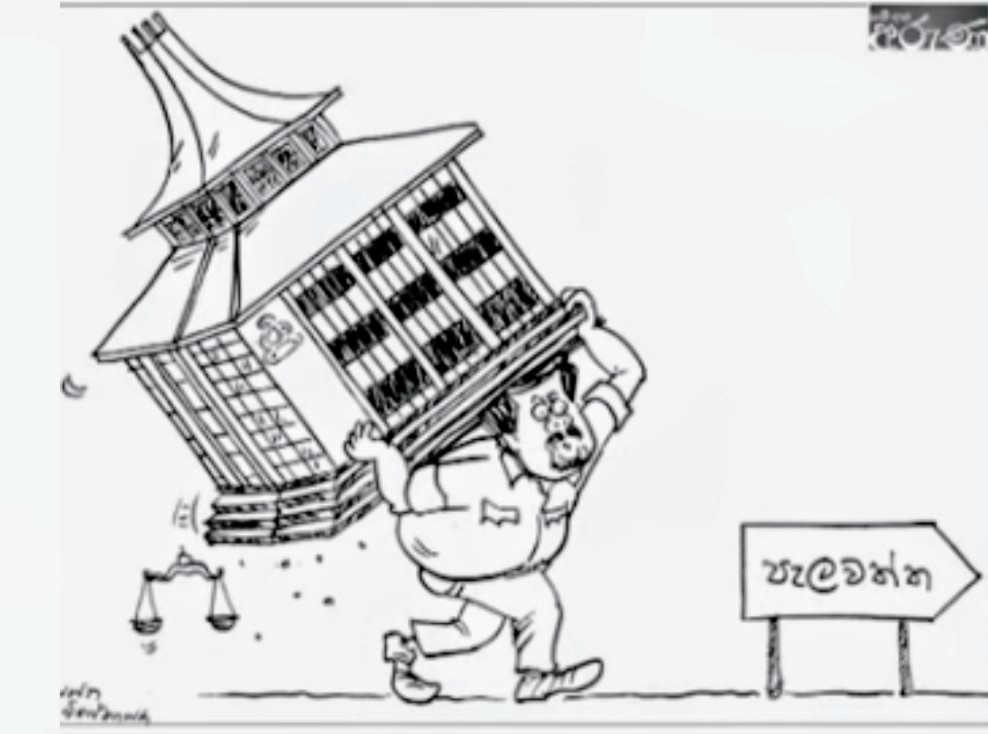
There is a serious question that arises when we read the Supreme Court’s decision in 2022 and the “22nd Amendment” decision in 2026 together.
The Supreme Court’s decision regarding the 22nd Amendment to the Constitution of Sri Lanka was notified to Parliament on 22 September 2026.
The main statement there was that the 22nd Amendment Bill or any part thereof does not need to be approved by a referendum under Article 83 of the Constitution. It can be passed by a special majority in Parliament.
But is it legally justified to conclude from here that “there is no problem with judicial independence”?
That is where the question lies.
Can we forget what the Supreme Court said in 2022?...
In 2022, in the Inland Revenue (Amendment) Bill (SC SD 64–71/2022), the Supreme Court made a very important observation on the relationship between the tenure of judges and judicial independence.
The court clearly stated that a constitutional amendment that changes the retirement age or tenure in a way that directly or indirectly affects the judges currently in office affects the independence of the judiciary. The court clearly stated that it conflicts with Article 3 and that in such a situation a referendum is required.
The important words used there are,
“impacting on incumbent judges, whether directly or indirectly” (“அமன்மன் பார்குத்தியார்குத்தியார்கு அதுமன் The meaning is clear. It does not mean “only if the retirement age of judges is reduced”, but changing the retirement age or period of office in a way that directly or indirectly affects the judges currently in office is an issue that affects judicial independence.
What is this 2022 case.....
The case In re Inland Revenue (Amendment) Bill – SC SD 64–71/2022, if briefly stated, is as follows.
The Supreme Court considered whether several provisions of the Inland Revenue (Amendment) Bill introduced in 2022 were in accordance with the Constitution.
The Supreme Court explained that changing the retirement age or period of office of judges, especially if it affects the judges currently in office, is a matter that affects judicial independence.
The ruling stated that such a change would affect the sovereignty of the people under Article 3 of the Constitution, and therefore a referendum under Article 83 may be required to make it happen.
The particularly important words are, “impacting on incumbent judges, whether directly or indirectly.”
Simply put, changing the tenure/retirement age of judges to affect incumbent judges = a constitutional issue of judicial independence = an issue of Article 3 and a referendum.
So what will happen in 2026?......
A key proposal in the 22nd Amendment Bill introduced in 2026 was to increase the retirement age of Supreme Court judges from 65 to 67 and that of Court of Appeal judges from 63 to 65.
Moreover, a 6-year term was also proposed for the Chief Justice.
Accordingly, the fundamental question was,
Would the subsequent change in the legal status of the tenure of the judges currently in office at the time of appointment not be applicable to the principle of “incumbent judges” identified by the Supreme Court in 2022? This is not a trivial question.
Can the question be concluded by saying “only the age has been increased”?....
This is the most important point in the discussion on the 22A Constitutional Amendment.
“Increasing the retirement age from 65 to 67 does not reduce the tenure of a judge, so it does not harm judicial independence,” one might say. This is one legal opinion.
In fact, the lawyers appearing for the government in the 22A trial also made similar arguments. The government side pointed out that the proposed amendment does not reduce the power of the judiciary and is aimed at increasing the efficiency of the judiciary.
But the other side asks a different question.
“Does not changing the legal status of the constitutional tenure of a judge currently in office after his appointment affect that tenure?” they ask.
The question is whether the words “directly or indirectly” used in the 2022 judgment can completely ignore this issue.
Another important point of the 2022 judgment.....
The 2022 judgment is not just about the retirement age. Its basic idea is that the security of tenure of judges is part of judicial independence.
For a court to be independent, a judge should not have unusual political influences or uncertainty about his position that changes at the whim of the rulers.
Therefore, retirement age is not simply an administrative number of “age”. It can be seen as a matter related to the security of tenure provided to the judge by the Constitution.
So what does the 2026 Supreme Court say?...
According to the determination notified to Parliament by the Speaker on September 22, 2026, no part of the 22nd Amendment is in a position to require a referendum under Article 83.
The Supreme Court has also made two amendments to Clause 2.
One of them is particularly important in relation to the Chief Justice.
A second proviso should be added that the proposed 6-year limit shall not apply to a person who is in office as Chief Justice on the date of commencement of the Act.
This is a very important point, because it shows that the Supreme Court has not completely ignored the issue of the tenure of the current Chief Justice.
So what is the real issue between 2022 and 2026?...
In 2022, the Supreme Court had recognized the direct link between judicial independence and the tenure of the current judges. It had linked Article 3 and the need for a referendum.
In 2026, the Supreme Court decided that the principle did not require a referendum for the full 22A. Therefore, the reasoning given in the 2026 Full Determination that the 2022 principle does not apply to 22A is the center of this legal debate.
Herein lies the issue that society needs to clarify.
In 2022, the Supreme Court, which said that “the retirement age/office revision period for current judges affects only judicial independence,” said why the retirement age change from 65 → 67 in 2026 does not reach the limit of Article 3 / Article 83?
The full legal reasoning for it should be clear to the public.
Does “no referendum required” mean “no impact”?...
No. These two are not the same issue.
Whether a referendum is required under Article 83 is a question of a constitutional limitation.
Whether there is an impact on judicial independence is a question of a constitutional principle. Although the two are related, they are not the same sentence.
Therefore:
“22A does not require a referendum. Therefore, there is no issue of judicial independence.” The argument does not flow logically automatically.
For that, it must first be explained on what legal basis the 2022 precedents are changed by the 2026 Bill.
Another important point...
There is a very important legal limitation here.
The main conclusions of the Supreme Court's determination were announced to Parliament on September 22, 2026.
The Speaker has ordered that the Full Determination be printed in the Official Record of Parliament.
Therefore, without examining the full logic, saying "the Supreme Court rejected the 2022 decision" and
"the Supreme Court determined that 22A has no impact on judicial independence" are extremely broad statements.
What has been officially confirmed so far is that a referendum is not required.
But the fundamental point that must not be forgotten...
Judicial independence is not just about whether a judge can be bribed or threatened. It is a broader constitutional concept that is linked to the security of a judge's office, tenure, appointment, removal, and institutional independence in making his decisions.
Therefore, when the law on the retirement age of judges is changed,
it is not enough to end the question by saying, "This is only about the retirement age."
The question that needs to be asked is:
"What impact will this change have on the constitutional tenure and institutional independence of judges?"
In the end, the question that concerns the public is this...
In 2022, the Supreme Court had said:
A change in the retirement age or tenure that directly or indirectly affects existing judges affects judicial independence and engages Article 3.
In 2026, the same subject of the retirement age of judges has returned as a major constitutional amendment in Parliament. The Supreme Court has ruled that a referendum is not necessary.
So what needs to be explained to the public is why the relationship “incumbent judges – tenure – judicial independence – Article 3” identified in 2022 will not apply to 22A in 2026?
What legal limit does 22A not exceed in the 2022 precedent?
What is the legal basis for the proposition that a change in the retirement age of judges is not a change in the tenure of judges?
How does applying the new age limit to current judges not change the constitutional position that existed at the time of their appointment?
Without answering such questions,
“A referendum is not necessary; Then there is no question of judicial independence either”
This debate cannot be ended with a short political slogan.
Just because a doubt arises about the independence of the judiciary, it cannot be conclusively determined that it is an impact. But with a clear precedent in the Supreme Court itself in 2022, an absolute statement that “judicial independence will not be affected” regarding an amendment that changes the retirement age of judges in 2026 cannot be made without legal analysis.
The question is not only whether there will be a referendum or not.
The question is how to protect the constitutional principle of security of tenure, which requires the judiciary to be independent of the rulers.
The public has the right to know a clear, transparent and complete legal answer to that question.
Judicial independence is not a privilege granted to the rulers. It is a constitutional protection that protects the sovereignty of the people.
The real debate on Amendment 22A begins there. It doesn't end. It actually starts from there.
(The cartoon was taken from Yukthiya.lk)
Jayalathge Sunil Gamini ✍️