How a “Terrorist” Sees the PSTA...
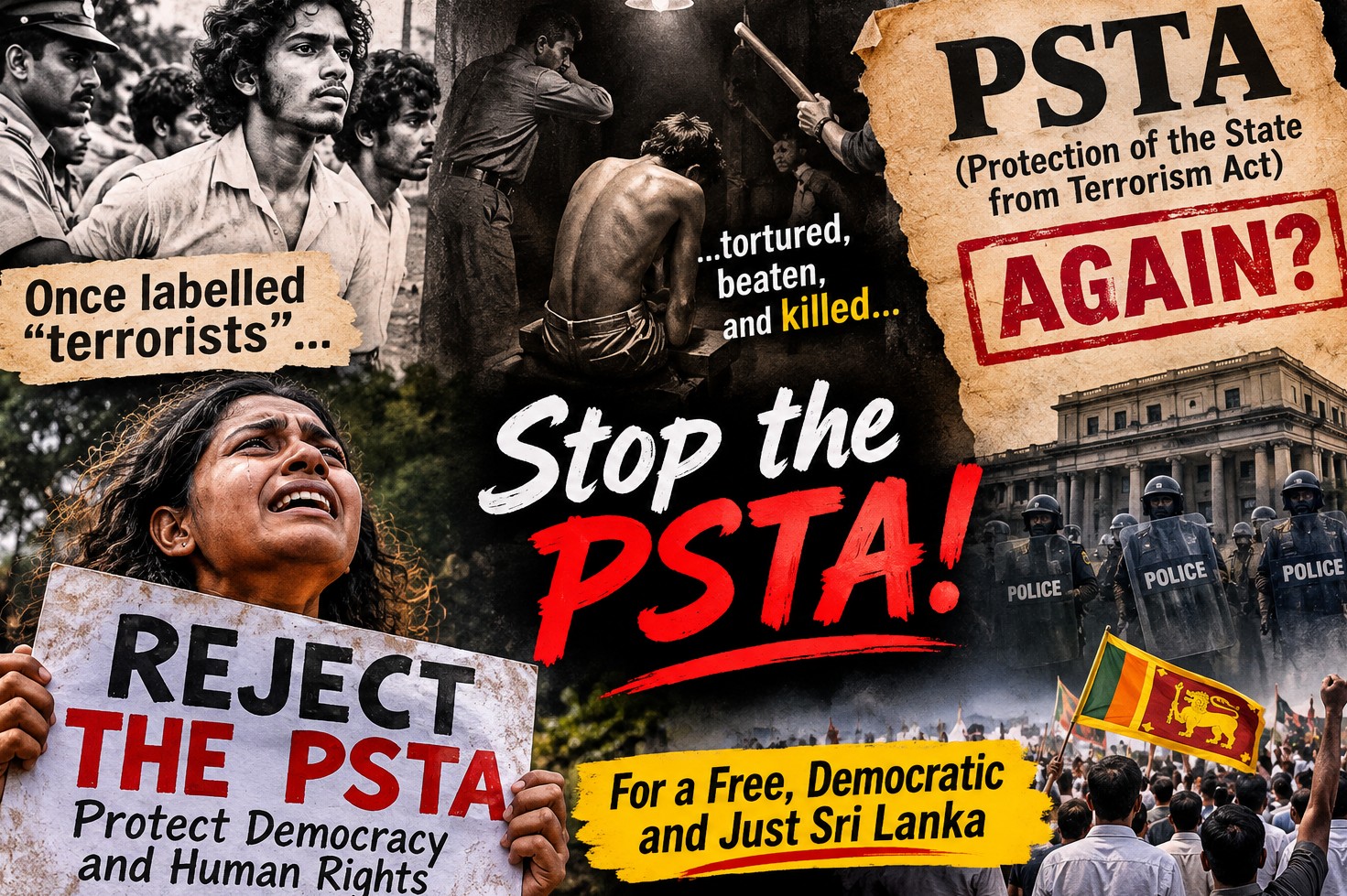
I belong to the group of people who were the first in Sri Lanka to be labelled “terrorists.”
When we were building a political movement, this was the term the government used to describe us, making our group the first political movement in Sri Lanka to be branded in this way. Until then, the term “terrorists” had not been part of Sri Lanka’s political vocabulary.
At that time, even police officers had no proper understanding of who these so-called “terrorists” were. During that period, young men with slightly long hair, particularly those sporting a hairstyle known as “sideburns,” were suspected of being “terrorists” and arrested by the police.
In most cases, these young men had absolutely no connection with our political movement. Yet the police officers had no understanding whatsoever that the government had introduced this label because of the political ideas held by people inside their heads.
As a result, anyone who had such a hairstyle was arrested on suspicion, simply because of their appearance. Their sideburns and beards were shaved off, and they were brutally assaulted.
During that period, being openly labelled a “terrorist” caused us tremendous difficulties, both within society and even within our own families. In the years that followed, thousands of young men and women who were branded as terrorists were killed merely on suspicion. The killing of Kataragama Premawathie Manamperi is one such example. Most of those young people who were killed had absolutely no connection with our political organisation.
During that period, in the 1970s, we were held in the custody of the Criminal Investigation Department (CID) as suspects. Our families were not even allowed to know that we were being detained.
We were subjected to torture and interrogation at the CID's Fourth Floor, also known as the “Lock-up Place” office. At night, we were placed in police cells. Once every two weeks, we were taken in a CID jeep to the Aluthkade Courts. An officer would carry our case files into the courtroom, show them to the judge and confirm that the prisoner was in good condition. (At the time, we referred to these judges as “fortune-telling deities,” because they certified that we were doing well without even seeing us.) After that, the jeep carrying us would be driven to the entrance of Magazine Prison, where records would be made indicating that we had been admitted and subsequently taken out again.
In this manner, I was held in CID custody for 360 days and subjected to various forms of torture and physical assault. During that entire period, I was not allowed to see any member of my family or obtain legal advice. That was how we were detained under the ordinary laws of Sri Lanka.
However, because the restrictions imposed by those ordinary laws made it difficult to punish us, the April 1971 insurgents, the government of that time enacted the Criminal Justice Commissions Act.
Is it a farce or a tragedy that members of a political party whose predecessors suffered under those very punishments are now part of the present government, yet appear to have forgotten or disregarded this history?
In 1979, following the youth uprisings in Northern Sri Lanka, the government enacted the “Temporary Provisions Act for the Prevention of Terrorism” (Prevention of Terrorism Act – PTA). This gave legal sanction to actions that the police and law enforcement authorities had previously carried out unlawfully.
At the time, civil society groups took to the streets in opposition to this legislation.
However, the government of J. R. Jayewardene used thuggish force to suppress those protests. Tens of thousands of young lives, in both the North and the South, were subjected to torture and suffering under this Act, and many perished as a result.
The Janatha Vimukthi Peramuna (JVP), the main party in the government currently in power, emerged from a history built upon the blood of its own predecessors and comrades, tens of thousands of whom paid with their lives after being tortured and persecuted as “terrorists” under this very legislation.
If they have any memory of their predecessors, they should understand better than anyone else in this country that those who were killed and tortured under the label of “terrorism” were, above all, people from their own political ranks. They should also understand that the very act of branding people as “terrorists” has itself been a national tragedy.
Now, before attempting to enact the proposed “Protection of the State from Terrorism Act” (PSTA), the first thing this government should do is systematically reform the Sri Lankan Police.
It is common knowledge that the existing police force assaults suspects even without any justification, sometimes apparently for no reason other than their own amusement, and in certain cases tortures them to death. I remind the gentlemen and ladies in this government to revisit what happened to their own predecessors and to understand the true nature and quality of the state, its police and its armed forces.
How many suspects have died in police custody since this government came to power? Have the eyes of those who came to power become blind to these incidents?
The Sri Lanka Police demonstrates its true character through the brutality with which it raises its hand against the powerless, while showing reluctance to act against the powerful. The recent incidents involving the young man in Homagama and the child in Kadawatha clearly demonstrate the arbitrary nature of police conduct.
What this government is doing through these new laws is providing an increasingly reckless and criminal police force with further opportunities to commit acts of cruelty without any accountability. Enacting laws to help an undisciplined police force conceal its criminal conduct is nothing more than “building ladders for monkeys that are already jumping around.”
But is it not an even greater tragedy for this country that the leaders of this government are drafting laws to grant even more power to a police force that has already been responsible for the deaths of tens of thousands of their own comrades? If anyone believes that these proposed laws will make the people of this country safer, it is because that person has failed to properly read or understand the history of our country.
The Sri Lanka Police has operated in an extremely arbitrary manner, even without laws of this nature, often behaving in ways that are utterly degrading to humanity itself.
The present government came to power promising to establish and protect the democratic rights of the people. Yet, its attempt to enact anti-democratic legislation such as the “Protection of the State from Terrorism Act” and the “Organized Crime Prevention Act” is, on the one hand, a farce and, on the other, an attempt to bury the democratic and human rights of the citizens of this country.
Once these laws are enacted, what will remain is a country in which every legal avenue necessary for establishing a police state has been provided. In a country governed by such laws, speaking about human rights could inevitably become a threat to one's own life.
Even without such laws, the country's security institutions have operated in a ruthless manner. Therefore, expressing opposition to these proposed laws, which are intended to institutionalise and further strengthen such conditions, is the duty and responsibility of every democratic citizen.
It is the duty of all democratic-minded people and civil society organisations to take to the streets, oppose these laws and compel the government to withdraw them.
What must be done today may become impossible tomorrow, because tomorrow these very laws could be used against those of us who oppose them. We cannot prevent the tears of tomorrow if our eyes fail to recognise the destruction that is approaching today.
At this moment, unless all civil society organisations and citizens who value democratic rights unite in opposition and prevent the enactment of these laws, it will be inevitable that they will have to shed tears tomorrow.
Ranjith Henayaka Arachchi ✍️