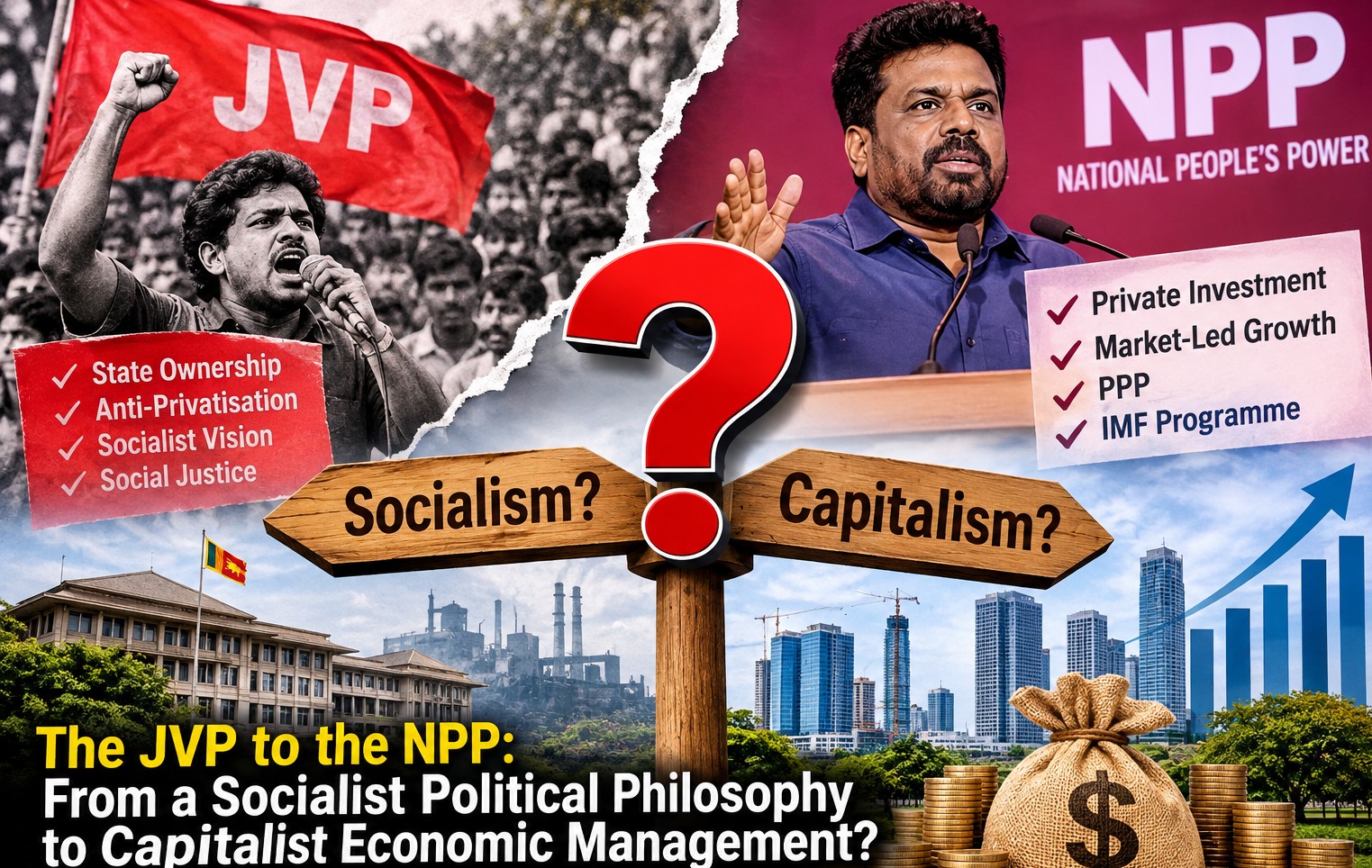
From a Socialist Political Philosophy to Capitalist Economic Management?
In our previous article, we examined how Sri Lanka’s economic policies evolved from a state-centred economic system in the 1970s towards a market-oriented economic system.
Particular attention was given to the position taken by the JVP movement in 2004 against the privatisation of state resources.
Today, a government led politically by that same JVP movement, under the National People's Power (NPP), is governing the country.
Therefore, the important question before us today is: What is the relationship between the JVP’s past economic philosophy and the economic policies of the present NPP government?
This is not merely a political criticism. It is an examination of a fundamental shift in policy.
The JVP’s Traditional Economic Philosophy...
From its inception, the JVP identified itself as a left-wing, Marxist political movement.
Its political thinking placed considerable emphasis on criticising the capitalist economic system, the power of private capital and class inequalities within society.
Protecting state resources, opposing the privatisation of state institutions, strengthening domestic production and maintaining state intervention in key sectors of the economy were important elements of this political approach.
The JVP’s opposition in 2004 to the proposal to privatise the Ceylon Electricity Board (CEB) is a clear example of this position.
However, over time, the JVP expanded its political alliances and entered parliamentary politics and eventually the arena of state governance.
With the National People's Power (NPP) coming to power in 2024, this transformation entered a new phase.
What Is the Economic Policy of the NPP Government?
The best way to identify the economic policy of the present government is to examine not its political slogans, but the policies it implements, its budgets and its international financial agreements.
In its 2026 Budget Speech, the government clearly identifies private-sector-led investment and economic growth as the principal driving forces of the country's economy.
Furthermore, attracting domestic and foreign private investment, integrating Sri Lanka into export markets and global value chains, expanding Public–Private Partnerships (PPPs), modernising state-owned enterprises and creating an investment-friendly environment have been presented as key priorities in the 2026 Budget.
Looking at these policies, it becomes clear that the present government considers private investment, market forces and business activity, rather than state ownership and direct state production, to be the primary drivers of economic growth.
These are not the defining characteristics of a socialist economy. They are characteristics of a market-oriented capitalist economy.
The IMF Programme and Economic Reforms...
To understand the economic policy of the present government, we must also examine the programme of the International Monetary Fund (IMF).
The IMF programme began in 2023, before the present NPP government came to power. Therefore, it would be inaccurate to describe it as a programme initiated by the NPP government.
However, after assuming power, the present government has continued implementing that programme.
The main objectives of the IMF programme include increasing government revenue, achieving fiscal stability, ensuring debt sustainability and reforming state-owned enterprises.
Maintaining fuel and electricity prices according to the cost-recovery principle is also part of its policy framework.
In economic terms, such policies incorporate characteristics of market-oriented reforms and fiscal discipline.
However, simply accepting an IMF programme is not sufficient to determine whether a government is neoliberal. Its actual content, the manner in which it is implemented, the role of the state and its impact on society must also be examined.
The Existence of Social Welfare Does Not Make an Economy Socialist...
There is a common misconception that needs to be clarified here.
A government does not become socialist simply because it provides subsidies to low-income communities, implements welfare programmes such as Aswesuma, or maintains free education and healthcare services.
Many capitalist countries also have strong social protection systems.
The fundamental difference between socialism and capitalism is not determined by whether subsidies or welfare programmes exist.
It is determined by questions such as:
Who owns the means of production in the economy? Who controls capital and productive resources? Who makes the major economic decisions? Are those decisions determined by market forces and private capital, or by democratic, socially accountable planning and state intervention?
Therefore, a capitalist economy can have extensive welfare programmes. Similarly, socialist or mixed economic models can also allow a certain degree of market activity.
So, What Is the Economic Philosophy of the NPP Government?
When we consider together the budgetary policies announced so far, the priority given to private investment, the promotion of Public–Private Partnerships and the continuation of the IMF programme, it becomes difficult to describe the economic policy of the present NPP government as socialist.
A more accurate description would be a capitalist mixed economy based on private-sector participation and market forces.
The government continues to maintain social welfare programmes. The public sector also remains in place. However, the government has identified private investment and market activity as the principal driving forces of economic growth.
It is also reasonable to question whether this policy framework contains neoliberal characteristics.
In particular, the reduction of the state's economic role, cost-recovery pricing mechanisms, the prioritisation of the private sector and market liberalisation provide grounds for such an assessment.
However, it would also be inaccurate to describe this as an economic system that completely removes the state from the economy.
Is This a Change in Policy or a Change in Political Promises?
The most important question before us is not whether a government has the right to change its economic policies.
Depending on a country's economic conditions, debt crisis, foreign exchange shortages and international circumstances, a government may be compelled to revise its policies.
However, such changes must be clearly explained to the public.
On what grounds does the JVP movement, which once fought against the privatisation of state resources, now accept the modernisation of state-owned enterprises, private investment and Public–Private Partnerships?
Why does a political movement that once criticised the capitalist economic system now recognise the private sector as the principal driving force of economic growth?
Is this an essential and practical decision taken to overcome the economic crisis?
Or does it represent a fundamental departure from the JVP's traditional economic philosophy?
The government must provide clear answers to these questions to the people.
Finally...
A political party has the right to change its policies. However, the people also have the right to question those changes.
Socialism is not merely a word used on an election platform. It is a fundamental political philosophy concerning ownership, power, production and the distribution of resources within an economy.
Similarly, capitalism is not simply about the existence of private businesses. It is a system concerning the ownership of productive resources and capital, as well as the mechanisms through which economic decisions are made.
When we examine the policies of the present NPP government, what we see is not a socialist economic transformation, but a capitalist mixed economy centred on private-sector participation and market forces.
Therefore, the question the people should be asking is not merely whether the government still talks about socialism.
The more important questions are:
Whose economic policies is this government implementing? Who benefits from these policies? And who bears their burden?
The gap between socialist promises in politics and the actual policies of a government can only be measured by the answers to these questions.
Jayalathge Sunil Gamini ✍️