Why Did France's Youth Take to the Streets?
The Story Behind Today's Massive Student Protest in Paris
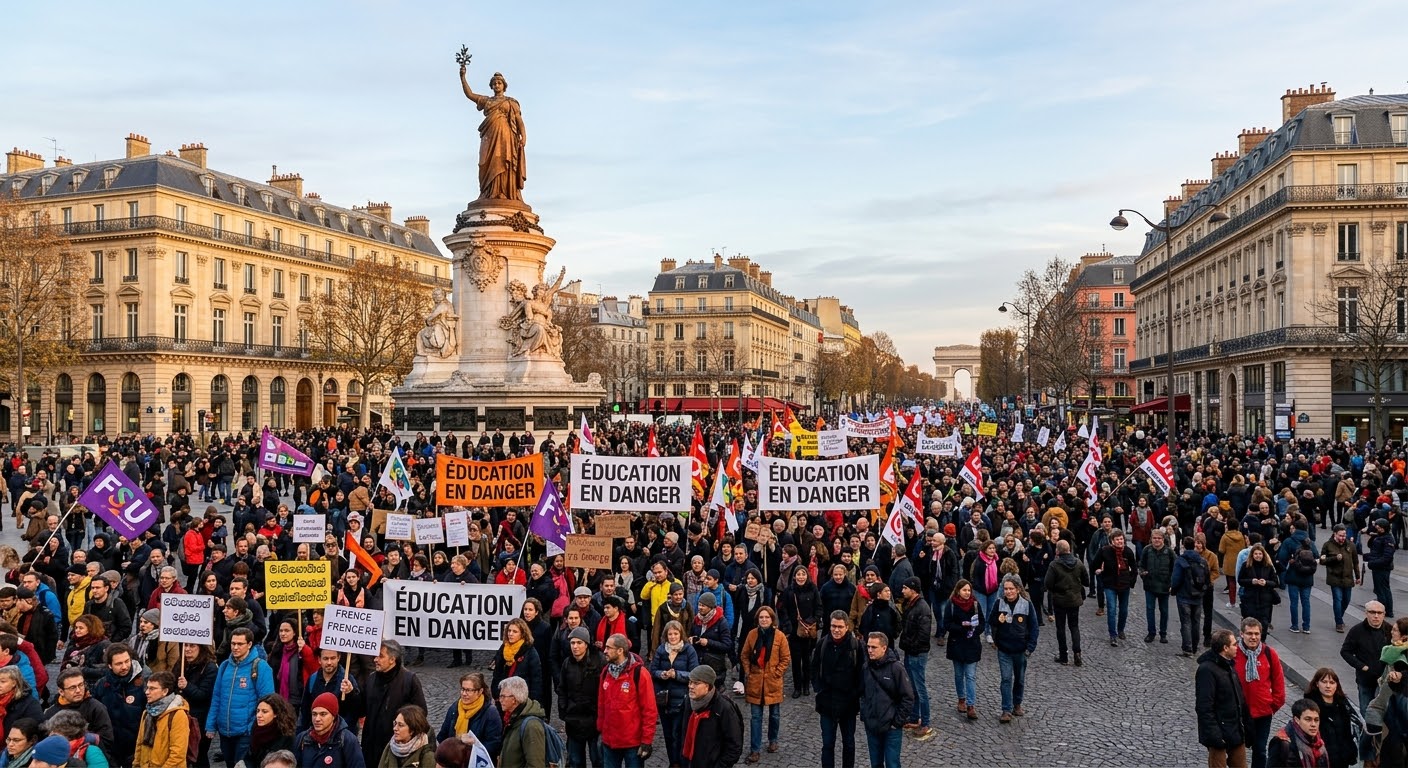
On October 6, 2026 (today), thousands of high school students, university students, and education sector workers are scheduled to gather for a massive protest march from Place de la République to Place de la Nation in Paris.
This is not merely a one-day student protest....
Long-standing frustration over the shortage of schoolteachers in France, classroom overcrowding, the deterioration of school buildings, insufficient funding for education, and issues with the university admissions system has now evolved into a national-level protest movement.
Where Did This Protest Begin?
An early spark of the current wave of protests can be traced back to September, when teachers in the Créteil region protested against staff shortages.
As students joined in, the movement rapidly spread from schools around Paris to schools across the entire country.
Within days, school blockades, blocked entrances, and student marches were observed nationwide. By early October, a significant portion of France's thousands of schools was impacted by the demonstrations.
What Are the Students Demanding?
The key demands center around
several main issues:
Ending the Teacher Shortage Students are protesting classes held without teachers, lost instructional hours, and insufficient preparation for examinations.
Reducing Classroom Overcrowding They emphasize that large class sizes under a single teacher severely degrade the quality of education.
Emergency Investments in School Buildings and Infrastructure Both students and teachers allege that buildings and educational facilities in many schools have fallen into disrepair.
Reforming School Hours and Educational Pressure Long school schedules, increasing academic pressure, and the resulting mental stress on students are key topics of discussion in the protest.
Changes to the Parcoursup System Protesters strongly criticize the Parcoursup system—used by French high schoolers for university admissions—arguing that it exacerbates academic pressure and social inequality.
What Is Happening in Paris Today?
Today, October 6, marks a major national day of protest dubbed "Acte III" by student organizations.
The main march in Paris is scheduled to set off at 2:00 PM from Place de la République, moving via Boulevard Voltaire toward Place de la Nation.
Along with high school and university student unions, major trade unions including CGT, FSU, Solidaires, and FNEC-FO have voiced their support. Parent organizations have also expressed solidarity with the students.
But the Issue Extends Beyond Education...
This protest unfolds amid heightened political and social tension surrounding France’s 2027 budget.
Trade unions had already voiced opposition to inadequate resource allocation for public services, education, and other utilities. The public sector protests on September 29 also drew large turnouts.
Consequently, the students' demands today have escalated beyond the question of "How much money is allocated for education?" into a broader societal debate:
"How much is the state truly investing in its youth?"
Why Did Protests Turn Violent?...
This remains one of the most sensitive aspects of the movement. Alongside peaceful marches, several locations witnessed school blockades, clashes, property damage, and confrontations with law enforcement.
The French government states that certain acts of violence may involve outside individuals or political factions not directly connected to the core movement.
Conversely, students and human rights organizations are raising sharp questions about police tactics.
According to government figures as of October 5, 6,059 individuals had been detained, while 215 students, 85 education workers, and 715 police officers/gendarmes were reported injured. Ten internal investigations had been launched by the IGPN—the body responsible for auditing French national police conduct.
Organizations such as Amnesty International and Ligue des droits de l’Homme have urged authorities to protect the rights of peaceful protesters and de-escalate tensions.
So, Is This a "Political Protest"?..
It cannot be simplified as such. The initial demands were clearly grounded in issues surrounding education, teaching staff, school facilities, and student experiences.
However, because the movement aligns with wider dissatisfaction regarding the national budget, public services, public spending, and government policies, it has acquired undeniable political weight. The government accuses extremist political groups of influencing the protests, an assertion the protesters deny.
The Defining Question Facing French Society Today
What echoes through the streets of Paris today is not just the voice of students.
It is a fundamental question:
"Is education an expense, or an investment in the country's future?"
French youth are challenging the practicality of "equal opportunity" when forced to learn in classrooms without teachers, decaying school structures, overcrowded rooms, and a system with unequal educational access.
Therefore, the protest on October 6, 2026 (today) in Paris should not be viewed merely as another march, but as part of a deep conversation within French society regarding public education, state investment, social inequality, and the future of the younger generation.
The core question is not simply that students took to the streets.
The core question is why conditions deteriorated to the point where they had no other choice.
Sunil Gamini Jayalathge✍️