The Government That Promised Tax Cuts Is Now Burdening the People with Taxes!
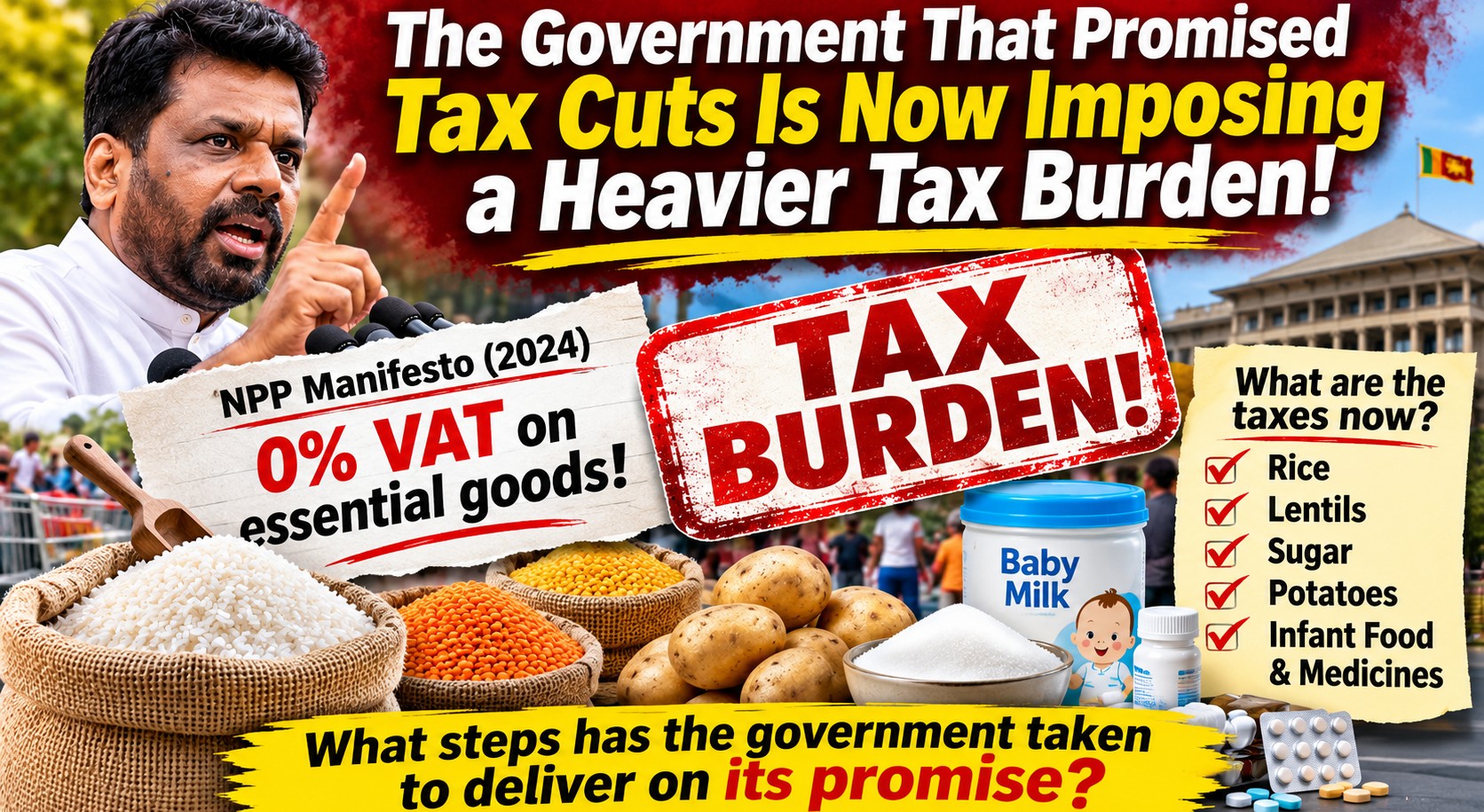
What happened to the promise to remove taxes on essential food items?
It is now time to examine the tax policy of the NPP government, which came to power promising to reduce the cost of living and ease the tax burden on essential goods.
On page 57 of the NPP policy manifesto presented at the 2024 Presidential Election, the party made a clear promise to introduce 0% VAT on essential food items, locally produced milk and eggs, infant milk powder, medicines and other essential products.
But what happened to that promise after the government came to power?
Let us examine the current tax situation.
1. Taxes imposed on essential food items
According to the Sri Lanka Customs 2026 tariff documents and the Special Commodity Levy (SCL) schedule, the following SCL rates apply to several imported essential food items.
Commodity
SCL
Potatoes
Rs. 80 per kg
Red Lentils
Rs. 0.25 per kg
Yellow Lentils
Rs. 0.25 per kg
Sugar
Rs. 50 per kg*
Rice
Rs. 65 per kg*
Special attention is required regarding sugar and rice. The May 2026 SCL schedule issued by Customs lists Rs. 50 per kg for sugar and Rs. 65 per kg for certain varieties of rice. However, a different rate also appears in the tariff schedule for sugar. Therefore, the applicable rate must be confirmed against the latest relevant Gazette notification. The rice tariff was also amended by a Gazette notification dated 2 November.
In addition to these SCL charges, other taxes and levies, including Customs Duty, VAT, SSCL (Social Security Contribution Levy) and other applicable charges, may also apply depending on the commodity and its HS code.
Therefore, these figures represent only the SCL imposed per kilogram. They do not represent the total import tax burden.
2. The decision taken after the government came to power
In March 2024, the previous government had decided to abolish the Special Commodity Levy on certain goods.
However, on 18 December 2024, the NPP government decided not to implement that decision and instead to continue the existing tax system from 1 January 2025.
The government's argument was that removing the SCL could lead to the imposition of other taxes, potentially increasing the prices of goods.
Nevertheless, it is entirely reasonable to question why a government that promised tax relief to the people decided to maintain the existing tax system without implementing the proposed changes.
3. The increase in the potato tax
There is a particular issue that deserves attention here.
In January 2024, the SCL on imported potatoes stood at Rs. 50 per kilogram. According to Gazette No. 2412/38 dated 30 November 2024, this was increased to Rs. 60 per kilogram.
The Central Bank of Sri Lanka's Annual Economic Review 2025 states that this tax was further increased to Rs. 80 per kilogram with effect from 26 August 2025.
Accordingly, the potato tax, which stood at Rs. 60 per kilogram in November 2024, increased to Rs. 80 per kilogram in August 2025.
That represents an increase of Rs. 20 per kilogram.
4. The latest amendment to the rice tax
According to Gazette No. 2513/02 dated 2 November 2026, the SCL of Rs. 65 per kilogram previously imposed on certain varieties of raw and parboiled rice has been removed.
However, it was reported on 4 November that a combined import tax of Rs. 280 per kilogram applies to Sticky Rice and Jasmine Rice.
This is not a general tax concession that opens the door to unrestricted rice imports for the ordinary market. The relevant imports are subject to specific requirements and conditions.
5. The situation regarding infant food and medicines
VAT exemptions on infant milk powder and qualifying medicines were already in place before the NPP government came to power.
Therefore, these existing exemptions cannot be presented as new tax concessions introduced by the current government.
Furthermore, not all infant nutritional products and all health-related products qualify for these exemptions.
The main question is whether the government has gone beyond simply maintaining existing concessions and implemented the additional tax relief it promised to the people.
6. Questions the government must answer
Based on these facts, several questions need to be put to the government:
Why has the promise to introduce 0% VAT on essential food items not been implemented across all relevant products?
Why was the SCL on potatoes increased from Rs. 60 to Rs. 80 per kilogram?
Why did the government decide not to implement the previous decision to abolish the Special Commodity Levy?
What new tax concessions, if any, have been introduced for infant food and medicines beyond the exemptions that already existed?
How much relief has this tax policy actually provided to the monthly food expenses of an ordinary family?
Ultimately, what matters is not merely an increase in government tax revenue. The real issue is who bears the burden of those taxes.
Tax policies on essential goods directly affect low-income families, who spend a substantial proportion of their income on food. Lower-middle-income groups, including public sector employees, are also facing an extremely difficult economic situation.
It is the government's responsibility to explain the gap between the promises made to the people before coming to power and the decisions taken after assuming office.
Election promises must not be measured by speeches delivered on political platforms, but by the tangible relief they bring to the cost of living of ordinary people.
Jayalathge Sunil Gamini ✍️