The Economic Reality of a People Forced to Pawn Even Their Gold Jewellery to Make Ends Meet!
If the Government Says the Economy Is Growing, Why Are Ordinary Families Still Drowning in Debt?
The Government claims that Sri Lanka's economy is recovering and that the country has achieved economic growth. It points to statistics relating to Gross Domestic Product (GDP) growth, foreign reserves, changes in inflation and overall economic stability.
However, amid all these claims, there is one extremely important question we must ask:
Has the quality of life of ordinary people actually improved?
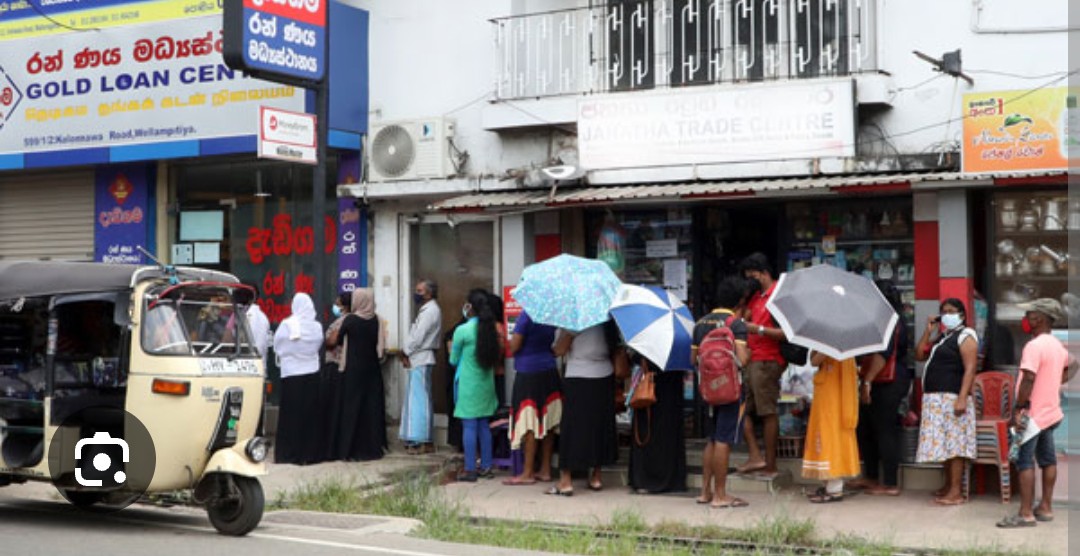
We must pay attention to families struggling to make ends meet on their monthly salaries, people borrowing money to purchase food, households unable to meet their children's educational expenses, elderly people struggling to find money to buy essential medicines, and those who are ultimately forced to pawn even their gold jewellery just to survive.
This is not merely an emotional political statement. It is the country's actual economic situation, which must also be examined through statistical evidence.
Gold-Backed Loans Exceed Rs. 1 Trillion!
According to statistics compiled using data from the Central Bank of Sri Lanka, the outstanding balance of gold-backed loans granted by licensed commercial banks stood at Rs. 660.2 billion at the end of 2024.
By the end of 2025, this figure had increased to Rs. 897.9 billion.
By August 2026, it had risen further to Rs. 1,161.8 billion, equivalent to Rs. 1.16 trillion.
Compared with the end of 2024, this represents an increase of approximately Rs. 501.6 billion, or around 76%.
This is not a figure that can simply be ignored.
Furthermore, gold-backed lending by private finance companies reportedly increased by approximately 64.1% in 2025.
These figures point to a growing trend of people taking their gold jewellery to banks and financial institutions, a development that demands serious investigation.
One important qualification must be made here. Rising gold prices can increase the amount of money people are eligible to borrow against jewellery they have already pawned. Therefore, an increase in the outstanding loan balance alone does not prove that the number of people newly pawning their jewellery has increased.
Nevertheless, even after acknowledging this limitation, the rapid growth in gold-backed lending remains a serious warning sign about the level of household indebtedness in the country.
Families Are Even Borrowing to Meet Their Basic Food Needs!
A report on household debt in Sri Lanka, published by the United Nations Development Programme (UNDP) in September 2024, provides particularly important evidence in this regard.
According to a national survey conducted among 25,000 households during 2022–2023:
38.5% of households had borrowed money from various sources.
19.3% of households faced debt-related difficulties in meeting their basic needs.
Such households borrowed an average of 4.48 times a year to meet their basic consumption needs.
Another significant finding in the report was that, among households borrowing to meet basic consumption needs, pawning gold jewellery accounted for 31.1% of their borrowing sources.
Loans obtained from moneylenders accounted for 24%, while bank loans represented 23.5%.
This clearly demonstrates that pawning gold jewellery had become more than just a way for some families to meet unexpected financial needs. It had also become a means of financing their day-to-day survival.
Although these figures relate to 2022–2023, the socioeconomic vulnerability they reveal remains an issue that must be investigated today.
Most Household Income Is Being Consumed by Expenses!
According to the preliminary results for January to March of the Department of Census and Statistics' 2025 Household Income and Expenditure Survey, the average monthly household income stood at Rs. 120,266.
The average monthly household expenditure was Rs. 116,191.
This leaves a difference of just Rs. 4,075 between average household income and expenditure. In other words, approximately 96.6% of average household income was spent on expenses.
This does not mean that every household experiences the same financial circumstances. However, it is an important indication of just how narrow the gap between household income and expenditure has become.
When an unexpected hospital bill arises, a child needs something for school, the house requires repairs, or another unforeseen expense occurs, where can such a family find the money?
How many families have no alternative but to pawn their gold jewellery to meet such expenses?
These are questions we must examine as a society.
The Urban Middle Class Is Not Immune to Economic Pressure!
Another important finding from the UNDP survey is that household debt problems are not confined to rural communities.
Among urban households, 26.2% had resorted to borrowing to meet basic consumption needs, compared with 17.9% of rural households.
This indicates that urban families, too, were facing considerable financial pressure when trying to cover food, transport, healthcare and other essential expenses.
The salaried middle class is also affected by this problem. When monthly salaries remain stagnant while the costs of food, transport, housing, electricity, water, healthcare and education continue to rise, their real purchasing power declines.
Once the savings accumulated during an economic crisis are exhausted, borrowing begins. When families are forced to take out new loans to repay existing debts, their financial stability deteriorates even further.
Economic Growth Has Not Eradicated Poverty!
According to the World Bank's October 2026 Sri Lanka Economic Report, economic growth is projected at 4.4% for 2026 and 4.2% for 2027.
However, the poverty rate for 2025 is estimated at 16.9%, which remains higher than the level recorded before the economic crisis.
Economic growth is important. But what is the social value of that growth if its benefits do not reach low- and middle-income households?
An increase in GDP alone does not improve a child's daily meals. It does not guarantee that a patient can afford essential medicines. Nor does it reduce the debt burden of a salaried employee.
The true measure of economic recovery must be the improvement in living standards that ordinary families actually experience.
We Must Not Ignore the Risk of Gold Jewellery Being Auctioned!
When borrowers are unable to repay their pawned loans within the stipulated period, their gold jewellery faces the risk of being auctioned.
What people lose in such circumstances is not merely the monetary value of a piece of jewellery.
For some families, these ornaments are precious heirlooms passed down through generations. For others, they represent assets accumulated for a daughter's future marriage, or possessions carefully preserved by a mother or wife throughout her lifetime.
A newspaper report published in November 2025, citing Ministry of Finance data, stated that outstanding pawned-loan balances had increased from Rs. 210 billion in 2019 to Rs. 571 billion by March 2024.
However, this figure must not be incorrectly interpreted as the value of gold jewellery auctioned during that period.
What we need today are official statistics for 2024, 2025 and 2026 showing the amounts of matured pawned loans, renewed loans and gold jewellery sold through auctions.
The Government and the Central Bank must make this information publicly available.
What the Central Bank's 70% Limit on Gold-Backed Lending Reveals!
Effective from 25 May 2026, a maximum loan-to-value limit of 70% of the market value of pledged gold has been imposed on gold-backed lending.
This is a regulatory measure intended to manage risks within the banking and financial system.
However, such a measure alone cannot change the underlying economic circumstances that force people to borrow even to meet their most basic needs.
Restricting the amount people can borrow does not increase their incomes. It does not reduce food prices. It does not make medicines more affordable. Nor does it create additional employment opportunities.
The Government's responsibility should be to address the underlying economic conditions that continue to push people into debt.
Several Questions the Government Must Answer!
Amid the economic growth statistics presented to the public, the Government must provide answers to the following questions:
How many people have newly pawned their gold jewellery with banks and financial institutions between September 2024 and 2026?
How much of these borrowed funds has been used to pay for food, medicines, education and everyday living expenses?
How many pieces of gold jewellery have been auctioned because borrowers were unable to repay their loans?
By how much has the real purchasing power of ordinary salaried households improved?
What specific measures has the Government taken to ensure that the benefits of economic growth reach low- and middle-income households?
These are not unreasonable questions raised against the Government. They are fundamental questions of public accountability that must be asked of any government elected with the people's tax money.
What Does It Mean to Say the Economy Has Changed? Whose Lives Have Actually Changed?
The success of a country's economy cannot be measured solely by the performance of the stock market. Nor can it be judged merely by rising bank profits, increasing foreign reserves or GDP figures.
Can people afford to meet their family's food requirements with their monthly salaries?
Can they set aside money for their children's education?
Can they afford medicines when they or their family members fall ill?
When an emergency arises, can they manage their lives without having to visit a bank and pawn gold jewellery inherited from previous generations?
That is where the true meaning of economic recovery lies.
If people are still being forced to pawn even their gold jewellery simply to make ends meet, the Government that claims the economy is growing must answer one fundamental question:
When will the benefits of this economic growth actually reach the people?
The economic success of those in power must not be measured solely by the statistics they present. It must be measured by how much the lives of ordinary people under their administration have genuinely improved.
While people's gold jewellery is finding its way into bank vaults, have the Government's economic achievements found their way into the lives of the people?
Answering that question is the Government's responsibility.
Jayalathge Sunil Gamini ✍️