France’s Future Political Power Struggle!
Which Direction Is France Heading Ahead of the 2027 Presidential Election?
France is not simply heading towards another ordinary presidential election. The political and social transformation emerging within French society ahead of the 2027 presidential election is becoming a potentially decisive turning point, one that could reshape not only the country's political power structure but also the future political direction of Europe.
One of the most striking features of this development is the wave of protests that has spread across France since the second half of 2026. Public dissatisfaction over the cost of living, wages, job insecurity, pensions, cuts to public services and social inequality continues to spill onto the streets.
Young people, student movements, the working class and trade unions represent different dimensions of these protests.
What is the underlying political message behind all this?
It is not simply opposition to the current government. Rather, it reflects the fact that people are seeking answers to a fundamental question: What kind of economic and social policies should guide France's future?
The Verdict on Macron’s Decade in Power!
With Emmanuel Macron's presidency coming to an end, the 2027 election will also serve as a public assessment of his political legacy. Under the French Constitution, he cannot run for a third consecutive presidential term.
Policies concerning the increase in the retirement age, control of public expenditure, economic reforms, the cost of living and public services have already become subjects of intense debate within French society.
While some people support Macron's economic policies, criticism over social inequality and the weakening of people's political representation has also grown.
The political fragmentation that emerged in the French Parliament following the snap parliamentary election of 2024, together with growing instability in governance, has further complicated this crisis.
Three Major Political Blocs on the Political Stage!
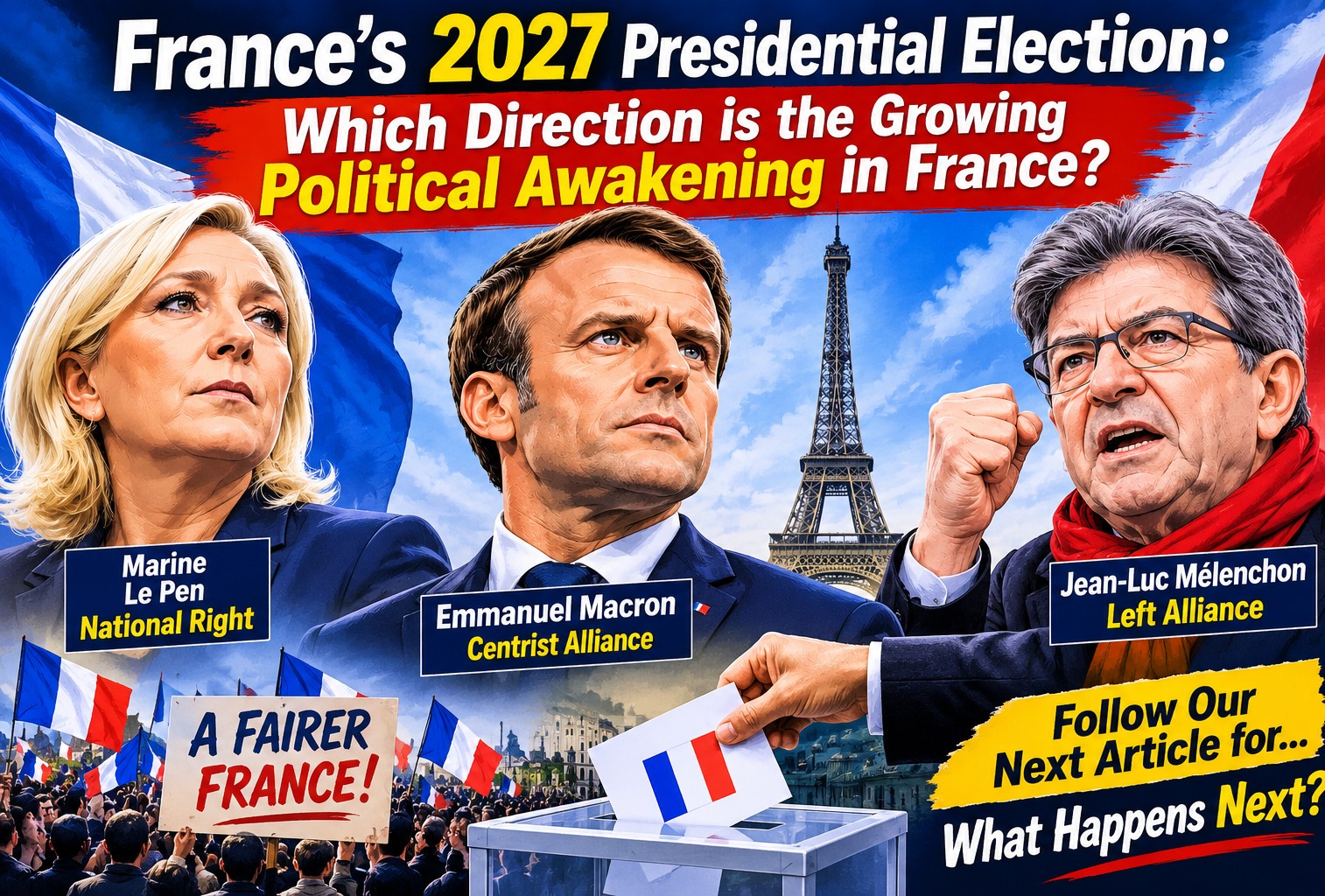
Several major political forces are currently seeking to strengthen their positions ahead of the 2027 presidential election.
1. The Nationalist Right
The Rassemblement National (RN), led by Marine Le Pen, has become one of the major forces in French politics.
Immigration policy, national identity, security, national sovereignty and relations with the European Union are among its principal political themes.
Marine Le Pen is preparing for the 2027 presidential election, while the appeal proceedings in her legal case remain an important factor that could influence the electoral contest.
2. The Left and Radical Left
The La France Insoumise (LFI) movement, led by Jean-Luc Mélenchon, advocates social justice, higher taxation on wealthy groups, wage increases, pension reform and the strengthening of public services.
However, the left-wing alliance known as the Nouveau Front Populaire, whose constituent parties worked together during the 2024 election, is now facing numerous internal disagreements.
Building consensus on leadership, policies and electoral strategies among the Socialist Party, the Greens, the Communist Party and LFI has become increasingly difficult.
3. The Centrist and Traditional Right-Wing Bloc
Political forces including Macron's Renaissance party, Édouard Philippe's Horizons and the traditional conservative party Les Républicains are also searching for their future political positions.
Economic stability, fiscal discipline, investment and European integration remain their principal themes.
However, competition over leadership and the selection of a common presidential candidate also persists within this bloc.
The Critical Challenge Facing the Left!
One of the most significant features of France's current political situation is the weakening unity among left-wing political forces, even as public dissatisfaction continues to grow.
The parties that contested the 2024 election as a common alliance are now increasingly pursuing separate political paths.
In this context, the emergence of Raphaël Glucksmann, who represents social-democratic politics, is also noteworthy.
His growing political prominence alongside forces associated with the Socialist Party and Place Publique, together with his reported victory in the social-democratic primary in October 2026, has added a new dimension to the balance of power within the left.
Consequently, the question facing the French left is no longer simply who will stand against the right. It must also determine the future leadership and ideological direction of the left-wing political movement itself.
A New Political Picture Emerging from Opinion Polls!
Opinion poll reports published during the first week of November 2026 have provided important indications of the competitive political landscape in France.
Several of these surveys have reportedly placed Marine Le Pen in first position and Jean-Luc Mélenchon in second.
However, not all surveys produce identical results. The nature of the contest could change significantly depending on the candidacies of Raphaël Glucksmann and Édouard Philippe in particular.
Another important political development is Macron's proposal to build a broad alliance involving social democrats, centrists and right-wing political forces.
Yet even potential future leaders within his own political camp have not expressed clear agreement with this proposal.
All these developments demonstrate that the political contest in France is no longer a straightforward confrontation between the traditional left and right.
The Real Political Questions Facing France!
Today, the French people are confronting several fundamental questions.
Can people afford the rising cost of living?
Does the younger generation have a future?
Can public services and social protection be safeguarded?
How should the challenges surrounding immigration policy and national identity be addressed?
Is it possible to build a political system in which those who come to power through the people's votes are genuinely accountable to the people?
These are among the questions likely to become decisive in the 2027 presidential election.
Ultimately, France is facing more than the question of choosing a president. It is a political struggle over the country's future social and economic direction.
Will public protests on the streets translate into political change? Will the nationalist right continue to expand its influence? Can left-wing forces overcome their internal divisions and develop a common programme? Can new leadership emerge to carry forward Macron's centrist political legacy?
The answers to all these questions will become clearer through the political developments of the coming months.
I hope to examine the decisive turning points in France's next political struggle in a second article. This will include the internal power struggle within the left, the politics of succession to Macron, Marine Le Pen's future strategies and the new alliances that may emerge ahead of the 2027 election.
These developments are also important to the Sri Lankan community living in France. Decisions concerning French democracy, immigration policy, workers' rights and social protection directly affect the everyday lives of foreign communities living in the country.
Therefore, we must continue to watch France's political future closely!
Jayalathge Sunil Gamini ✍️