France’s 2027 Presidential Election: A Far-Right Surge or a Left-Wing Comeback?
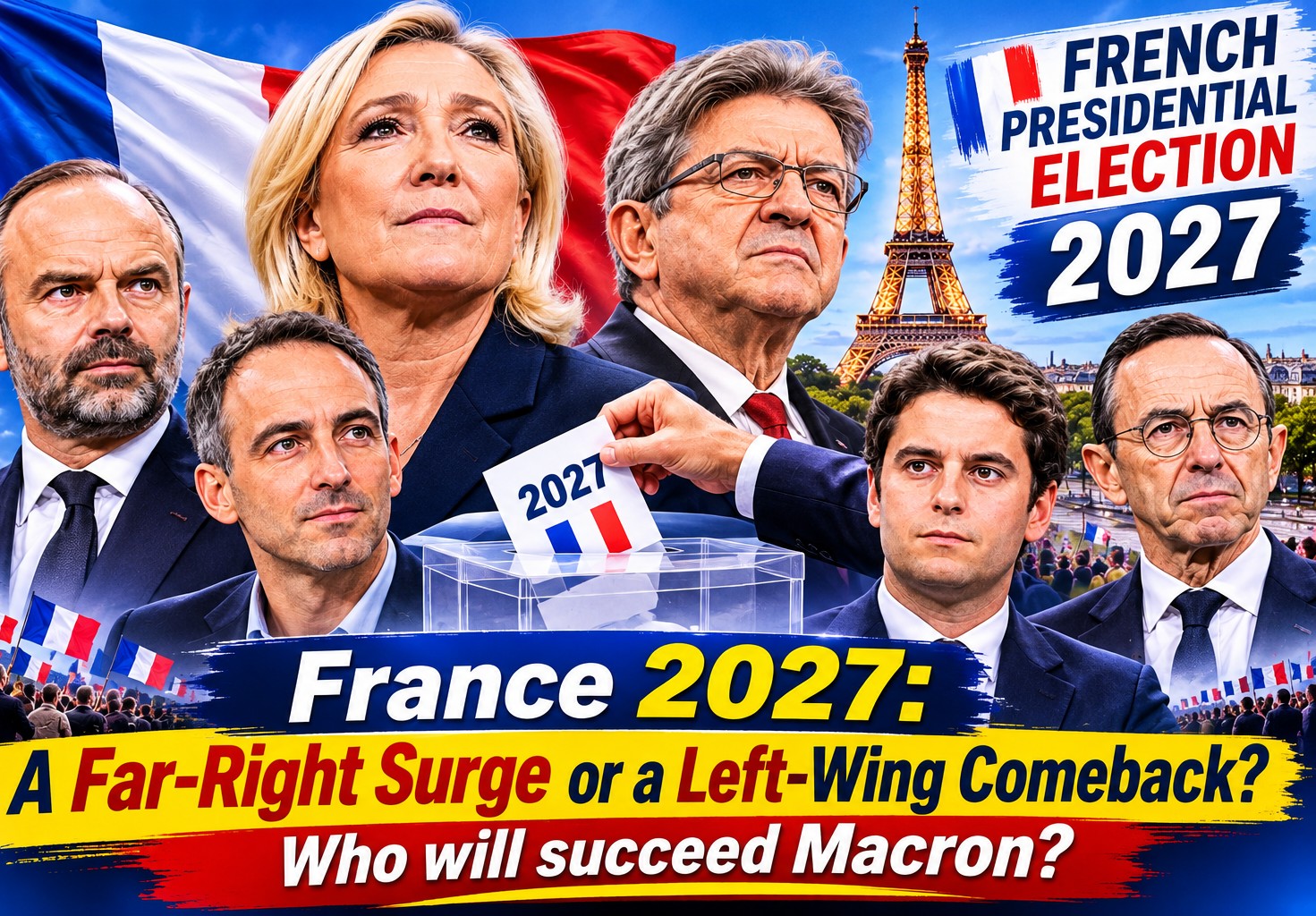
Who will take power in France after Macron? Marine Le Pen leads the opinion polls as centrist politics faces a crisis!
The political battle for France’s 2027 presidential election is gradually heating up. President Emmanuel Macron’s second term is approaching its end, and under the French Constitution, he cannot run for a third consecutive term as president.
Therefore, the 2027 presidential election is about much more than choosing a new individual to occupy the Élysée Palace. It represents a decisive moment that will determine the political, economic and social direction France takes in the post-Macron era.
In particular, the struggle for power between right-wing nationalism, left-wing politics advocating social transformation, and centrist liberalism is emerging as the defining feature of this election.
Who Will Take Power After Macron?
Several major political figures have already emerged as potential contenders for France’s political leadership.
• Marine Le Pen
The strongest candidate representing right-wing nationalism.
Marine Le Pen is the leading figure of the Rassemblement National (RN) party and one of the most prominent personalities in the 2027 presidential race.
The main themes of her political programme include immigration control, national security, French sovereignty and a reassessment of France’s relationship with the European Union.
The rising cost of living, public concerns over immigration policies and growing dissatisfaction with traditional political parties have created a favourable political environment for her campaign.
However, her political future is also linked to a legal controversy. In the case involving the misuse of European Parliament funds, an appeals court sentenced her in July 2026. However, the ban preventing her from standing in elections was lifted, meaning she is currently able to contest the 2027 presidential election.
Nevertheless, the outcome of her further appeal before the higher court remains an important issue to watch.
• Jean-Luc Mélenchon
The leading force of the French left.
Jean-Luc Mélenchon, leader of La France Insoumise (LFI), is another powerful figure in the upcoming presidential contest.
His political programme includes higher taxes on wealthy individuals, increases in the minimum wage, stronger social welfare provisions, pension reforms and the protection of public services.
He represents a political movement that advocates more radical social and economic transformation than traditional French left-wing politics.
However, divisions among left-wing parties and the lack of agreement on a common presidential candidate remain major challenges to his chances of winning.
• Édouard Philippe
The leading hope of centrist politics.
Édouard Philippe, former Prime Minister under Emmanuel Macron, is also positioning himself as a strong contender for the presidency.
Representing his Horizons party, he emphasises economic reforms, fiscal discipline, security and administrative efficiency.
However, a noticeable decline in his popularity in recent opinion polls has become a significant concern.
• Raphaël Glucksmann
A representative of the social-democratic camp.
Raphaël Glucksmann, who represents the political forces associated with Place Publique and the Socialist Party, focuses on European cooperation, democracy, social justice and human rights.
His main challenge is to establish a distinct and influential position within France’s broader left-wing electorate.
• Gabriel Attal and Bruno Retailleau
Two other important political forces in the presidential race.
Former Prime Minister Gabriel Attal, representing the Renaissance party, is seeking to establish himself as a future leader of Macron’s centrist political camp.
Bruno Retailleau represents the traditional right-wing politics of Les Républicains. Law and order, immigration control and strengthening state authority are among his main political priorities.
In addition, political figures such as David Lisnard, Marine Tondelier and Éric Zemmour are also seeking to play significant roles in the electoral contest.
Television Debates Heat Up the Presidential Race
A special presidential election debate organised on November 16 by television channels TF1 and LCI, in collaboration with the organisation Restos du Cœur, attracted considerable attention in French political circles.
Marine Le Pen, Jean-Luc Mélenchon, Raphaël Glucksmann, Gabriel Attal and Bruno Retailleau participated in the debate. Édouard Philippe had also been invited but was unable to attend due to an engagement at the municipal administration of Le Havre.
What made this debate particularly significant was that it was not simply a policy discussion among political leaders. People experiencing poverty and volunteers from the Restos du Cœur organisation were given the opportunity to question the candidates directly.
Restos du Cœur is a charitable organisation that distributes food to people living in poverty. The debate itself was held inside one of the organisation’s warehouses.
Candidates were required to explain their policies on the cost of living, wages, housing, pensions, food prices and measures to combat poverty.
Heated exchanges also took place over taxation policies and how the candidates intended to finance their proposed programmes.
The debate can be regarded as an important occasion that brought the realities of contemporary French society to the centre of the presidential election campaign.
Marine Le Pen Leads the Opinion Polls
According to various opinion polls published in November 2026, Marine Le Pen is currently leading in voting intentions for the first round of the presidential election.
The principal results of the survey conducted by the Ifop polling institute between November 13 and 16 were as follows:
Marine Le Pen – 34.3%
Jean-Luc Mélenchon – 18.8%
Édouard Philippe – 12.4%
Raphaël Glucksmann – 10.2%
David Lisnard – 10%
The YouGov survey conducted between November 12 and 17 also placed Marine Le Pen in the lead with 34.2%, while Jean-Luc Mélenchon came second with 19.2%.
Both surveys indicate a considerable gap between Marine Le Pen and the other major candidates.
Particularly noteworthy is the decline in Édouard Philippe’s popularity, which reportedly fell from 22% in July 2026 to 12% in November. This highlights the challenges facing the centrist political camp.
However, it is important to emphasise that opinion polls are not election results, and voting intentions can change depending on the candidates included and the combinations of potential contenders being tested.
What Will Determine the Outcome of the Second Round?
The French presidential election operates under a two-round electoral system.
If no candidate receives more than 50% of the votes cast in the first round, the two candidates receiving the highest number of votes advance to the second round.
Therefore, leading the first round alone is not enough to secure the presidency.
The decisive factor will be which candidate receives the support of voters whose preferred candidates were eliminated in the first round.
An important feature of French politics in this context is the tendency of different political camps to unite against the far right. This approach is sometimes referred to as the Front républicain (Republican Front).
However, it remains unclear how strong such a united front will be in this election. The decisions of left-wing, centrist and traditional right-wing voters could significantly alter the final outcome.
Is France’s Political Crisis Creating an Opportunity for the Right?
The growing political strength of Marine Le Pen cannot be explained simply in terms of her personal popularity.
It is also an expression of increasing public dissatisfaction with France’s existing political and economic system.
Rising living costs, the housing crisis, employment insecurity, public debates surrounding immigration and declining confidence in political leadership are all important factors.
In particular, if the centrist political camp fails to rebuild public confidence in its policies, it could create an even more favourable environment for right-wing nationalist forces.
Nevertheless, if left-wing forces manage to unite against the right-wing surge, the balance of political power could change.
The Main Challenge Facing the Left
The principal challenge facing French left-wing politics at this moment is reaching agreement on a common political programme and a single presidential candidate.
The formation of the New Popular Front (NFP) alliance during the 2024 parliamentary elections demonstrated that left-wing parties were capable of working together.
However, achieving such unity in a presidential election is considerably more complicated because of competing leadership ambitions, policy differences and individual political interests.
If the differences between Mélenchon, Glucksmann, the Socialist Party and the Green Party cannot be resolved, there is a risk that the left-wing electorate will become fragmented.
Such a situation could benefit a right-wing candidate not only in the first round but also in the second round.
An Important Political Lesson for Sri Lanka Too
France’s 2027 presidential election offers several important lessons for people studying politics in countries such as Sri Lanka.
First, issues affecting the cost of living, wages, employment and social security must occupy a central place in political debate.
Second, although a political party may come to power by capitalising on public dissatisfaction, it is difficult to maintain long-term public confidence without providing genuine solutions to the problems behind that dissatisfaction.
Third, democracy is not a process that ends with casting a vote. People must have the opportunity to question political leaders about their policies, promises, management of public finances and accountability to the public.
The fact that a social organisation such as France’s Restos du Cœur, which distributes food to people living in poverty, can directly bring the concerns of disadvantaged communities before presidential candidates is also an important feature of a democratic political culture.
Ultimately, the French People Will Decide!
The first round, scheduled for April 18, 2027, and the second round, scheduled for May 2, will determine the future political direction of France.
According to current opinion polls, Marine Le Pen is clearly in a strong position. However, her victory is far from guaranteed.
The unity of left-wing forces, the political reorganisation of the centrist camp, the candidates’ public debates and the actual economic experiences of ordinary people will all influence the final outcome.
Will France move towards right-wing nationalism? Or will left-wing and democratic forces succeed in rebuilding their political strength?
The 2027 presidential election will provide the answer.
Jayalathge Sunil Gamini ✍️