Can the Law Be Challenged Under the Guise of a Robe?
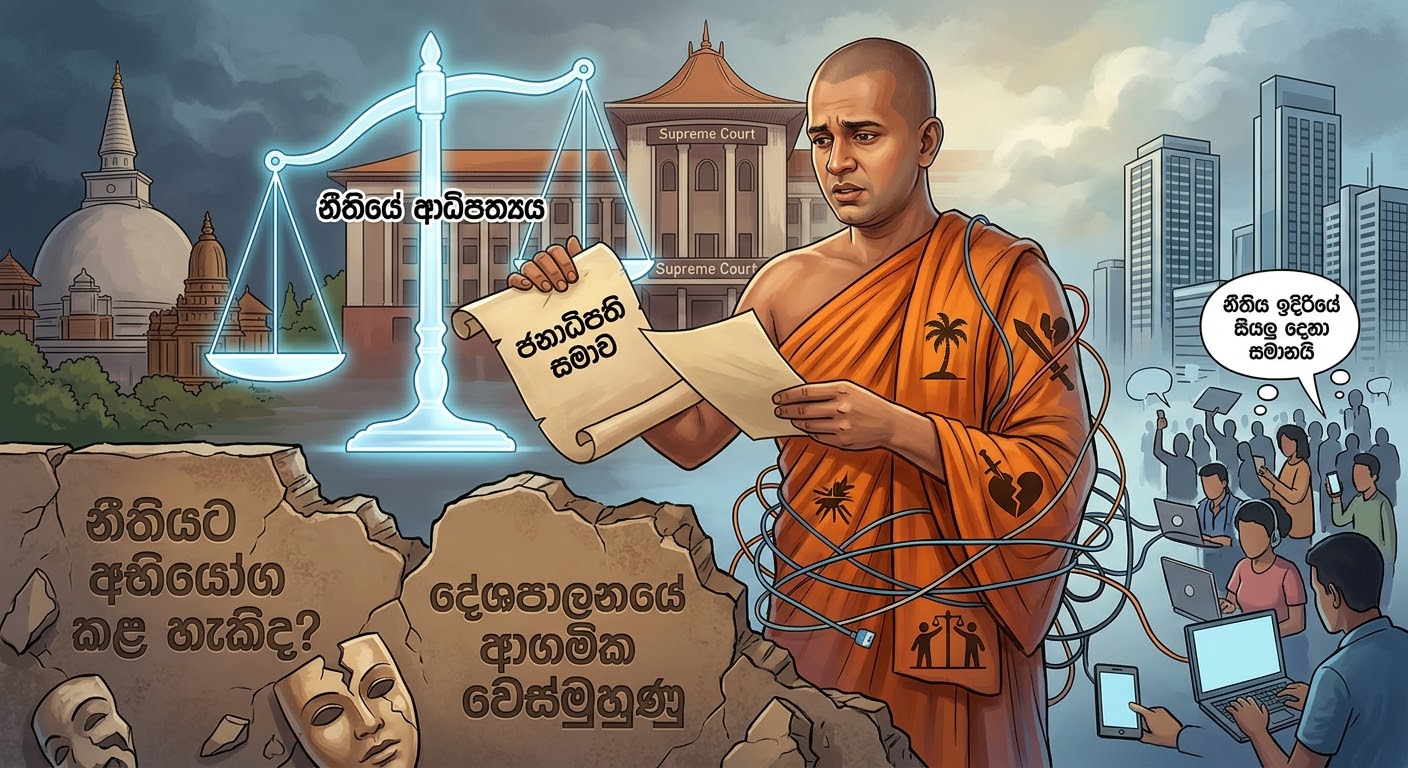
It is time to strip away presidential pardons, monastic discipline, and the religious masks of politics!
If everyone is equal before the law, can an individual wearing a monastic robe be subject to a different set of rules? If the President has the power to grant pardons, can it be turned into a political weapon to protect favored individuals? Is religious respect a license to be exempt from the law?
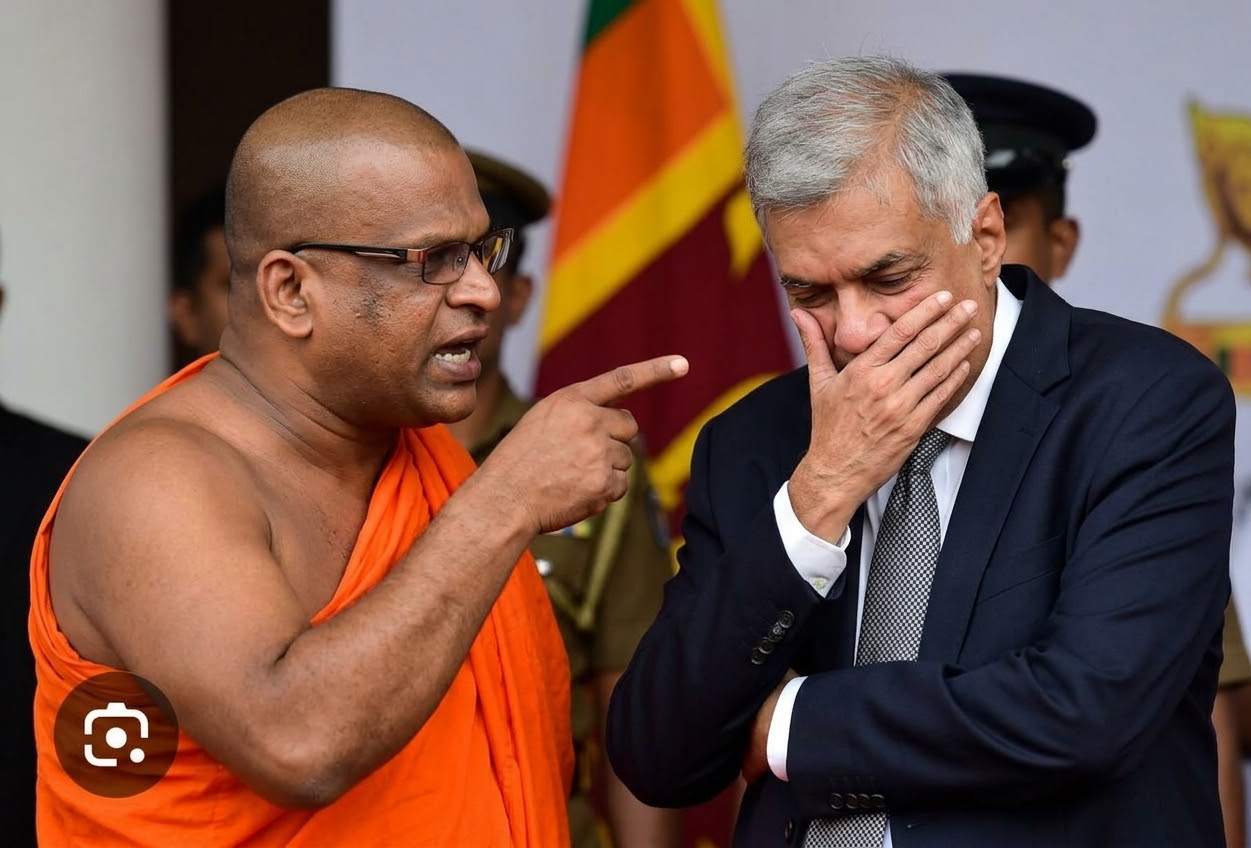
The Supreme Court ruling regarding the presidential pardon granted to Venerable Galagodaatte Gnanasara Thero raised far more than a simple legal issue concerning a single monk. It is an event that places profound questions before society regarding Sri Lanka's politics, religious institutions, the independence of the judiciary, and the exercise of state power.
The question we must ask here is not whether we are for or against Gnanasara Thero. The question we must address is whether the rule of law can vary according to an individual's status, political connections, and religious identity.
A Presidential Pardon Is Not a License to Protect Political Allies!...
Article 34 of the Constitution of the Democratic Socialist Republic of Sri Lanka vests specific powers in the President, including the power to grant pardons. However, this power does not exist outside the Constitution.
The President may be the head of the executive branch of the country, but he is not above the law. Even the powers vested in him are subject to constitutional limits, relevant legal requirements, and judicial review.
The Supreme Court’s ruling—considering the pardon granted to Gnanasara Thero unconstitutional and arbitrary, thereby setting it aside—demonstrates that even the discretion of the President can be tested and examined by the law.
The political lesson here is very clear.
If a ruler believes that once a court delivers a verdict, presidential power can be used to free someone who is politically or personally important to them, that is not the rule of law—it is the arbitrariness of power.
A presidential pardon is not a tool to exact political revenge on judicial verdicts or to grant privileges to close associates. It must be used according to legally recognized objectives and proper procedures.
If this is not the case, a dangerous precedent is created: the ordinary citizen must accept the consequences of a court verdict, while the powerful can escape through a political backdoor.
If the law applies only to the ordinary man and kneels before the powerful, that is not the rule of law, but the rule of the powerful.
The Robe Must Be Respected, But
One Cannot Escape the Law Under Its Guise!...
Respect for Buddhism and the Maha Sangha is a deeply rooted cultural characteristic of Sri Lankan society. However, there is a fundamental truth we must not forget here.
Respecting the monastic robe and refraining from questioning the conduct of every individual wearing that robe are not the same thing.
Even a person who respects Buddhism can ask critical questions about the conduct of a monk. Criticizing a monk's behavior is not an insult to Buddhism. Likewise, criticizing the actions of a particular individual is not an accusation against the entire Maha Sangha.
Matters concerning a monk's ordination, disciplinary status, and monastic responsibilities must be handled through the respective monastic institutions and disciplinary procedures. However, taking legal action regarding the violation of the country's general law is an entirely different matter.
When allegations of contempt of court, violence, or other illegal acts are raised, they must be investigated according to the relevant law. In such instances, the monastic robe must not serve as a guarantee of exemption from legal liability.
This is what we must examine:
Is every statement made by a person wearing a robe exempt from criticism?
Should state institutions hesitate in enforcing the law due to the political influence of a monk?
Is religious respect a reason to suspend an individual's accountability?
The answers to these questions are clear.
Religious respect must be protected. However, that respect cannot be used to create personal privileges above the law.
When Politicians Need a Monk, He Is a Hero; When a Problem Arises, He Is Just an Individual!
Looking back at Sri Lankan political history, we can identify instances where religious sentiments and the social influence of monks were utilized for political projects.
In acquiring political power, religious symbols, nationalist slogans, and the popularity of monks have proven advantageous to certain political movements.
When politicians need the votes of the people, the voice of a monk carries value. Temptations arise to use that influence to organize the public, exert pressure on opponents, or mainstream their political ideology.
Yet, when a legal crisis arises, how long do these relationships last?
This is not a problem restricted only to Gnanasara Thero; it is an issue concerning the relationship between religion and political power.
If religion is brought forward when politicians need to achieve their goals, and behind the law and individual accountability when questions of responsibility arise, this is not a sign of respect for religion, but the political exploitation of religion.
There is another grave danger here....
When religious leaders become overly intertwined with the power projects of political parties, the public is led to view even their legitimate social criticisms through the lens of bias. Consequently, the independent voice that ought to rise against political power can be weakened.
What ultimately happens is not the purification of religion from politics, but dragging religion into political conflicts.
The Political Role of a Monk:
Speaking for the People or Being a Tool of Party Politics?...
It is unreasonable to claim that the Maha Sangha has no right to express opinions on injustices occurring in society.
When poor people are oppressed, when corruption destroys the country's resources, when political power is abused, and when the rights of innocent people are violated, raising one's voice against it is a social responsibility.
However, the distinction must be recognized here.
Raising a voice against injustice is one thing; using religious authority for the power project of a political party or an individual is another.
If a monk raises a voice against a ruler who plunders public tax money, that criticism should be evaluated based on its fairness and factual foundation.
However, if someone points out the mistakes of only one ruler while remaining silent in the face of identical mistakes by a ruler close to them, society has every right to question that silence.
Marching onto the streets to fight when an injustice occurs under one government, but remaining silent when a similar injustice happens under a friendly government, is not a righteous intervention. It is a matter of political bias.
Similarly, it is inappropriate to judge the behavior of all monks uniformly simply based on their participation in protests. A distinction must be made between peaceful protest, intervention for social justice, and behaviors that incite violence or hatred.
The issue is not merely taking to the streets.
The issue is on whose behalf, for what purpose, through what method, and from what principled standpoint that intervention is carried out.
Can the Fundamental Qualities of Buddhism Be Forgotten in the Name of Protecting Buddhism?...
Buddhism is not merely a slogan to gain political power. It is a philosophy that guides us to examine greed, hatred, and delusion, to inspect our own conduct, and to consider the harm caused to others. Therefore, the behavior of anyone claiming to protect Buddhism must also be open to question.
If religious symbols are used to generate hatred toward others, to spread boundless hostility against political opponents, or to assume that one's conduct must be immune to any criticism, then the fairness of that behavior needs to be examined.
This does not mean that all monks behave this way. We must also appreciate the role of monks who serve the Dispensation (Sasana) with respect, guide the people, and stand up for social justice.
However, saying we respect that positive role does not mean we should sweep bad behavior under the rug.
Pointing out an individual's mistakes does not destroy the Sasana. Shielding individuals from criticism by prohibiting the pointing out of mistakes is what can harm both the Sasana and society.
Accepting the Court’s Verdict Is Not the Ruler's Whim, but the Fundamental Responsibility of Democracy!
In a democratic state, the separation of powers among the executive, the legislature, and the judiciary exists to prevent power from concentrating in the hands of a single individual or institution.
The President having power does not mean every decision he makes is correct. Parliament having power does not mean every action it takes is lawful.
A religious leader having social respect does not mean every statement he makes must be accepted without question.
Above all these, what must be safeguarded is the rule of law and institutional accountability.
If the Supreme Court nullifies a decision of the President, the parties responsible for that decision must clarify their accountability.
This should not be viewed merely as a political defeat. It is an institutional test demonstrating that state power must be subject to the law.
The principle applicable to Gnanasara Thero today must apply tomorrow to another politician, a state official, a business tycoon, or an ordinary citizen.
We do not want a country where those in power decide against whom the law should be enforced; we want a country where the law determines everyone's responsibility regardless of status.
What Should Be Done Now?
Instead of starting a fight to gain political advantage after such events, there are several key areas the state needs to focus on:
First — The presidential pardon process must be transparent. The relevant legal requirements, recommendations, and the basis for decision-making must be clear. Appropriate institutional safeguards must be considered to prevent the pardoning power from being used for personal friendships or political gains.
Second — Judicial verdicts must not be overridden by political power. Respecting judicial independence is the responsibility not only of the government, but of all political parties and state institutions.
Third — Responsibilities regarding monastic discipline must be fulfilled by the relevant religious institutions. When questions of monastic discipline arise regarding the conduct of monks, instead of ignoring them or suppressing them for political reasons, actions must be taken according to established procedures.
Fourth — Religious leaders must maintain an independent, critical voice free from political parties. Regardless of which party is in power, they should be able to see injustice as injustice, identify corruption as corruption, and respond fairly to the sufferings of the people.
Fifth — The public must distinguish between religious respect and individual accountability. Asking questions is not acting against religion. Demanding that the law be enforced is not anti-religious. Interpreting the criticism of an individual's conduct as an attack on the entire religious community is also inappropriate.
The Question We Must Finally Ask!..
The incident involving Gnanasara Thero forces us to rethink more than just the fate of an individual. It is a question about the political culture of a country.
Can someone be above the law simply because they hold political power?
Can someone be exempt from criticism simply because they command religious respect?
Can someone stand higher than a judicial verdict simply because they have popularity?
The answer to all of these is No!
The robe must be respected.
However, the conduct of every individual wearing the robe cannot be made immune to criticism.
The presidency must be respected. However, every decision of the President cannot be blindly accepted as compliant with the law.
The judiciary must be respected. However, that respect must not be limited to words; it must be demonstrated through upholding judicial independence and obeying court verdicts.
Religious respect cannot be placed above the law.
Political power cannot be placed above the law.
Personal friendships cannot be placed above the law.
Because every time individuals above the law are created, it is the powerless, ordinary citizens who lose the protection of the law.
Therefore, what is needed today is not a fight against the robe. Nor is it a fight against religion. What is needed is to build a strong critical culture within society against the exploitation of religion as a tool of political power, against the arbitrary use of executive power, and against placing any individual above the law.
What a country needs is not rulers who stand above the law, nor religious leaders who stand above the law.
What a country needs are rulers who are accountable before the law, religious leaders who respect discipline, and a people who never surrender their right to question in front of any powerful figure.
Sunil Gamini Jayalathge ✍️