A Lesson for Sri Lanka from France!
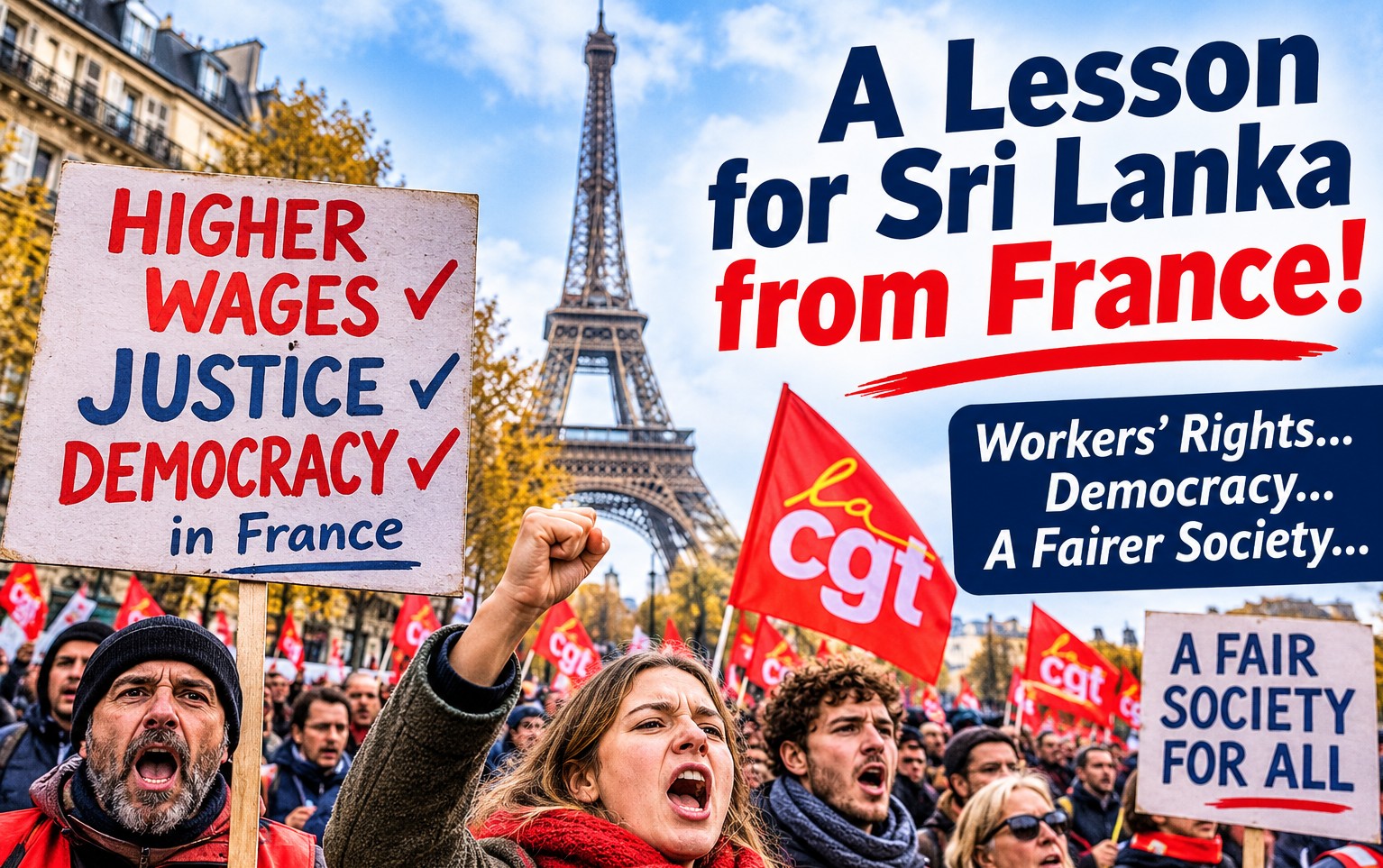
Democracy is not merely about voting once every five or six years to elect a government. It also fundamentally includes the right of citizens to continuously hold governments accountable and exert pressure on them over living standards, job security, wages and workers’ rights.
That is the democratic reality highlighted once again by the nationwide strike held in France today, Tuesday, 17 November 2026.
Public sector employees, teachers, railway workers, trade unions and students took part in today's industrial action, demanding higher public sector wages, the restoration of purchasing power lost due to inflation, and adequate funding for public services, among other issues.
What was the actual scale of today's strike?
According to figures released this evening by the French Ministry of the Interior, approximately 146,000 people took part in demonstrations across the country.
According to police estimates, 28,000 people participated in the main march in Paris, which proceeded from Place de la Nation to Place d'Italie. Paris police reported that the demonstration remained peaceful up to 5 p.m.
In Toulouse, nearly 10,000 people joined the march, representing approximately half the turnout recorded at the protest held on 5 November.
In Lille, students and workers also held discussions about the next steps in the strike movement. Some student groups expressed the view that the struggle should be expanded into a nationwide general strike.
An important point to consider is that although participation was lower than on 5 November, the underlying problems surrounding wages and the cost of living remain unresolved.
Which trade unions participated in the strike?
Almost all the major trade union organisations representing France's public sector employees supported today's strike.
Organisations including CGT, FO, CFDT, UNSA, FSU, Solidaires, CFE-CGC and FA-FP presented a common demand for higher public sector wages.
In particular, the CFDT, which had previously attempted to secure a solution through negotiations, joined today's strike after declaring that the government's proposals were insufficient.
This demonstrates that negotiating with the government and organising protests in defence of workers' rights are not mutually exclusive approaches.
How serious is the public sector wage problem?
One issue that received particular attention in the context of today's strike is the minimum wage adjustment scheduled to come into effect on 1 December.
The government has decided to increase the minimum wage by 1.6%.
However, this adjustment has further exposed the problem surrounding basic salaries in the public sector.
According to Sophie Binet, General Secretary of the French CGT trade union, following the minimum wage increase, the basic salaries of approximately 1.2 million public sector employees are expected to fall below the new minimum wage level. The union also states that the basic salaries of a further 600,000 employees will remain below the minimum wage.
The struggle to increase the Point d'indice
One of the principal mechanisms used to determine public sector salaries in France is the Point d'indice system.
Trade unions argue that a lasting solution to the wage problem cannot be achieved without increasing the value of this index.
Their main demands include:
An immediate increase in the basic salaries of public sector employees.
An increase in the value of the Point d'indice.
Linking the index to inflation.
Improving the incomes of employees at the lower end of the public sector pay scales.
Protecting the purchasing power of public sector workers.
Abolishing the one-day salary deduction (jour de carence), which affects workers' rights.
The fundamental question arising here is this: If a country's economic indicators are improving while the real incomes of public sector employees are declining, who is actually benefiting from that economic success?
Impact on railways, schools and public services
Today's strike also affected France's transport and education sectors.
Among railway workers, the CGT-Cheminots, SUD-Rail and CFDT-Cheminots trade unions had called for participation in the strike.
Some regional train services were cancelled, while replacement buses had to be introduced on certain routes. However, no significant disruption was reported across the national TGV high-speed rail network.
In the Île-de-France region, services were reduced on several railway lines. In particular, certain sections of RER D and the Transilien J and N lines were affected. Several metro and RER stations in central Paris were temporarily closed for security reasons.
The education sector was also affected. Student protests and blockades took place around schools and universities in several cities. In Toulouse, security forces intervened to remove blockades at nearly ten schools.
A new question emerges as strike participation declines
Another important aspect of today's strike is the decline in participation among public sector employees compared with 5 November.
According to preliminary figures released by the French Ministry for Public Service and Public Accounts, strike participation stood at:
2.59% in the state civil service.
3.93% in the hospital and healthcare public service.
1.96% in the territorial public service.
It was also reported that participation in the state civil service strike on 5 November had been close to 10%.
These figures clearly indicate that participation in today's industrial action was lower. However, this does not mean that the employees' wage problems have been resolved.
Negotiations between the government and trade unions
French Prime Minister Sébastien Lecornu met representatives of public sector trade unions on 13 November.
The meeting was significant because it brought together almost all the major public sector trade union representatives for a single round of discussions, something that had not happened for nearly twenty years. However, no agreement was reached following the meeting.
The Prime Minister proposed launching a month-long negotiation process covering five issues, including salary increases for lower-paid employees. The next meeting is scheduled for 11 December.
Nevertheless, there is still no agreement on the trade unions' principal demands: a general wage increase for all public sector employees and linking the Point d'indice to inflation.
Student rights and judicial intervention
Another significant development was reported during today's protests.
The French administrative court suspended a police decision restricting public gatherings and demonstrations around ten schools and five university locations in Paris. The decision had been challenged by the UNEF student organisation.
The court found that the reasons presented for imposing a five-day ban on gatherings in those areas had not been sufficiently substantiated. It also stated that the restriction represented a disproportionate interference with fundamental freedoms.
This is important because it demonstrates that while the need to maintain public safety during strikes must be recognised, the rights to assemble and protest must also be protected by law.
Why is the French strike relevant to Sri Lanka?
At this point, we must turn our attention to Sri Lanka's current political and economic situation.
The National People's Power (NPP) government came to power amid enormous public expectations. A corruption-free administration, an economy that provides relief to ordinary people, greater efficiency in the public service and social justice were among the key expectations.
However, the problems faced by ordinary people, including the rising cost of living, wage disputes and employment rights, do not automatically disappear when a new government assumes power.
The protests emerging among Sri Lankan public sector employees following the presentation of the 2027 Budget, together with the demands raised by their trade unions, must also be examined in this context.
The issue is not simply whether public sector employees are going on strike. The more important question is what economic and employment-related circumstances are driving them towards industrial action.
Where are the politicians who once stood in opposition?
When political parties are outside government, it is relatively easy to raise their voices in defence of people's rights. However, facing those same demands after assuming political power presents an entirely different challenge.
A political movement that once supported public sector struggles, participated in strikes and criticised the economic policies of previous governments must also have its own policies and actions scrutinised when it comes to power.
Therefore, several questions must be put to the National People's Power government:
What practical programme has been introduced to protect the real purchasing power of public sector employees' salaries?
Is there a plan to revise wages in line with the rising cost of living?
Is the government attempting to restrict workers' rights in the name of improving public sector efficiency?
Have the government's claims of economic stability been translated into tangible relief in people's everyday lives?
Does the government still recognise, in the same way as it did when in opposition, the right of trade unions to organise struggles and industrial action?
These are legitimate questions that citizens have every right to raise with any democratic government.
Is a strike an act against the country?
Strikes can undoubtedly cause inconvenience to the public. They can disrupt transport, healthcare, education and other essential services. Therefore, the rights of the public and the need to maintain essential services must also be taken into consideration during industrial action.
However, these concerns cannot be used as a justification for abolishing workers' right to present their demands.
Trade unions are not organisations that exist merely to endorse government policies. They are democratic institutions established to defend workers' rights and promote collective bargaining.
At the same time, the mere fact that a strike takes place does not mean that every demand is necessarily justified or that the government must automatically agree to all of them.
What is needed is a fair negotiation process, transparent and reliable data, and a mechanism for reaching solutions in which both sides accept their responsibilities.
The real lesson Sri Lanka should learn from France
The most important lesson Sri Lanka can draw from today's strike in France is that the relationship between a government and its people does not end with an election.
A government may have to manage an economic crisis. It may also have to consider International Monetary Fund conditions, revenue shortfalls, public debt and budgetary constraints.
Nevertheless, the living standards of ordinary people and the rights of workers must never be forgotten in the process.
The success of economic stabilisation should not be measured solely through budget surpluses, foreign reserves or economic growth percentages.
We must also examine how the consequences of those economic policies affect an ordinary family's dinner table, a child's education, a worker's salary and a pensioner's quality of life.
The people of France are taking to the streets today not merely to demand a change of government. They are demanding that their voices be heard when economic decisions affecting their lives are made.
The question that must be asked of the Sri Lankan government
When a political movement that once took to the streets alongside the people and fought for their rights is now in government, is it prepared to listen to those same people when they take to the streets to defend their rights?
That is the lesson France offers Sri Lanka.
Governments may change. Political slogans may change. But people's rights, human dignity and democratic freedoms must not change simply because political power has changed hands.
Jayalathge Sunil Gamini ✍️